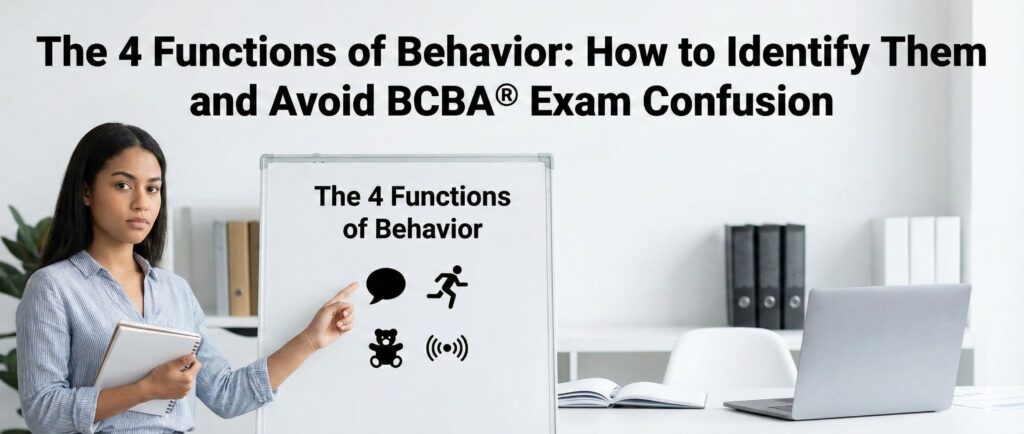
The Four Functions of Behavior ABA: How to Identify Them and Avoid BCBA® Exam Confusion
If you’re studying for the BCBA® exam, you’ve probably heard this sentence a hundred times: “Behavior is maintained by its function, not its form.” Understanding the four functions of behavior ABA is one of the fastest ways to read exam vignettes accurately and design effective interventions in real practice.
But on test day, function questions can still feel tricky:
-
The stem describes hitting, crying, running away… is this escape, attention, or automatic?
-
The client gets both a break and attention – which function do you pick?
-
The question mixes in motivating operations (MOs) and you’re not sure what they want.
In this article, we’ll break it down clearly:
-
The 4 functions of behavior in ABA
-
Everyday and clinical examples
-
How to read exam stems for actual function vs topography
-
Common BCBA® exam traps
-
A few practice questions with explanations
If you want to review other core concepts alongside the four functions of behavior ABA, you can also read our guides on differential reinforcement (https://bcbamockexam.com/differential-reinforcement-aba/), extinction in ABA (https://bcbamockexam.com/extinction-aba/), and motivating operations (https://bcbamockexam.com/motivating-operations-aba/).
1. The Four Functions of Behavior ABA: Quick Overview
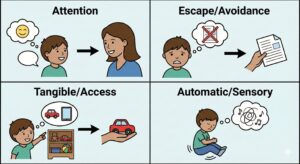
In applied behavior analysis, we typically group behavioral functions into four major categories:
-
Attention – to get social interaction (positive or negative)
-
Escape/Avoidance – to get away from or postpone something
-
Access to Tangibles/Activities – to get something concrete or a preferred event
-
Automatic/Sensory – to get internal sensory reinforcement (or relief) without social mediation
Key idea for the exam: Topography (what the behavior looks like) is less important than function (what consequence is maintaining it). The same behavior (e.g., screaming) can serve any of the four functions of behavior ABA depending on the contingency.
For a broader context on how consequences and reinforcement work, you can review our article on schedules of reinforcement in ABA (https://bcbamockexam.com/schedules-of-reinforcement-aba/) or extinction in ABA (https://bcbamockexam.com/extinction-aba/). For official task list wording, see the BACB website (https://www.bacb.com).
2. Four Functions of Behavior ABA: “Look at Me”
Definition
Behavior maintained by social attention from others (adults, peers, siblings), including positive or negative attention.
Attention can be:
-
Positive: praise, smiles, conversation, comfort
-
Negative: reprimands, scolding, arguing, “Stop doing that!”
If attention follows the behavior and the behavior increases or maintains, attention is probably functioning as a reinforcer.
Everyday Examples
-
A child makes silly noises during dinner. Parents repeatedly say “Stop that, it’s annoying” and look at the child. Noises keep happening → likely attention-maintained.
-
A teenager posts provocative content online. Each time, peers flood the comments. Posting increases → attention function.
Clinical/ABA Examples
-
During independent work, a student calls out “Teacher! Look!” multiple times. Each time, the teacher walks over and engages briefly. Calling out continues or increases → attention.
-
A child lightly hits their sibling; the sibling always yells back or chases them. Hitting persists → the sibling’s reaction is attention.

If you’re working on function-based interventions, attention-maintained behavior is often targeted with differential reinforcement (e.g., DRA/FCT). You can see examples in our differential reinforcement ABA guide (https://bcbamockexam.com/differential-reinforcement-aba/).
Exam Clues for Attention
In the stem, look for:
-
“Immediately after the behavior, the caregiver talks to or looks at the client.”
-
“Even negative responses (scolding, lecturing) follow the behavior and the behavior increases.”
-
“The behavior mostly occurs when the adult is busy with something else (phone, other student).”
If the main consistent consequence is social interaction, think attention.
3. Escape/Avoidance Function: “Get Me Out of This”
Definition
Behavior maintained by the removal, delay, or reduction of an aversive task, demand, or situation.
-
Escape = getting away from something already happening.
-
Avoidance = preventing something from happening in the first place.
Everyday Examples
-
When given chores, a teenager complains loudly until the parent says “Fine, I’ll do it myself.” Complaining increases → escape from chores.
-
At a loud party, someone leaves early and feels immediate relief; leaving early becomes more likely in future → escape from aversive noise.
Clinical/ABA Examples
-
When a math worksheet is presented, the client screams. The teacher removes the worksheet “to calm things down.” Screaming increases over days → escape-maintained.
-
A client runs away each time a non-preferred group activity starts. Staff chase them and activity is delayed. Elopement continues → escaping the activity.
Exam Clues for Escape/Avoidance
Look for:
-
Behavior occurs when demands are presented or difficult tasks start.
-
Behavior is followed by removal or delay of the demand.
-
Caregivers say things like, “He always does this when it’s time to…” (homework, chores, transitions).
When getting out of something consistently follows the behavior → think escape/avoidance.
4. Tangible Function: “I Want That”
Definition
Behavior maintained by access to specific items or activities, such as toys, food, electronics, or special events. The consequence is getting something the person wants.
Everyday Examples
-
A child cries at the store; each time, the parent eventually buys a candy bar. Crying at the store increases → tangible function.
-
A teenager repeatedly interrupts until the parent hands over the phone. Interrupting increases → access to phone.
Clinical/ABA Examples
-
A client screams when the tablet is removed. Staff return the tablet “to calm them” → screaming is reinforced by tangible access.
-
A learner hits when denied a specific toy. When hitting happens, adults hand over the toy to avoid escalation. Hitting persists → maintained by getting the toy.
Exam Clues for Tangible
Look for:
-
Behavior often occurs after denial of an item or when an item/activity is removed.
-
Behavior is consistently followed by access to the denied item/activity.
-
Parents say, “He always does this when I say ‘no’ to… (the iPad, candy, etc.).”
If the main consistent consequence is getting something concrete, think tangible.
5. Automatic/Sensory Function: “It Just Feels Good (or Less Bad)”
Definition
Behavior maintained by sensory consequences produced by the behavior itself, not dependent on social mediation. Also called automatic reinforcement (positive or negative).
-
Automatic positive reinforcement – behavior produces pleasant sensory input (e.g., hand-flapping, humming, rocking, stimming).
-
Automatic negative reinforcement – behavior reduces or removes internal discomfort (e.g., scratching an itch, pressing on your head during a headache, covering ears during loud sounds).
Everyday Examples
-
Biting nails because it “feels satisfying” and no one says anything. The behavior happens even alone → likely automatic.
-
Listening to music and tapping your fingers for the sensory rhythm, regardless of who’s around → automatic.
Clinical/ABA Examples
-
A client rocks back and forth or flaps hands whether alone or with others, across multiple settings, and no specific social consequence maintains it → automatically reinforced.
-
A child bangs their head even when alone in bed; staff find them with marks in the morning. No clear social consequence is present → likely automatic.
Exam Clues for Automatic
Look for:
-
Behavior occurs even when no one else is around.
-
Behavior persists across many situations with no clear social consequence pattern.
-
The stem notes that behavior seems to provide sensory stimulation or relief.
If the behavior is maintained without social mediation, think automatic.
For more on how automatic behavior may interact with extinction or sensory extinction, see our extinction ABA guide (https://bcbamockexam.com/extinction-aba/) and the BACB resources on treatment ethics (https://www.bacb.com/resources/).
6. How to Identify Function (in Real Life and on the Exam)
In practice, we use functional behavior assessment (FBA) or sometimes functional analysis (FA) to identify function:
-
Indirect methods: interviews, questionnaires, rating scales
-
Descriptive methods: ABC data (Antecedent–Behavior–Consequence)
-
Experimental FA: systematically manipulating conditions (attention, escape, alone, play, tangible)
For exam purposes, you often don’t need to label the exact method, but you do need to:
Pay attention to antecedents
-
What reliably happens right before the behavior?
-
Demand? Denial? Being alone? Ignored?
Pay attention to consequences
-
What consistently happens right after the behavior?
-
Attention? Break? Item delivered? No clear social change?
Look for patterns over multiple episodes
The exam likes to describe repeated scenarios that point to the same function.
One instance is not enough; they’ll usually give you a pattern.
And remember: Function is about what maintains the behavior over time, not what happens once. Linking the four functions of behavior ABA with your knowledge of motivating operations (https://bcbamockexam.com/motivating-operations-aba/) will also help you interpret why behavior happens “right now.”
7. Common BCBA® Exam Traps with the Four Functions of Behavior ABA
Trap 1 – Confusing Tangible vs Attention
Scenario: A child screams after being told they can’t have the iPad. The parent eventually gives the iPad and talks with the child. Which is it: attention or tangible?
On the exam:
-
Ask: What consequence is most consistently linked to the behavior in the stem?
-
If the stem emphasizes the item itself and the history of “giving the item to stop the behavior,” pick tangible.
-
If the focus is more on interaction and talking, with no access to specific items, pick attention.
Trap 2 – Assuming Escape Any Time Work Is Involved
Just because a task is present doesn’t automatically mean escape.
Example:
The client hums softly while working and keeps working. No break is given. Humming likely automatic, not escape.
Look for removal or delay of demands to label escape.
Trap 3 – Ignoring Automatic Function When No One Is Around
If the stem says:
-
“Behavior occurs in the bedroom alone at night”
-
“Behavior continues even when staff are not responding”
-
“The client engages in the behavior across many situations with no clear social consequence”
That strongly suggests automatic, even if elsewhere in the day the behavior also contacts some social consequences.
Trap 4 – Confusing MO with Function
-
MO (motivating operation) changes the value of a consequence.
-
Function is the type of consequence that actually maintains behavior.
Example:
Deprivation from attention is an MO that makes attention more valuable.
But the function of the behavior is still attention if attention follows the behavior and maintains it.
If you struggle with this distinction, review our motivating operations ABA article (https://bcbamockexam.com/motivating-operations-aba/) alongside this four functions of behavior ABA guide.
Trap 5 – Multiple Functions
In real life, behaviors often have multiple functions (e.g., escape + attention).
On the exam:
-
Sometimes you’ll be asked to choose the most likely primary function based on the info given.
-
If more than one consequence occurs, look at what is emphasized or repeated in the stem.
8. Mini BCBA® Exam–Style Questions (With Explanations)
Four Functions of Behavior ABA
Question 1 – Attention or Tangible?
At a store, a child starts screaming when the parent walks past the toy aisle without stopping. The parent initially ignores the screaming, but after a few minutes of continuous crying, they hand the child a small toy “just this once” so they can finish shopping. On future trips, the child screams as soon as they pass the toy aisle, and the parent again buys a toy to stop the screaming. What is the MOST likely primary function of the screaming?
A. Attention
B. Escape
C. Tangible
D. Automatic
Correct Answer: C – Tangible
Why?
-
The consistent consequence is access to toys.
-
While the parent may also talk to the child, the key maintaining variable is getting the toy.
-
No demands are being removed (so not escape), and the scenario is clearly socially mediated (so not automatic).
Question 2 – Escape
A student engages in loud vocal protests whenever the teacher presents a long writing assignment. The teacher often responds by saying, “Okay, let’s just do the first two lines today and finish the rest tomorrow,” which ends the protest for that day. Over time, protests become more frequent whenever long assignments are given. What is the MOST likely function of the protests?
A. Escape
B. Attention
C. Tangible
D. Automatic
Correct Answer: A – Escape
Why?
-
Behavior occurs specifically in response to long writing assignments (demands).
-
The consequence is the reduction/postponement of the assignment.
-
That’s classic escape-maintained behavior.
Question 3 – Automatic
A client frequently flaps their hands while sitting alone in the waiting room, in the classroom when the teacher is busy, and at home in their bedroom. Staff and caregivers have tried ignoring the behavior and not providing attention or items following hand-flapping. The behavior continues at similar levels across settings. What is the MOST likely function of the hand-flapping?
A. Attention
B. Automatic
C. Tangible
D. Escape
Correct Answer: B – Automatic
Why?
-
Behavior occurs even when alone and across many situations.
-
No consistent social consequence is described; ignoring has not reduced the behavior.
-
This pattern strongly suggests automatic reinforcement.
If you want to see how function-based treatments might incorporate extinction or differential reinforcement for each function, you can explore our other BCBA exam prep articles at https://bcbamockexam.com or try a free full-length BCBA® mock exam (https://bcbamockexam.com/free-bcba-mock-exam/).
9. Key Takeaways
The four functions of behavior ABA are:
-
Attention
-
Escape/Avoidance
-
Tangible/Access
-
Automatic/Sensory
For the BCBA® exam, always ask:
-
What reliably happens before the behavior (antecedent)?
-
What reliably happens after the behavior (consequence)?
-
Over time, what seems to maintain or increase the behavior?
Avoid focusing only on what the behavior looks like; focus on what it achieves for the individual.
Be careful about exam traps:
-
Tangible vs attention
-
Escape vs automatic
-
Function vs MO
-
Assuming a function from a single event rather than a pattern
To continue building your conceptual fluency, pair this article with our guides on motivating operations in ABA (https://bcbamockexam.com/motivating-operations-aba/), discriminative stimuli (https://bcbamockexam.com/discriminative-stimulus-aba/), and extinction in ABA (https://bcbamockexam.com/extinction-aba/).