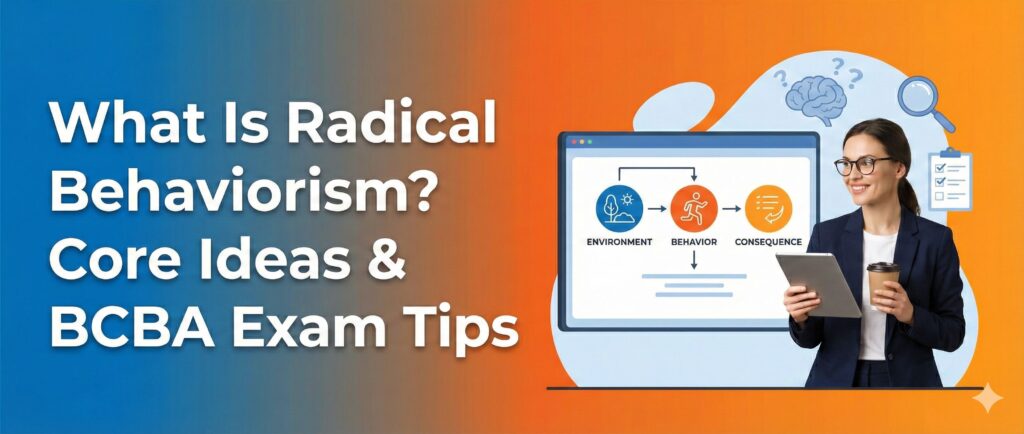
What Is Radical Behaviorism? Core Ideas, Misconceptions, and BCBA® Exam Style Questions
By BCBA Mock Exam
Radical behaviorism is the philosophical foundation of ABA and appears throughout the BCBA® exam in textbooks, Task List explanations, and practice questions.
But the exam isn’t just asking: “Who started radical behaviorism?”
It’s really asking:
-
What is radical behaviorism as a philosophical position?
-
How is it different from methodological behaviorism and mentalism?
-
How does it treat private events (thoughts, feelings, sensations)?
In this article, we’ll cover:
-
A clear definition of radical behaviorism
-
How it compares to methodological behaviorism and mentalism
-
The role of private events
-
Key ideas like selection by consequences
-
Common misconceptions
-
A few BCBA® exam–style questions with explanations
1. Behaviorism: The Big Picture
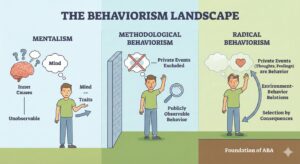
Before we zoom in, it helps to see where this philosophy fits in the landscape.
Very broadly:
-
Mentalism
-
Explains behavior by appealing to unobservable inner causes (e.g., “he hit because he was angry,” “she didn’t study because she lacks motivation”).
-
Mental events are treated as causal agents that are often not directly measurable.
-
-
Methodological behaviorism
-
Focuses only on observable behavior and publicly measurable events.
-
Typically ignores private events (thoughts, feelings) or treats them as outside the scope of a science of behavior.
-
-
Radical behaviorism
-
The philosophical foundation of modern ABA, originating with B. F. Skinner.
-
Includes all behavior, public and private, within the scope of analysis.
-
Explains behavior mainly in terms of environment–behavior relations and selection by consequences, not inner mental entities.
-
On the BCBA® exam, you need to know how this philosophy is unique.
2. What Is Radical Behaviorism?
Short definition Radical behaviorism is the philosophy of behavior analysis that views all behavior—including thoughts, feelings, and sensations—as subject to the same basic behavioral principles and explains behavior in terms of environmental histories and consequences rather than inner mental causes.
Key pieces:
-
“Radical” here means “to the root”, not “extreme” or “harsh.”
-
It does not deny that thoughts and feelings exist.
-
It argues that private events are behaviors too, and should be explained with the same principles we use for overt actions.
Radical behaviorism is the philosophical base for:
-
Applied Behavior Analysis (ABA)
-
Experimental analysis of behavior
-
Concepts like reinforcement, punishment, stimulus control, motivating operations, verbal behavior, selectionism
3. Private Events in Radical Behaviorism
One of the biggest differences between radical and methodological behaviorism is how they treat private events.
Private events = events that are only accessible to the individual experiencing them, such as:
-
Thoughts
-
Feelings
-
Pain sensations
-
Images in one’s mind
What radical behaviorism says
-
Private events are real.
-
They are behavior (or other internal events of the body) occurring within the skin.
-
They are influenced by the same variables that affect public behavior: reinforcement, punishment, stimulus control, MOs, history, etc.
-
They do not get special “mental” status as ultimate causes.
For example:
-
Saying “I’m afraid” is public verbal behavior.
-
The feeling of fear (elevated heart rate, tension, sensations) is a private event.
-
This philosophy treats both as events that can be explained by past learning and current environmental conditions.
Crucial exam point this behavioral approach includes private events in the analysis, but does not use them as final causal explanations:
-
“He hit his peer because he was angry” is not considered a complete behavioral explanation.
-
A radical behaviorist would ask:
-
What environmental events evoked the “anger” behavior?
-
What consequences historically reinforced aggression in similar situations?
-
4. Radical Behaviorism vs Methodological Behaviorism
The BCBA® exam often contrasts these two.
Methodological behaviorism
-
Focuses only on directly observable behavior.
-
Tends to exclude private events from scientific study.
-
Might say: “We can’t study thoughts and feelings because they’re not observable.”
Radical behaviorism
-
Recognizes private events as legitimate subject matter.
-
Still requires publicly observable data for scientific analysis (we can’t “see” thoughts, but we can see their effects and report about them).
-
Treats private events as:
-
Behavior
-
Products of environmental history
-
Influenced by the same principles as overt behavior
-
Exam-friendly summary
-
Both methodological and this behavioral approach reject mentalistic explanations as final causes.
-
This behavioral approach goes further by including private events within the scope of a science of behavior.
5. Radical Behaviorism vs Mentalism
Mentalism says:
-
Behavior is explained by inner, unobservable entities (e.g., traits, drives, “mind,” “ego”).
-
These inner entities are often treated as causes that do not themselves need behavioral explanation.
This behavioral approach says:
-
Inner events (thoughts, feelings) occur and can influence behavior, but they are not independent, uncaused agents.
-
They themselves need explanation in terms of:
-
Learning history
-
Environment
-
Biology and context
-
Example:
-
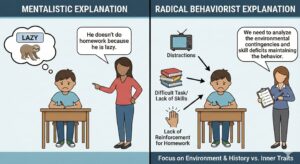
Mentalistic: “He failed the exam because he has low self-esteem.”
-
Radical behaviorist:
-
Questions what behaviors and environmental histories are being summarized by “low self-esteem”
-
Looks at study habits, reinforcement history, feedback from teachers, skill level, etc.
-
Avoids treating “self-esteem” as a mysterious inner cause.
-
On the exam, the best answer often:
-
Replaces mentalistic “traits” with observable behavior + environmental variables.
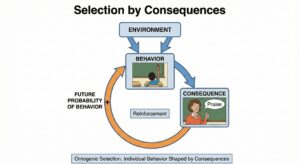
6. Selection by Consequences: A Core Idea in Radical Behaviorism
This behavioral approach uses a selectionist model of behavior: Behavior is shaped and maintained by its consequences over time.
Skinner talked about three levels of selection:
-
Phylogenic – selection of species characteristics through natural selection (e.g., reflexes, basic capacities).
-
Ontogenic – selection of individual behavior through reinforcement and punishment across the life of the organism.
-
Cultural – selection of patterns of behavior in groups through social and cultural consequences.
For the BCBA® exam:
-
You don’t need to write an essay on evolution.
-
You do need to recognize that this behavioral approach sees behavior as the product of selection by consequences, not inner traits or hypothetical mental entities.
7. Radical Behaviorism and Verbal Behavior
This behavioral approach is also the foundation for Skinner’s analysis of verbal behavior.
Key idea:
-
Language is treated as behavior that is:
-
Learned through reinforcement and environmental contingencies
-
Controlled by antecedents and consequences (e.g., MOs, discriminative stimuli, listener behavior)
-
-
You don’t need to invoke “language modules” or “innate grammar rules” to explain basic functional aspects of language.
On the exam, when you see questions about:
-
Verbal operants (mands, tacts, intraverbals, etc.)
-
How language is shaped by reinforcement histories …you’re looking at an application of radical behaviorism to language.
8. Common Misconceptions About Radical Behaviorism
Misconception 1 – “Radical behaviorism ignores feelings and thoughts.” False. This behavioral approachincludes feelings and thoughts as behavior, but:
-
Treats them as things to be explained, not as explanations in themselves.
-
Recognizes they are often private and difficult to measure directly.
Misconception 2 – “Radical behaviorism says people are robots controlled only by the environment.” This behavioral approach emphasizes environment–behavior–consequence relations, but it also acknowledges:
-
The role of biological variables
-
The complexity of learning history
-
The fact that the individual is part of the environment for others (and for themselves through self-management). It does not claim that humans are mechanical robots; it simply insists on naturalistic, observable, and testable explanations.
Misconception 3 – “Radical behaviorism is just about punishment and control.” In practice, ABA and this behavioral approach emphasize:
-
Positive reinforcement
-
Skill building
-
Ethical, socially significant changes On the BCBA® exam, punishment-heavy, control-focused, or coercive options are rarely the best choice — especially when reinforcement-based alternatives are available.
9. How Radical Behaviorism Shows Up on the BCBA® Exam
You will typically see this behavioral approachin questions that:
-
Ask you to identify the philosophical position underlying ABA
-
Contrast radical vs methodological behaviorism
-
Contrast radical behaviorism vs mentalism
-
Ask how to respond to mentalistic explanations (e.g., “lazy,” “unmotivated,” “stubborn”)
-
Ask what this behavioral approach says about private events
Common stems:
-
“Which of the following statements best reflects radical behaviorism?”
-
“Which position views private events as behavior subject to the same principles as overt behavior?”
-
“Which perspective is most consistent with the foundation of applied behavior analysis?”
In these cases, look for answers that:
-
Include private events as behavior
-
Emphasize environmental variables and consequences
-
Avoid treating inner mental states as independent causal agents
10. Mini BCBA® Exam–Style Questions (With Explanations)
Question 1 – Private Events
A supervisor explains to a trainee that thoughts and feelings are real events but should be understood in terms of the same behavioral principles that govern observable behavior. The supervisor adds that these private events are not used as final causes of behavior, but as part of what needs to be explained.
This explanation is most consistent with: A. Methodological behaviorism B. Mentalism C. Radical behaviorism D. Structuralism
Correct Answer: C – Radical behaviorism Why?
-
Radical behaviorism includes private events as behavior and explains them with the same principles as overt behavior.
-
Methodological behaviorism typically ignores private events.
-
Mentalism treats inner events as causal entities.
-
Structuralism isn’t the core position underlying ABA.
Question 2 – Mentalistic Explanation
A teacher says, “He doesn’t complete his work because he’s lazy.” The BCBA wants to respond in a way that aligns with this behavioral approach.
Which is the BEST response? A. Agree and document “laziness” as the main function of the behavior B. Explain that “lazy” is a label and focus instead on the observable behaviors and environmental contingencies maintaining work refusal C. Ask the student whether he feels lazy and base the plan entirely on his self-report D. Provide a punishment procedure to reduce laziness
Correct Answer: B Why?
-
Radical behaviorism replaces vague trait labels with observable behavior and environmental explanations.
-
A acknowledges the mentalistic label as a cause, which is not behavior-analytic.
-
C over-relies on private events as explanatory.
-
D still treats “laziness” as a cause rather than focusing on behavior and contingencies.
Question 3 – Radical vs Methodological Behaviorism
Which statement BEST differentiates this behavioral approach from methodological behaviorism? A. Radical behaviorism rejects private events, while methodological behaviorism accepts them B. Radical behaviorism includes private events as behavior, while methodological behaviorism largely excludes them from analysis C. Radical behaviorism relies on mentalistic constructs, while methodological behaviorism avoids them D. There is no meaningful difference between radical and methodological behaviorism
Correct Answer: B Why?
-
Radical behaviorism includes private events within its scope; methodological behaviorism tends to exclude or ignore them.
-
A reverses the roles.
-
C is incorrect; this behavioral approach does not rely on mentalistic constructs.
-
D is factually wrong in the context of the exam and literature.
11. Key Takeaways
-
Radical behaviorism is the philosophical foundation of ABA.
-
It views all behavior—including private events like thoughts and feelings—as subject to the same behavioral principles.
-
It rejects mentalism as a final explanation and focuses on environmental variables and selection by consequences.
-
It differs from methodological behaviorism by including private events in the scope of analysis, instead of ignoring them.
-
On the BCBA® exam, the “radical behaviorism” answer is usually the one that:
-
Treats private events as behavior,
-
Explains behavior using observable contingencies,
-
Avoids mentalistic “traits” as causes.
-