
What Is Generalization in ABA?
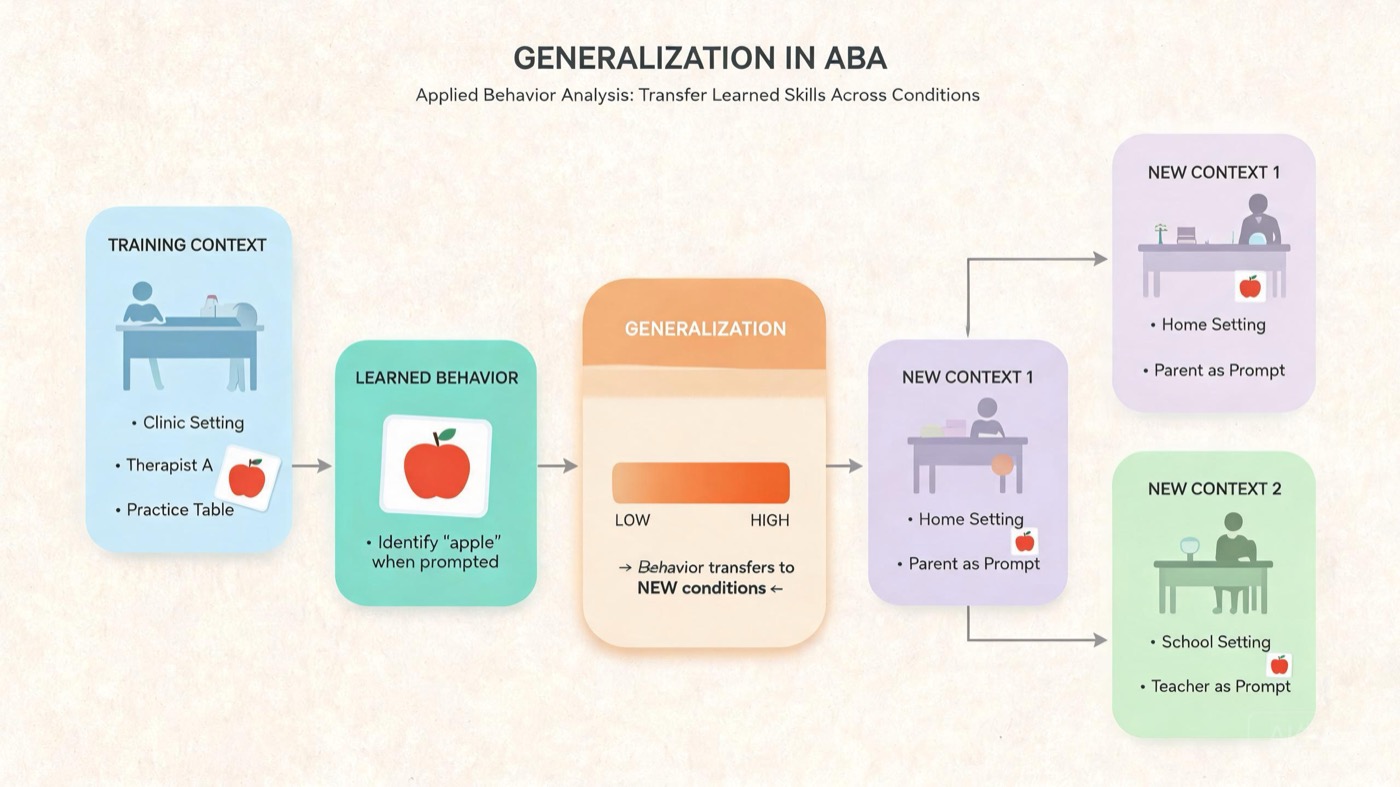
In applied behavior analysis (ABA), generalization aba refers to the occurrence of a learned behavior under different, non-training conditions. It is a critical outcome because without it, skills remain isolated and useless in real-world settings. The BCBA exam heavily tests this concept, so understanding its dimensions is essential.
Table of Contents
- What Is Generalization in ABA?
- ABA Examples of Generalization with ABC Analysis
- Why Generalization Matters for the BCBA Exam
- Quick Checklist for Generalization in ABA
- Strategies to Promote Generalization
- Summary: Generalization in ABA for the BCBA Exam
- References
Stimulus Generalization vs. Response Generalization
Stimulus generalization occurs when a behavior is emitted in the presence of stimuli similar to the original discriminative stimulus (SD). For example, a child who learns to say ‘hello’ when a specific peer greets them may also say ‘hello’ when a different peer greets them. In contrast, response generalization involves performing different behaviors that achieve the same outcome. For instance, a child who learns to ask for a break by saying ‘break’ might also use a sign or picture card to request a break.
Maintenance of Behavior Change
Maintenance is another form of generalization over time. A behavior is maintained when it continues to occur after the intervention has been withdrawn or reduced. On the BCBA exam, you may see scenarios where a learner performs a skill weeks or months after training, and you must identify this as maintenance.
ABA Examples of Generalization with ABC Analysis
Applying an ABC (Antecedent-Behavior-Consequence) analysis helps clarify how generalization occurs in practice. Below are two examples relevant to the BCBA exam.
Example 1: Generalizing Requesting Skills
Antecedent: A child wants juice at home (presence of parent and juice). Behavior: The child says ‘juice’. Consequence: The parent gives juice. Generalization is demonstrated when the child says ‘juice’ to a teacher at school when thirsty. The hypothesized function is access to tangibles. This shows stimulus generalization across settings and people.
Example 2: Generalizing Turn-Taking
Antecedent: A peer offers a toy during play. Behavior: The child takes a turn. Consequence: The peer continues playing. Generalization occurs when the child takes turns with different peers and with different toys. The function is social positive reinforcement. This example illustrates both stimulus generalization (different peers) and response generalization (taking turns in varied ways).
Example 3: Generalizing Safety Skills
Antecedent: A fire alarm sounds at school. Behavior: The student exits the building. Consequence: Teacher praise and safety. Generalization is shown when the student exits calmly at home during a drill. This requires stimulus generalization across environments and maintenance over time.
Why Generalization Matters for the BCBA Exam
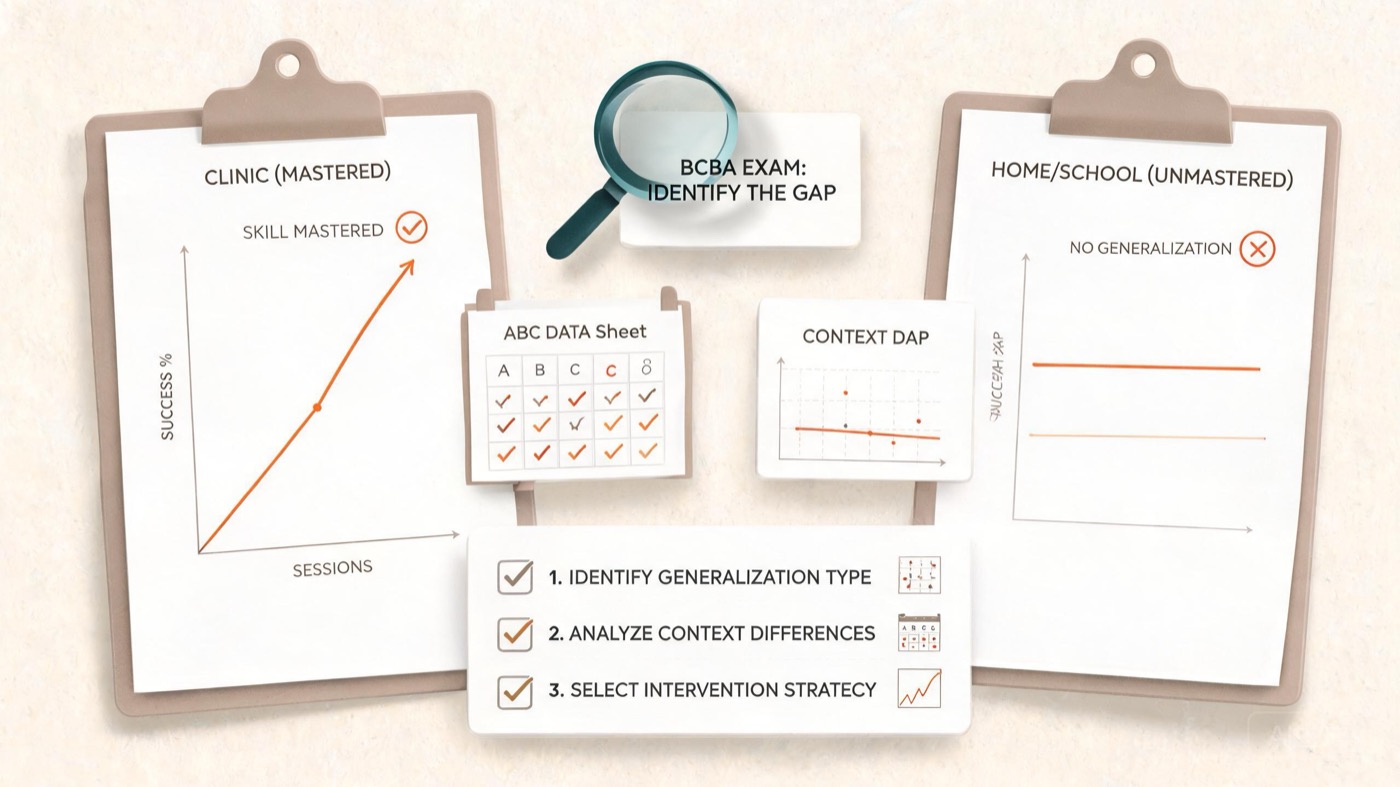
The BCBA exam expects you to identify generalization failures and select strategies to promote it. Many questions present a scenario where a skill is mastered in one context but not others. Recognizing the type of generalization missing is key.
Common Exam Traps to Avoid
Watch out for these traps that frequently appear on the exam:
- Trap 1: Confusing generalization with discrimination. Discrimination is responding differently to different stimuli; generalization is responding similarly. A question may describe a child who only says ‘hello’ to one person – that’s a discrimination, not generalization.
- Trap 2: Assuming generalization happens automatically. Generalization must be explicitly programmed. Do not assume that because a behavior is mastered in training, it will occur in other settings without planning.
- Trap 3: Overlooking maintenance as a dimension. Maintenance is often tested alongside generalization. If the question describes behavior weeks later, it is testing maintenance.
- Trap 4: Focusing only on stimulus generalization. Response generalization and maintenance are equally important. Read the scenario carefully to identify which type is being assessed.
Practice Prompts for Self-Testing
Test your understanding with these scenarios:
- Prompt 1: A child learns to say ‘please’ at home but does not say it at school. What type of generalization is lacking? Answer: Stimulus generalization (across settings).
- Prompt 2: A student learns to raise a hand to ask a question in math class. Later, the student raises a hand to ask for help in reading class. This demonstrates? Answer: Stimulus generalization (across subjects).
- Prompt 3: After a token economy ends, a child continues to complete chores. This is an example of? Answer: Maintenance.
Quick Checklist for Generalization in ABA
Before your exam, review this checklist to reinforce key points:
- Define stimulus generalization and response generalization with examples.
- Understand maintenance as generalization over time.
- Identify which type of generalization is missing in a scenario.
- Recall strategies: teach multiple exemplars, program common stimuli, use natural contingencies.
- Differentiate generalization from discrimination and prompt dependency.
- Remember that generalization must be planned, not assumed.
Strategies to Promote Generalization
Effective behavior analysts actively program for generalization. Key strategies include:
- Teaching multiple exemplars: Present varied examples during instruction to increase the likelihood of generalization.
- Using natural stimuli and consequences: Train in natural environments to reduce the need for transfer.
- Incorporating common stimuli: Include stimuli from the generalization setting in training sessions.
- Reinforcing unprompted generalization: Provide praise when a learner generalizes without direct teaching.
Summary: Generalization in ABA for the BCBA Exam
Generalization aba is a cornerstone of effective ABA intervention. The BCBA exam will test your ability to recognize stimulus generalization, response generalization, and maintenance. Avoid common traps by carefully reading scenarios and identifying the type of generalization at play. For more exam-focused resources, explore our BCBA exam prep guide and review the official BACB task list for additional study. With planned programming and thorough understanding, you can help learners achieve meaningful, durable behavior change.



