
What Is Behavior Skills Training (BST)?
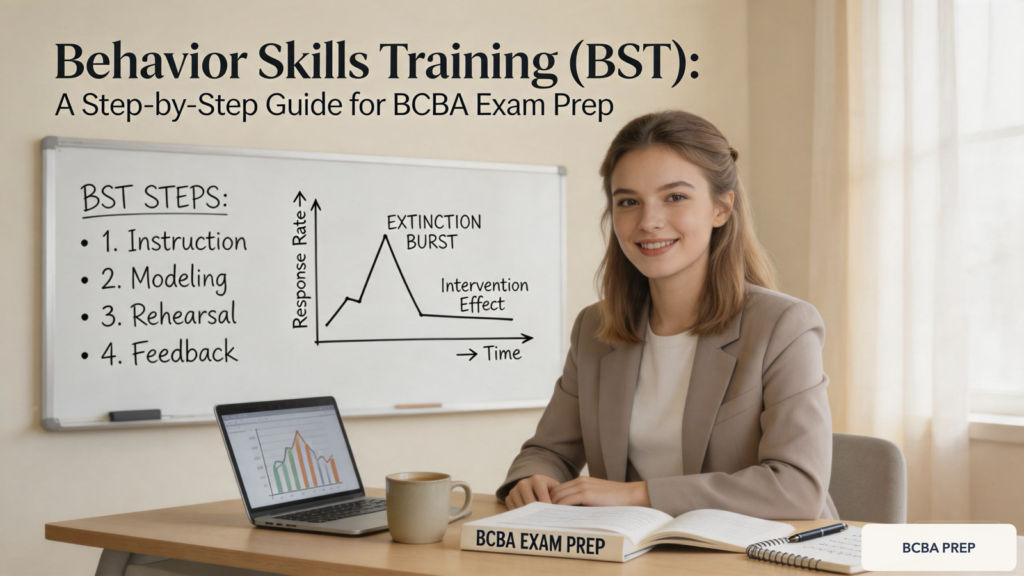
Behavior skills training (BST) is an evidence-based teaching method used in applied behavior analysis to develop new skills through a structured process. It combines instruction, modeling, rehearsal, and feedback to ensure the learner can perform the skill accurately and independently. On the BCBA exam, BST is a core procedure listed under the Task List, often tested in scenario-based questions.
Table of Contents
- What Is Behavior Skills Training (BST)?
- BST in Practice: Two Real-World ABA Examples
- BST Exam Relevance and Common Traps
- Quick Checklist for Behavior Skills Training
- Summary: Why BST Matters for Your BCBA Exam
The Four Core Steps of BST
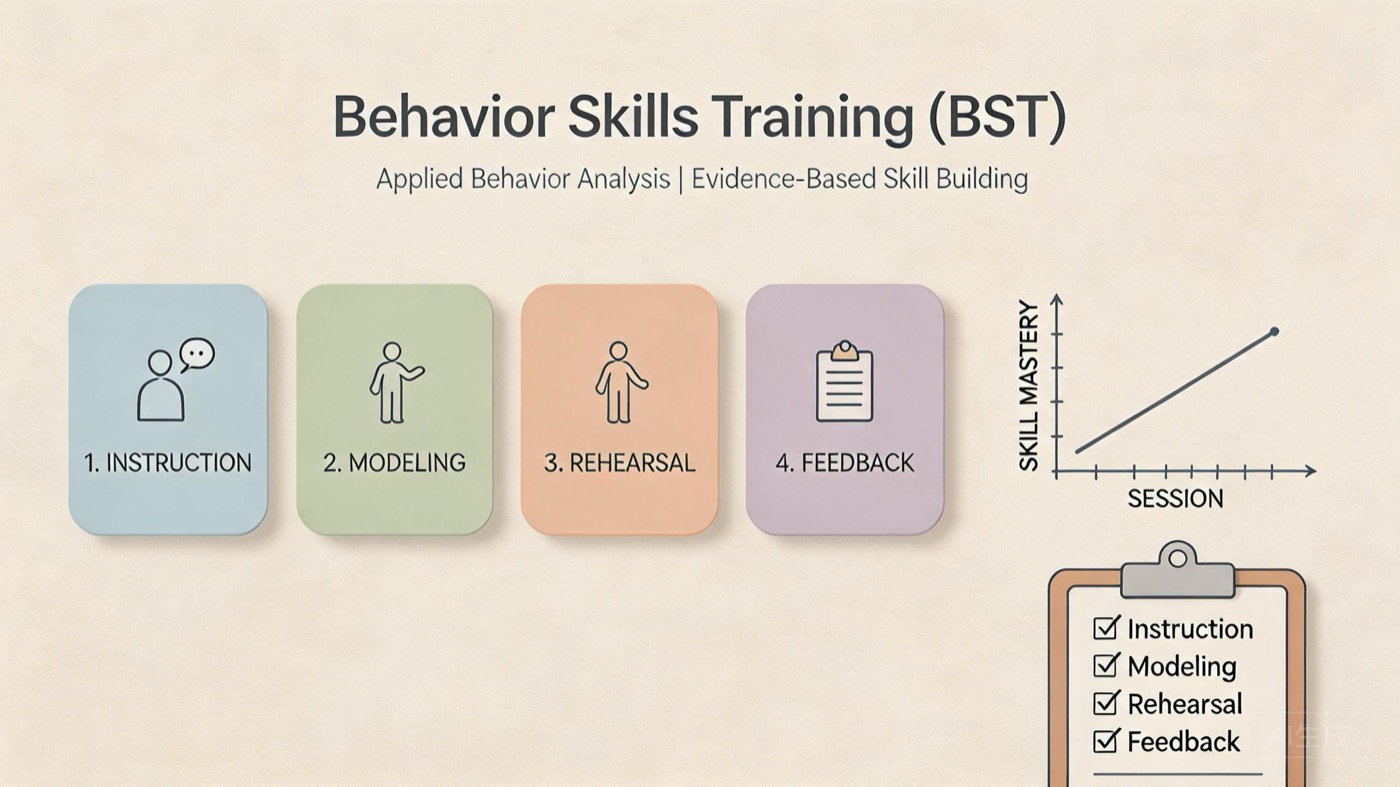
BST consists of four required components. Each step builds on the previous one, and omitting any step can reduce effectiveness.
- Instruction: Provide clear, concise descriptions of the target skill and when to use it. For example, tell a parent, ‘Give a token immediately after your child complies with a request.’
- Modeling: Demonstrate the skill correctly while the learner observes. Model both the behavior and the context.
- Rehearsal: The learner practices the skill in a role-play or real setting. This allows the trainer to assess accuracy.
- Feedback: Deliver immediate, specific feedback that includes praise for correct performance and corrective guidance for errors. Feedback should be both positive and constructive.
BST in Practice: Two Real-World ABA Examples
To understand how BST works in context, examine these examples with an ABC analysis and hypothesized function.
Example 1: Teaching a Parent to Implement a Token Economy
A BCBA wants to train a parent to use a token economy to reduce a child’s screaming for access to preferred items. The parent’s target behavior is delivering a token within 3 seconds of compliance.
- Instruction: The BCBA explains, ‘When your child asks politely, immediately give a token and say, Great job asking nicely!’
- Modeling: The BCBA role-plays the scenario, demonstrating the correct delivery of token and praise.
- Rehearsal: The parent practices while the BCBA observes, using a pre-arranged script.
- Feedback: ‘You delivered the token quickly, but remember to also provide specific praise. Try again with a descriptive praise statement.’
The hypothesized function of the child’s screaming is access to tangibles; the token economy teaches an appropriate alternative. The parent’s accurate implementation is reinforced by the BCBA’s positive feedback.
Example 2: Training a Staff Member to Conduct Discrete Trial Training (DTT)
A new staff member needs to run a DTT session for a learner with autism. The target behavior is presenting a discriminative stimulus, waiting 3 seconds, and delivering a prompt if needed.
- Instruction: The BCBA describes each step with a written script: ‘Say Point to car, wait 3 seconds, then point to the car if no response.’
- Modeling: The BCBA runs 3 trials while the staff member watches and takes notes.
- Rehearsal: The staff member conducts 5 trials with the BCBA acting as the learner.
- Feedback: ‘Great timing on the prompt delay. On trial 3, you accidentally delivered the prompt too early. Next time, count to three before prompting.’
If the staff member previously avoided DTT due to anxiety (function: escape), BST increases confidence through repeated practice and supportive feedback.
BST Exam Relevance and Common Traps
The BCBA exam frequently tests BST through scenario questions. Knowing the sequence and common errors is critical.
Key Terms You Must Know
- Behavioral skills training (BST): A package of instruction, modeling, rehearsal, and feedback.
- In situ training: Training conducted in the natural environment where the skill will be used, often after initial BST. This is different from role-play.
- Task List areas: BST aligns with Behavior-Change Procedures and Personnel Supervision (e.g., G-01, G-02 for the 6th edition).
How BST Is Tested
Common question formats include:
- Identify which BST step is missing from a description.
- Order the steps correctly.
- Choose when to use BST versus other procedures like behavioral chaining or shaping.
- Select the most effective feedback statement after a rehearsal.
Example stem: ‘A supervisor provides a written description and then asks the staff to practice. What is missing?’ Answer: Modeling.
Three Traps to Avoid on Exam Day
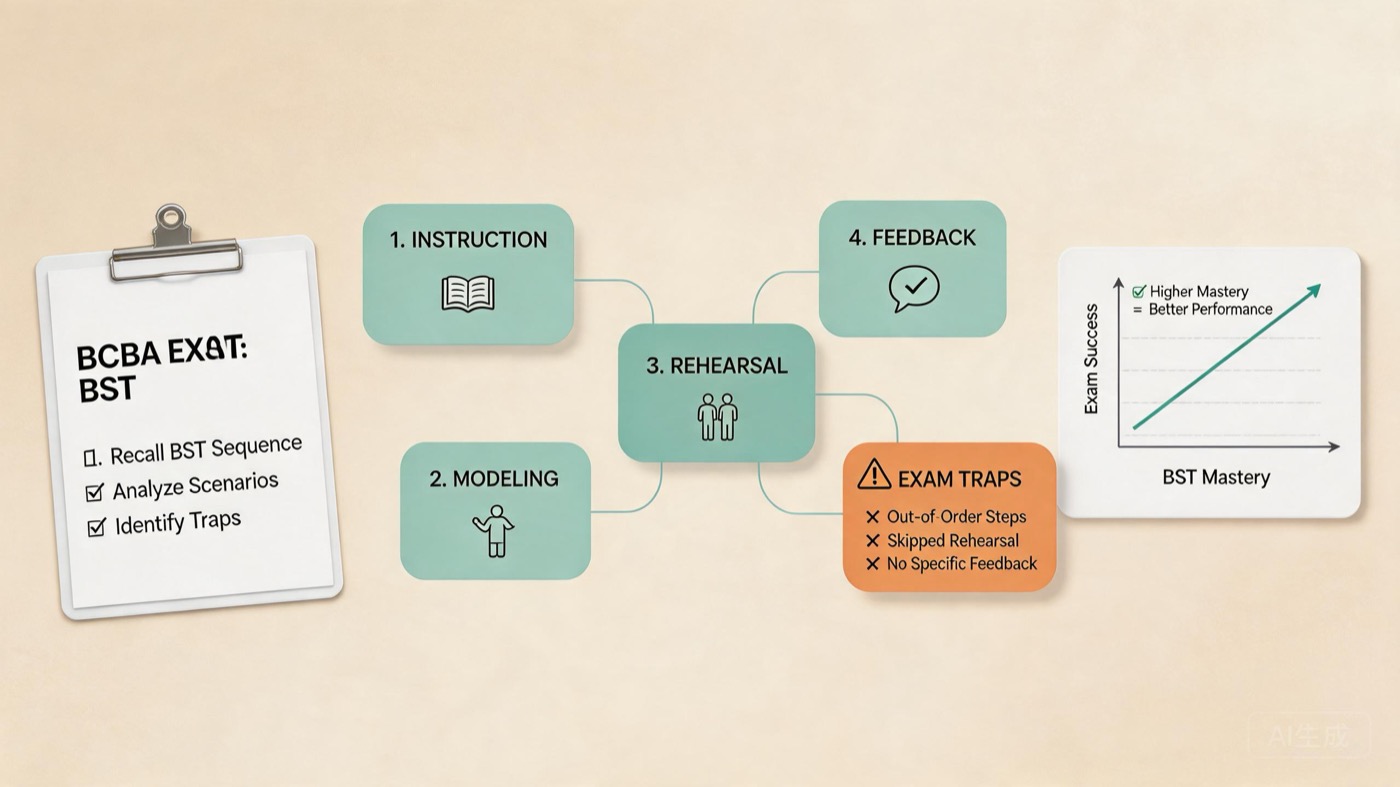
- Confusing BST with modeling alone: Remember, BST requires all four steps. Modeling is just one component.
- Forgetting feedback must be specific and positive: General praise like ‘Good job’ is not sufficient. Feedback should pinpoint the exact behavior and include reinforcement.
- Overlooking the rehearsal component: Rehearsal is essential for skill acquisition; passive observation alone does not count as BST.
Quick Checklist for Behavior Skills Training
Use this checklist when reviewing BST for the exam or preparing for supervision.
BST Implementation Checklist
- ☐ Provide clear instructions: define the skill, context, and criteria.
- ☐ Demonstrate the skill: model the behavior exactly as expected.
- ☐ Allow practice: the learner rehearses in a safe environment.
- ☐ Give immediate feedback: include both praise and error correction.
- ☐ Repeat until mastery: continue cycles until the learner meets a pre-set mastery criterion.
Tip: Ensure feedback is both corrective and reinforcing. For example, ‘I liked how you waited for the pause. Next time, try to deliver the prompt a little softer.’
Summary: Why BST Matters for Your BCBA Exam
Behavior skills training is a foundational procedure in ABA that ensures effective skill transfer from trainer to learner. On the BCBA exam, you must be able to identify, sequence, and apply each step. Mastering BST not only helps you pass the exam but also prepares you for ethical supervision and staff training in clinical practice. For more practice, check out our BCBA mock exams to test your knowledge of BST and other behavior-change procedures. Additionally, review the BACB Task List for the official standards.


