
What Is the BACB 6th Edition Task List?
The BACB 6th Edition Task List is the official blueprint for the BCBA exam, detailing the knowledge and skills every behavior analyst must master. It defines the domains and tasks tested, ensuring your study aligns with current professional standards. For candidates, this document is your primary study roadmap.
Table of Contents
- What Is the BACB 6th Edition Task List?
- How the 6th Edition Changes Exam Preparation
- Breaking Down the Task List: Key Domains Explained
- Applying the Task List: Real Exam-Style Examples
- Quick Checklist for BACB 6th Edition Task List Mastery
- Common Exam Traps and How to Avoid Them
- References
Think of the task list as the exam’s table of contents: every question on your test targets one of its items. The 6th edition, effective in 2025, introduces updates that reflect evolving best practices in applied behavior analysis. Reviewing it early helps you identify high-yield areas and manage your preparation efficiently.
How the 6th Edition Changes Exam Preparation
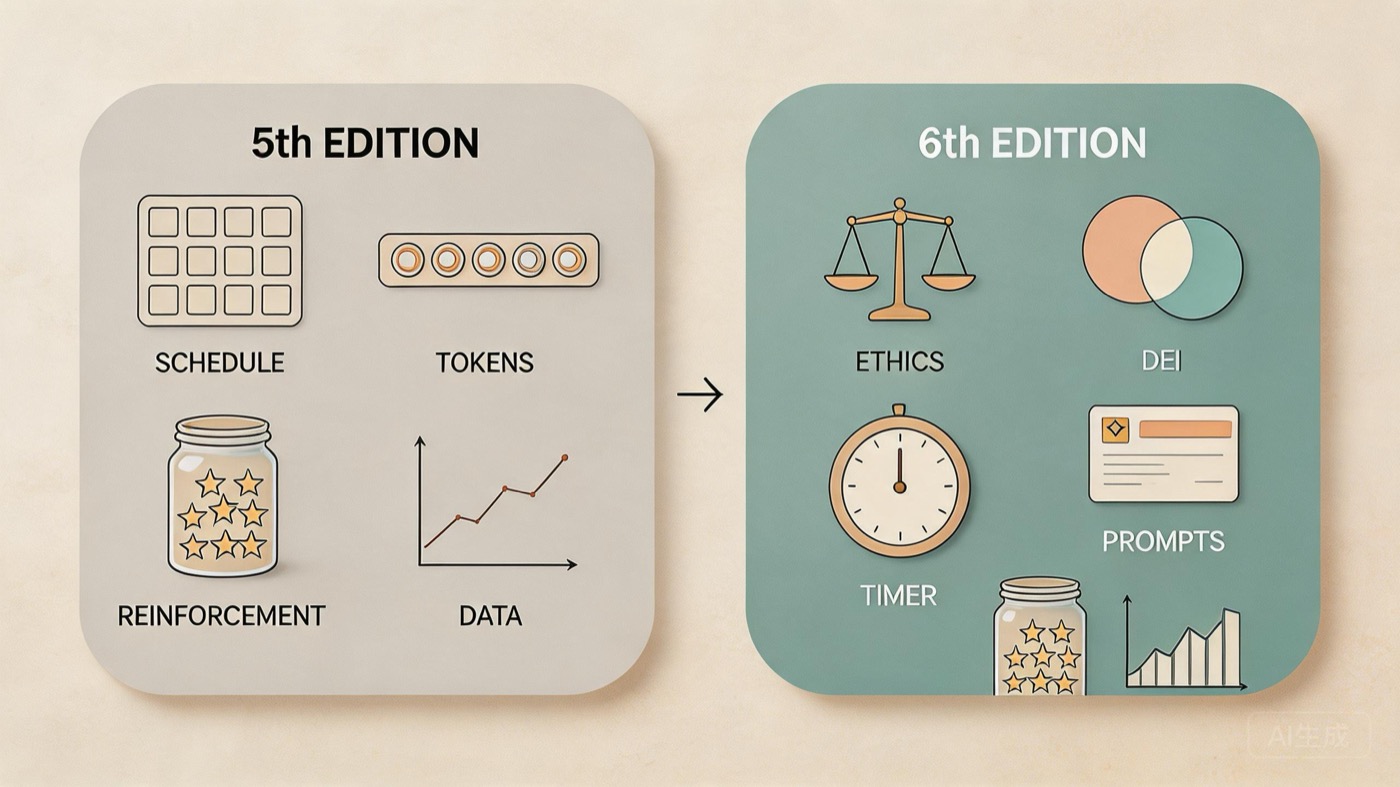
Compared to the 5th edition, the 6th edition task list shifts emphasis in several key areas. Understanding these changes ensures you don’t waste time on outdated content.
Updated Content Areas and Priorities
Major updates include a stronger focus on ethical decision-making, diversity, equity, and inclusion (DEI), and systems-level consultation. The domain weighting has also changed: Ethics now accounts for a larger percentage, while some traditional skill-acquisition items have been consolidated. Expect more questions on cultural responsiveness and compassionate care.
Practical tip: Allocate extra study time to the Ethics and Professionalism domain, as it is now the most heavily weighted. Use the ethics in ABA practice guide to strengthen this area.
What Stays the Same?
Core ABA principles remain unchanged. Foundational concepts like reinforcement, punishment, extinction, and stimulus control are still essential. The task list continues to require mastery of single-subject designs, functional assessments, and behavior reduction strategies. If you already studied the 5th edition, you have a solid base; focus your updates on the new emphases.
Breaking Down the Task List: Key Domains Explained
The 6th edition organizes content into four main domains. Here’s what each covers and how it appears on the exam.
Behavioral Assessment
This domain includes functional behavior assessments (FBAs), indirect and descriptive assessments, and ongoing data collection. You must be able to identify function using ABC recording and interpret measurement results. Common exam questions ask you to choose the next assessment step based on given data.
Intervention and Behavior Change
Covers skill acquisition and behavior reduction procedures. You need to select interventions matched to function, such as extinction for escape-maintained behavior or differential reinforcement for attention-seeking. The domain also includes generalization and maintenance planning.
Ethics and Professionalism
Emphasizes the BACB Ethics Code, including client rights, informed consent, mandatory reporting, and cultural competence. Exam items often present ethical dilemmas where you must identify the correct course of action. This domain rewards careful reading of the code.
Implementation, Management, and Supervision
Focuses on training staff, monitoring treatment integrity, and supervising RBTs. You should understand performance monitoring, accountability, and systems-level change. Typical questions ask you to design a training protocol or evaluate supervision outcomes.
Applying the Task List: Real Exam-Style Examples
Seeing the task list in action helps bridge theory to practice. Below are three examples illustrating how domain concepts appear on the BCBA exam.
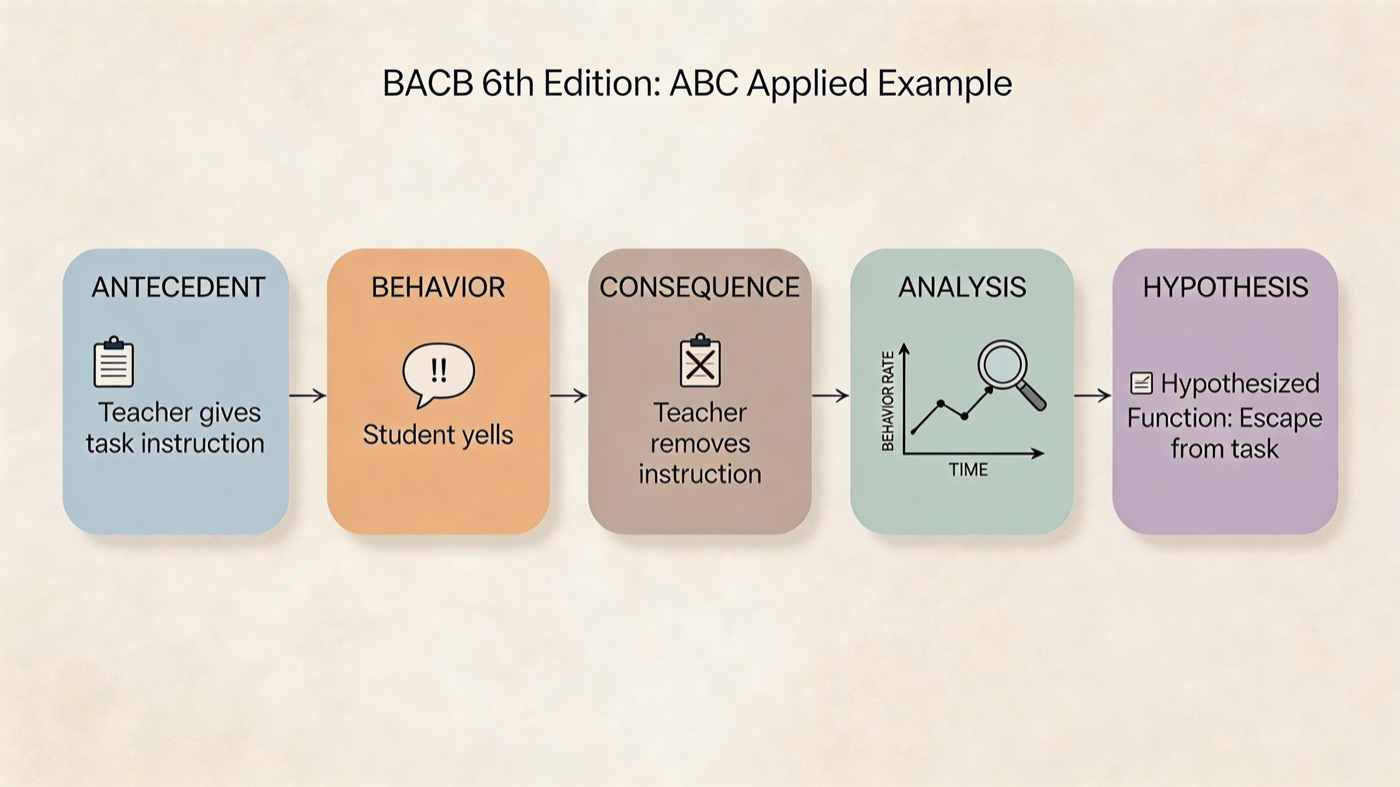
Example 1: Identifying Function in a Classroom Setting
ABC: Antecedent – teacher gives instruction; Behavior – student yells; Consequence – teacher removes instruction. Hypothesized function: escape from demands. On the exam, you would select an extinction procedure (do not remove instruction) and teach a replacement communication response.
Example 2: Selecting an Intervention Based on Function
ABC: Antecedent – peer attention; Behavior – hand flapping; Consequence – peers laugh. Hypothesized function: access to attention. The best intervention is to teach appropriate attention-seeking (e.g., raising hand) and provide contingent attention for that behavior. This aligns with the Intervention domain.
Example 3: Ethical Decision-Making in Intervention
ABC: Antecedent – parent requests an unapproved procedure; Behavior – BCBA explains why it violates the code; Consequence – parent agrees. This example highlights client rights and evidence-based practice. On the exam, you would prioritize ethical guidelines over parent preference unless the procedure has empirical support.
Quick Checklist for BACB 6th Edition Task List Mastery
Use this checklist to confirm you’ve covered all critical areas:
- Download the official task list from the BACB website.
- Identify your weak domains using a practice test, like the BCBA mock exam 6th edition.
- Review the Ethics Code for every applicable task.
- Practice ABC analysis for behavior scenarios in each domain.
- Apply the task list to case studies to simulate exam conditions.
Common Exam Traps and How to Avoid Them
Even well-prepared candidates stumble on these traps related to the 6th edition.
- Overlooking DEI content: The 6th edition includes more on cultural consideration. Candidates often skip it, despite it appearing in several items. Study the BACB’s cultural humility resources.
- Confusing domains: Tasks in the Assessment domain may look like Intervention. Remember: assessment is about identifying function and data; intervention is about applying procedures.
- Underestimating ethics weight: With ethics now a larger percentage, you need dedicated review. Use the ethics guide to drill scenarios.
The BACB 6th Edition Task List is your most powerful study tool. By focusing on updated domains, practicing with real examples, and sidestepping common traps, you’ll approach the exam with confidence. Combine this guide with a structured study plan and consistent mock exams for best results.



