
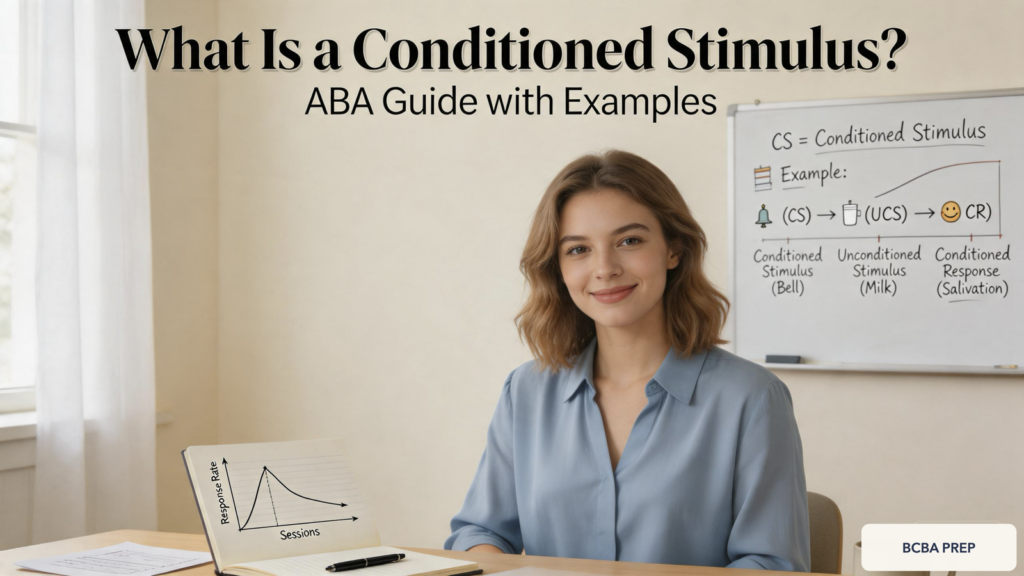
What Is a Conditioned Stimulus? Definition and Key Features
A conditioned stimulus (CS) is a previously neutral stimulus that, after repeated pairing with an unconditioned stimulus (US), begins to elicit a learned response. In ABA, understanding the CS is essential for analyzing how environmental events gain control over behavior. This concept is central to respondent conditioning and appears frequently on the BCBA exam.
Table of Contents
- What Is a Conditioned Stimulus? Definition and Key Features
- ABA Examples: Conditioned Stimuli in Behavior Intervention
- Conditioned Stimulus on the BCBA Exam: Common Traps and Tips
- Quick Reference: Conditioned Stimulus Checklist
- Final Summary
Conditioned Stimulus vs Unconditioned Stimulus
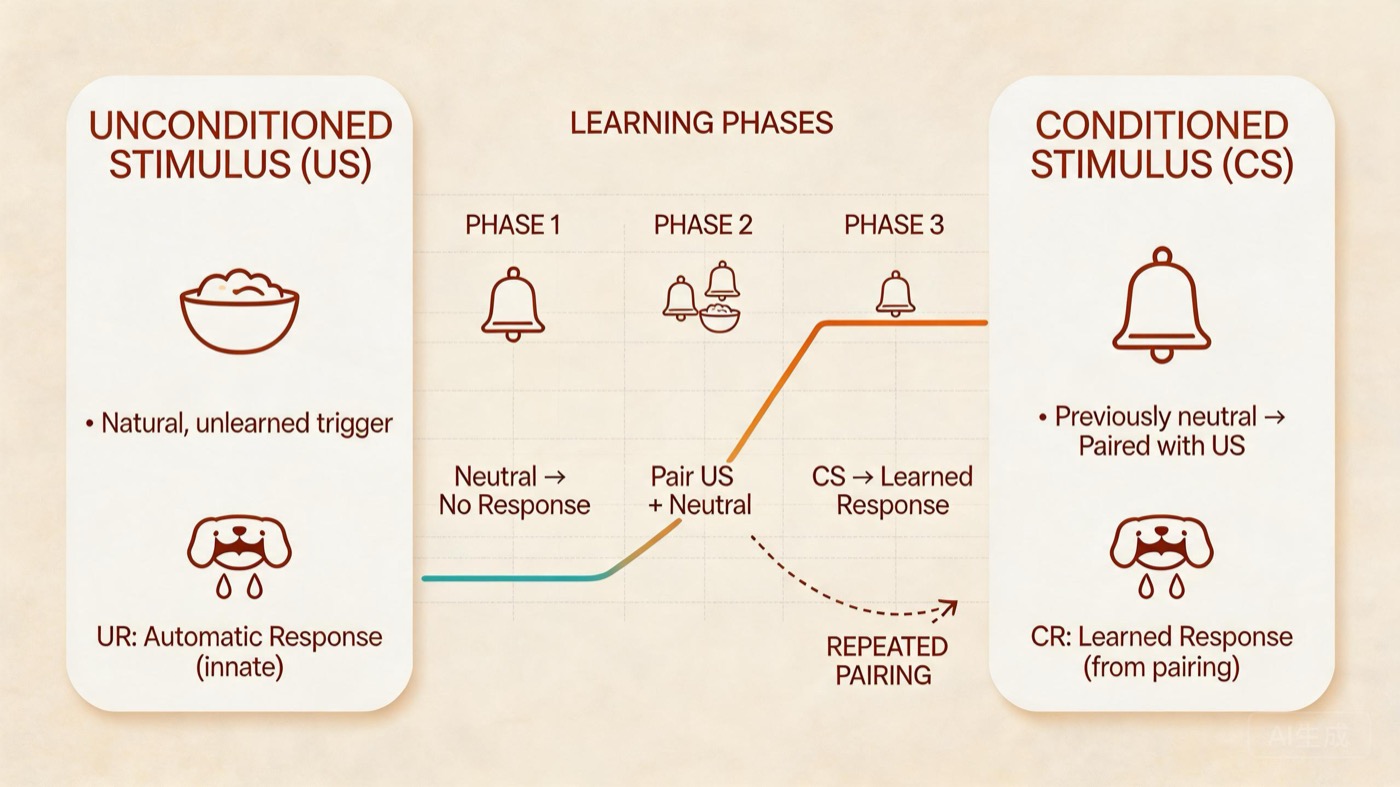
The main difference lies in learning history. An unconditioned stimulus (US) naturally triggers a reflexive response without prior learning (e.g., food eliciting salivation). A conditioned stimulus, by contrast, acquires its power through pairing with a US. For example, a bright light elicits pupil constriction without any training – that light is a US. But if a bell is repeatedly paired with a puff of air to the eye (US causing blink), the bell alone may eventually elicit a blink, making the bell a CS. The response to the CS (conditioned response) is often similar to the unconditioned response but may differ in magnitude or latency.
- US: Elicits response automatically (e.g., loud noise → startle).
- CS: Was neutral but now elicits response due to pairing (e.g., a bell predicting food).
- Response: Conditioned response (CR) is similar but not identical to unconditioned response (UR).
How a Neutral Stimulus Becomes Conditioned
The process begins with a neutral stimulus (NS) that does not evoke the target response. Through repeated pairing with a US, the NS transforms into a CS. Key steps include:
- Pairing: NS + US presented together over multiple trials.
- Acquisition: NS begins to elicit a conditioned response.
- Extinction: If CS is presented alone repeatedly, the CR weakens.
- Spontaneous recovery: CR may reappear after a pause without reinforcement.
It is important to note that the timing of the pairing matters. In most respondent conditioning procedures, the NS should precede the US by a short interval (typically 0.5–1 second) for optimal learning. This is called forward pairing. If the US comes first or the stimuli are presented simultaneously, conditioning is less effective. Additionally, the number of pairings required can vary depending on the intensity of the US and the nature of the response. Some conditioned responses can be acquired in just one trial, especially if the US is very strong (e.g., taste aversion after one pairing with illness).
ABA Examples: Conditioned Stimuli in Behavior Intervention
In applied behavior analysis, conditioned stimuli are commonly used in therapy to build new learning. Here are three practical examples.
Example 1: Token Board as Conditioned Reinforcer
ABC: A token (CS) is paired with access to a preferred toy (US). The token initially has no value but becomes reinforcing after pairings. The child works to earn tokens, which are exchanged for backup reinforcers. This is a classic example of how a neutral stimulus (the token) becomes a conditioned reinforcer, which is a type of conditioned stimulus that elicits approach and increases behavior.
Example 2: Therapist’s Voice as Conditioned Stimulus
ABC: The therapist says ‘Sit down’ (CS) while presenting a preferred activity (US). Over time, the verbal cue alone elicits sitting behavior. The conditioned stimulus now signals compliance. In this case, the conditioned response is sitting down, which is a learned reflexive behavior in the context of respondent conditioning, though it may also involve operant components.
Example 3: Bell Signaling Break Time
ABC: A bell rings (CS) right before a break from aversive tasks (US). The bell becomes a conditioned stimulus for escape, increasing the likelihood of the child working until the bell sounds. Here, the conditioned response is a state of relief or anticipation of escape, which can motivate behavior.
Example 4: Conditioned Emotional Response to a Phobia
ABC: A child sees a dog (NS) and then experiences a loud, scary noise (US) that elicits fear (UR). After one or more pairings, the dog alone (now CS) elicits fear (CR). This is a common example of how conditioned stimuli can lead to phobias. In ABA, understanding this process helps in designing systematic desensitization or counterconditioning interventions.
Conditioned Stimulus on the BCBA Exam: Common Traps and Tips
Exam questions often test your ability to distinguish CS from other stimuli and recognize changes over time.
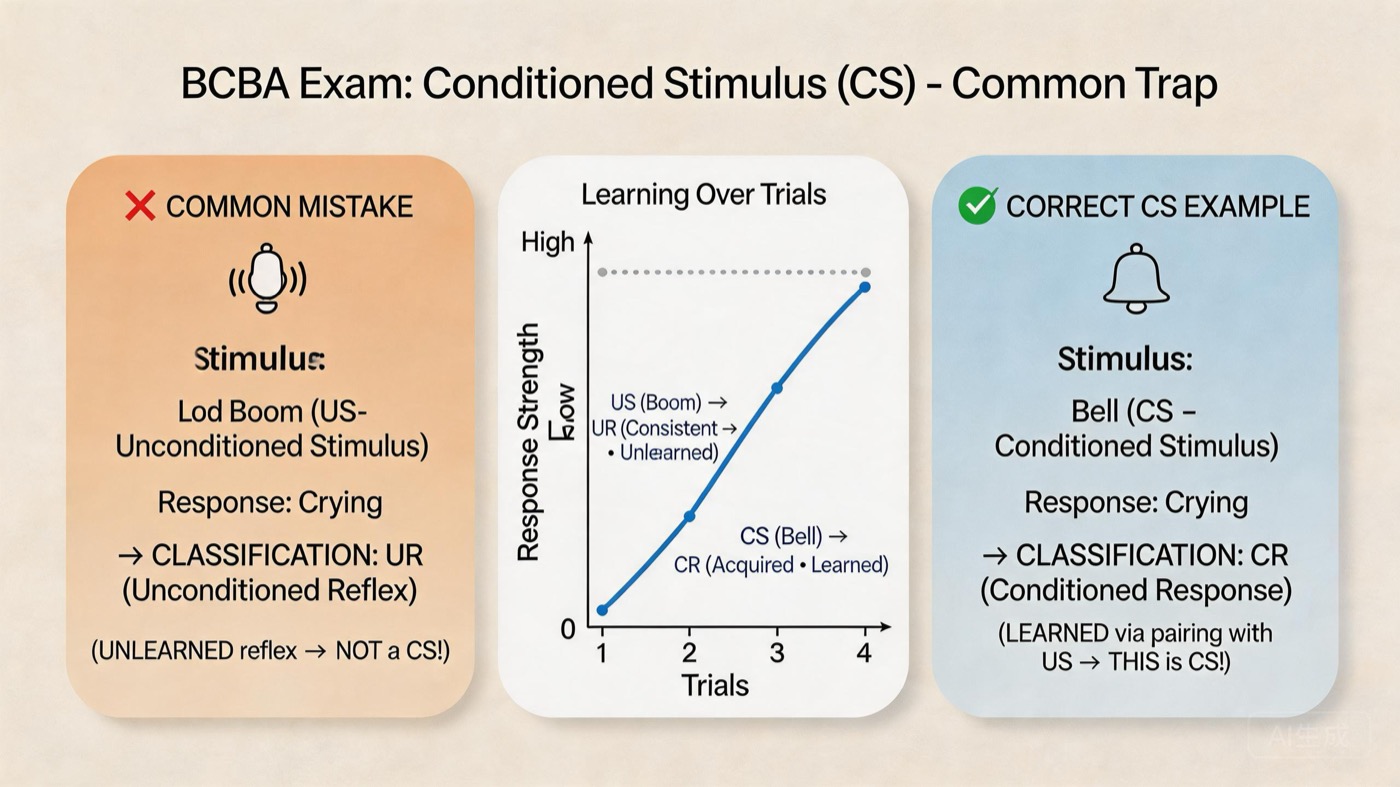
Trap 1: Confusing CS with Unconditioned Stimulus
For example, a child’s crying after a loud noise might be mistaken as a CS. But if crying is an unlearned reflex to pain, it is a UR, not a CS. Always consider the learning history. If the stimulus has always elicited the response, it is likely a US. If it only recently started eliciting the response after pairing, it is a CS.
Trap 2: Overlooking Extinction of Conditioned Stimuli
When a CS is no longer paired with the US, the conditioned response will extinguish. Expect exam items that describe extinction bursts or spontaneous recovery. Remember, the CS loses function without periodic pairing. For example, if a bell that predicted food is sounded many times without food, the dog will stop salivating to the bell.
Trap 3: Misidentifying the Stimulus Class
A CS often belongs to a broader stimulus class. For instance, tone CS may generalize to other similar tones. The test may include questions about stimulus generalization or discrimination. If a child learns to fear a specific white rat (CS), they may also show fear to other furry white objects. This is stimulus generalization.
Trap 4: Forgetting That CS Can Be Compound or Complex
Sometimes a CS is not a single stimulus but a combination. For example, a specific combination of a light and a tone may be paired with a US. The exam may ask about what happens if only one element is presented. In that case, the conditioned response may be weaker or absent due to overshadowing or blocking.
Quick Reference: Conditioned Stimulus Checklist
Use this checklist for last-minute review before the BCBA exam.
- Identify whether the stimulus was originally neutral.
- Confirm pairing history with an unconditioned stimulus.
- Check if the response is elicited (reflexive) rather than emitted.
- Recall that CS can extinguish if unpairing occurs.
- Remember that CS may generalize to similar stimuli.
- Consider that the CS may be part of a compound stimulus – test for overshadowing or blocking.
Final Summary
A conditioned stimulus is a learned trigger that develops through pairing with an unconditioned stimulus. In ABA practice, CS examples include token boards, therapist cues, bell signals, and phobic stimuli. For the BCBA exam, avoid confusing CS with US, watch for extinction effects, consider stimulus generalization, and be aware of compound stimuli. For more in-depth study, review our respondent conditioning guide and explore additional exam strategies on BCBA exam prep. For official details, visit the BACB website.


