
What Are BCBA Study Materials?
BCBA study materials are resources designed to help candidates prepare for the Board Certified Behavior Analyst exam. They include mock exams, flashcards, study guides, video courses, and task list breakdowns. The goal is to reinforce key concepts from the BACB 6th Edition Task List and build test-taking stamina. Modern materials also incorporate digital platforms, adaptive learning, and detailed performance analytics to pinpoint your weaknesses.
Table of Contents
- What Are BCBA Study Materials?
- How to Use BCBA Study Materials Effectively
- Real ABA Examples to Reinforce Study Materials
- Common Exam Traps and How to Avoid Them
- Quick Checklist: Are You Ready for the BCBA Exam?
- Summary and Next Steps
- References
High-quality study materials align with the latest BACB task list and offer real-world ABA examples to bridge theory to practice. The table below outlines the core resource types and their main benefits:
- Mock exams that simulate the actual test format, time constraints, and question distribution. They help you build endurance and time management skills.
- Flashcards for rapid review of terminology, definitions, and conceptual distinctions (e.g., DRA vs. DRO). Digital flashcards with spaced repetition are especially effective.
- Study guides that organize content by domain and subtopic, often including charts, summaries, and sample questions.
- Video courses with narrated explanations of complex topics such as schedules of reinforcement, stimulus equivalence, and functional analysis.
- Task list breakdowns that map every study material to specific exam content areas, ensuring no domain is missed.
When selecting materials, prioritize those that provide a cohesive system—one that combines instruction, practice, and feedback. Look for resources that include answer explanations for every question, not just correct answers, so you understand why a choice is right or wrong. The best BCBA study materials also offer progress tracking and adaptive recommendations to focus your study time on your weakest areas.
How to Use BCBA Study Materials Effectively
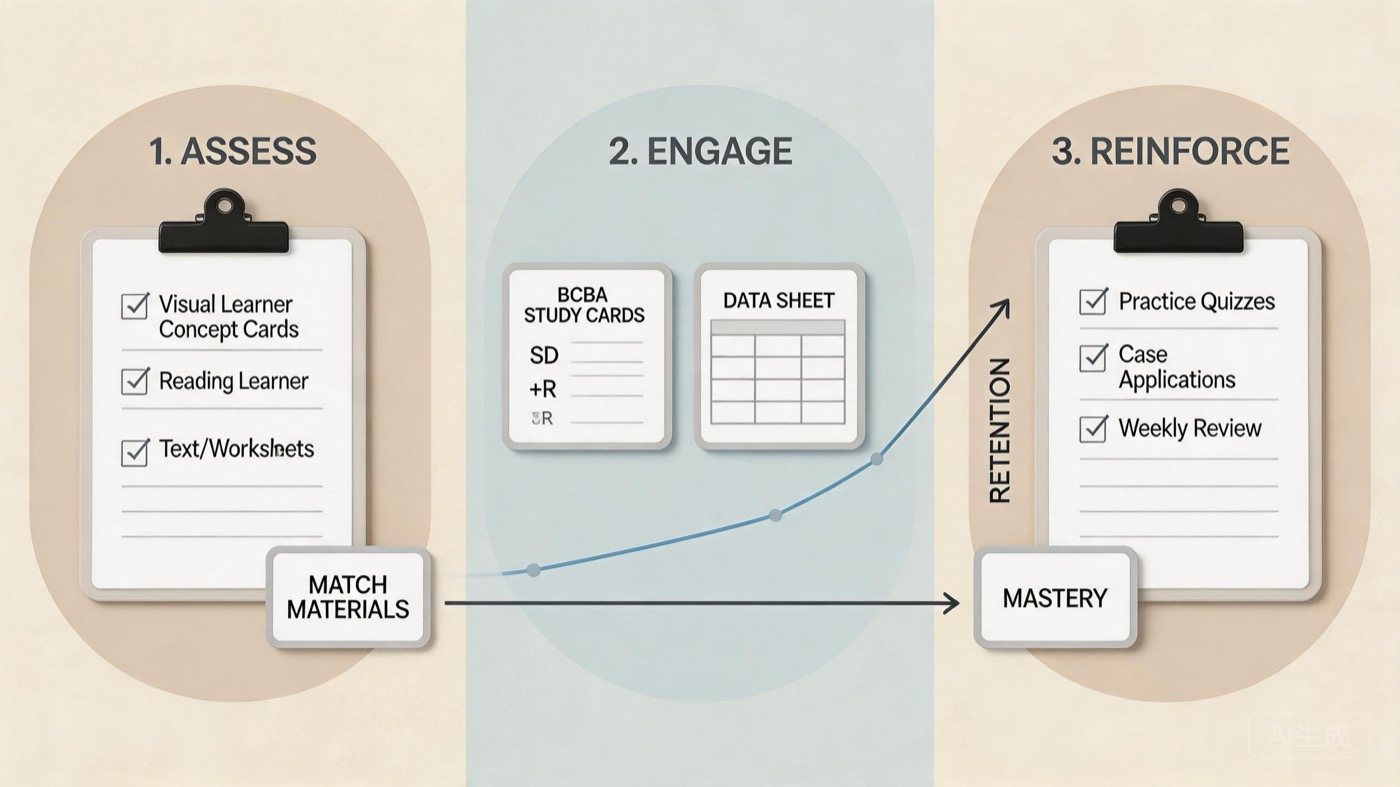
Simply owning study materials is not enough. You need a strategic approach to maximize retention and application. Without a plan, learners often waste time on comfortable topics or passively read without engaging. Below is a 3-phase study plan that integrates different resource types for optimal results.
The 3-Phase Study Plan
- Phase 1: Content Review. Use study guides and video courses to learn each domain. Take detailed notes and create your own flashcards. Aim to cover one domain per week. For example, spend week 1 on measurement and data analysis, week 2 on experimental design, and so on.
- Phase 2: Practice Tests. Take a full-length mock exam under timed conditions (4 hours, 160 questions). grade it and note your domain scores. Then thoroughly review each missed question—read the explanation until you understand the rationale. Keep a log of recurring mistake types (e.g., confusing negative reinforcement with punishment).
- Phase 3: Weakness Targeting. Focus on domains where you scored below 75%. Use flashcards and targeted drills. For example, if you struggled with ethics, work through the BACB Ethics Code case studies. Repeat a mock exam every two weeks to track progress.
Matching Materials to Your Learning Style
Identify your preferred learning style to choose the most effective materials. Visual learners benefit from video courses, flowcharts, and diagrams that illustrate concepts like the three-term contingency. Auditory learners can listen to recorded lectures or podcasts while commuting. Reading/writing learners thrive with study guides and note-taking; they may rewrite key concepts in their own words. Kinesthetic learners should use interactive mock exams, practice creating graphs, and role-play assessment scenarios. Combining multiple modalities (e.g., watching a video then taking a quiz) deepens memory.
Real ABA Examples to Reinforce Study Materials
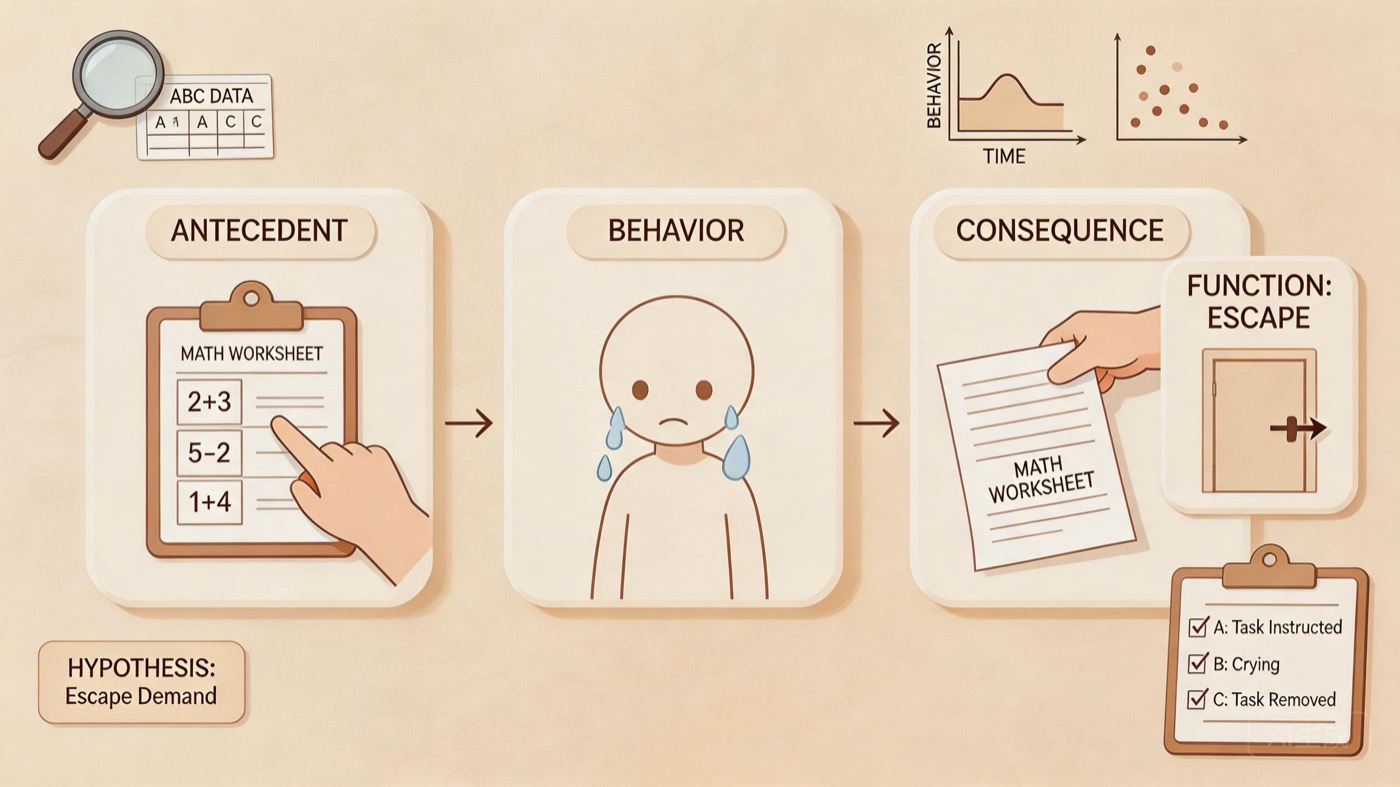
Applying concepts to real scenarios solidifies understanding and helps you generalize from textbook definitions to exam-style items. Below are three ABC examples illustrating common functions of behavior, plus an additional example to clarify a frequent point of confusion.
Example 1: Escape from Task Demands
Antecedent: Teacher gives instruction to complete math worksheet. Behavior: Crying. Consequence: Teacher removes worksheet. Function: Escape. This pattern is common in exam questions about escape-maintained behavior. Notice that the behavior removes an aversive demand. To test this, ask: “Does the behavior end a task or delay it?” If yes, it’s likely escape.
Example 2: Attention from Caregiver
Antecedent: Caregiver is on the phone. Behavior: Screaming. Consequence: Caregiver scolds child. Function: Attention. Note that even negative attention (scolding) can maintain behavior. In exams, be careful: if social disapproval functions as attention, the behavior is attention-maintained, not escape.
Example 3: Access to a Preferred Item
Antecedent: Tablet is visible but out of reach. Behavior: Grabbing. Consequence: Tablet is given. Function: Tangible. This example is frequently tested in relation to mands and requesting skills. A common trap: if a child is asked to clean up and then cries, and the tablet is removed, the function is escape (from cleaning) rather than tangible.
Example 4: Automatic Sensory Stimulation
Antecedent: Alone in a quiet room. Behavior: Hand flapping. Consequence: Sensory feedback (visual or proprioceptive). Function: Automatic/Sensory. This type does not involve social consequences. In exams, look for descriptions of behavior that persists even when no one is present. Differentiating automatic versus social functions is a common test item.
Common Exam Traps and How to Avoid Them
Many test-takers fall into predictable traps. Recognizing these patterns will help you choose the correct answer. Two of the most common are described below, plus an additional trap on measurement.
Confusing Functions of Behavior
Students often mix up escape and tangible functions. Remember: escape removes an aversive stimulus (like a task), while tangible provides access to a preferred item. Also, don’t forget the attention function: sometimes the consequence is reprimand but still maintains behavior. Practice with your BCBA study materials to differentiate these functions quickly by asking “What does the individual get or avoid?” Use a flow chart if needed.
Misapplying Differential Reinforcement
Differential reinforcement procedures have distinct rules. DRA reinforces an alternative behavior (any behavior that serves the same function, not necessarily incompatible), DRO reinforces the absence of the target behavior for a set time interval, and DRI reinforces a behavior that is physically incompatible with the target (e.g., sitting vs. walking). A common mistake: picking DRA when the description mentions only the absence of behavior—that’s DRO. Use flashcards to memorize each definition and a matching example.
Confusing Rate vs. Duration vs. Latency
Another frequent trap involves measurement. Rate counts responses per unit time; duration measures how long a behavior lasts; latency is the time from the antecedent to the start of the behavior. For instance, if the question asks how long after the instruction the child begins to cry, that’s latency, not duration. Review these distinctions with your study materials to avoid simple errors.
Quick Checklist: Are You Ready for the BCBA Exam?
Use this checklist to gauge your preparedness. Each item should be completed before exam day. Checking off these steps not only improves your knowledge but also reduces anxiety by building confidence.
- Complete a full-length mock exam under timed conditions and score at least 80%.
- Review all incorrect answers and understand the rationale for every option.
- Master the task list domains, especially those with lower scores—aim for 85% in each.
- Practice identifying functions of behavior from ABC data using at least 10 real or scenario-based examples.
- Use flashcards for core terminology and formulas (e.g., interobserver agreement, reinforcement schedules).
- Rest and sleep well the night before the exam; avoid last-minute cramming.
For a deeper dive into effective prep, check out our BCBA exam prep guide.
Summary and Next Steps
Preparing for the BCBA exam requires a mix of quality BCBA study materials and a disciplined study plan. Focus on understanding concepts through real-world examples, practice with mock exams, and target your weak areas systematically. The BCBA mock exam 6th edition is a valuable resource to simulate the real experience—it provides detailed feedback and mimics the exact format of the actual test.
Start today, stay consistent, and you will maximize your chances of passing on the first attempt. Good luck! For additional support, join our study community or schedule a free consultation.


