

What Is a Steady State in Behavior Analysis?
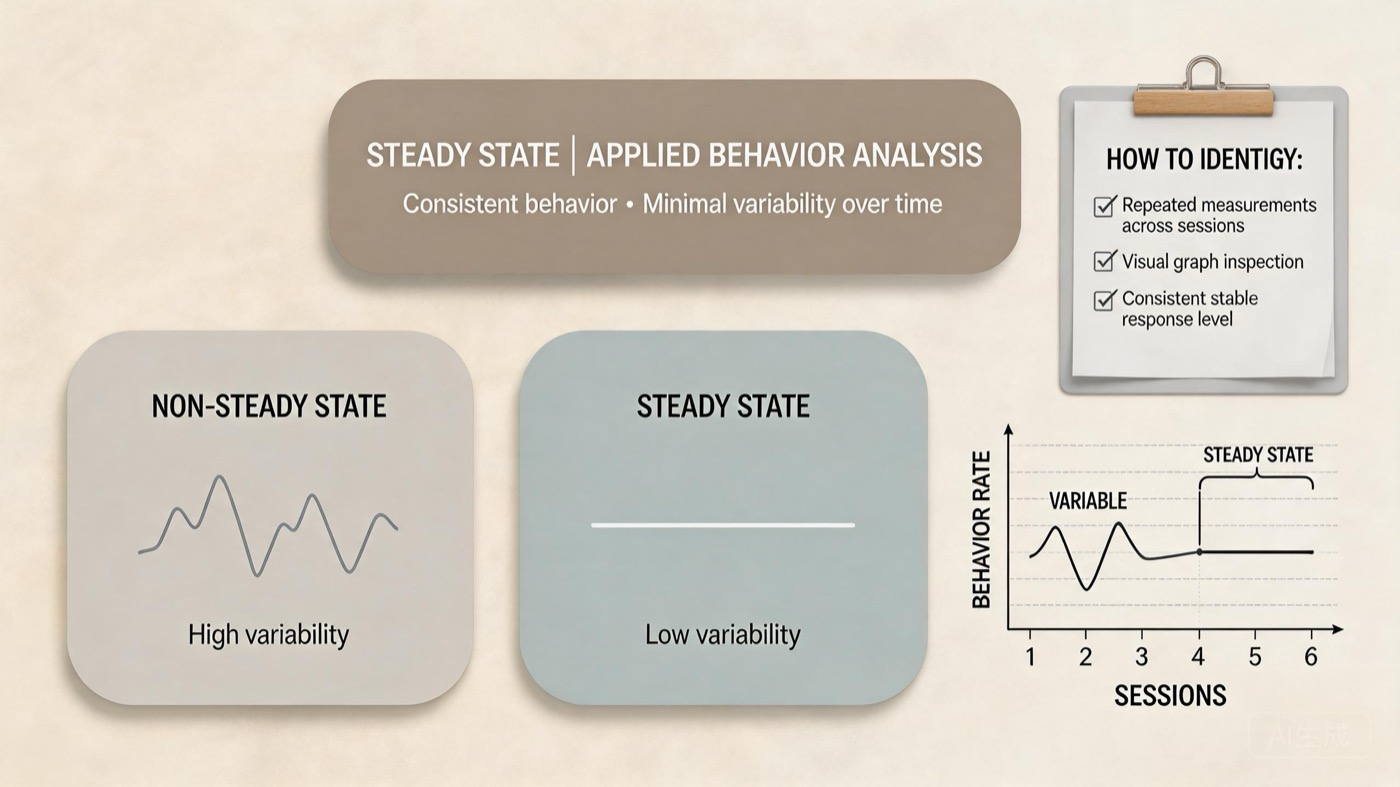
A steady state in ABA refers to a pattern of behavior that shows minimal variability over time. It is identified through repeated measures and visual inspection of graphed data. When behavior reaches a steady state, the data path is relatively flat, with no systematic increasing or decreasing trend and low variability around the mean level. This stability indicates that the behavior is under the control of stable environmental variables and is not being influenced by uncontrolled factors. The concept is foundational to single-subject research designs and the demonstration of experimental control.
Table of Contents
- What Is a Steady State in Behavior Analysis?
- Why Steady State Matters on the BCBA Exam
- Worked Examples of Steady State in ABA
- Quick Checklist for Identifying a Steady State
- References
Defining Behavioral Steady State
In applied behavior analysis, a steady state is the period during which behavior is stable enough to serve as a reliable baseline before introducing an intervention. This stability is essential for predicting what behavior would look like without treatment, thereby allowing researchers to demonstrate experimental control. Practitioners typically look for at least three consecutive data points within a narrow range to confirm a steady state. However, this requirement can vary depending on the behavior’s typical variability and the context. For instance, highly variable behaviors may require more data points or a broader stability criterion, such as 80% of data points falling within a specific range.
Contrast with Variability and Trends
It is important to distinguish a steady state from data patterns that show trends (steady increase or decrease) or high variability (wide scatter of data points). A trend indicates behavior is changing directionally, making it difficult to predict future performance. High variability suggests behavior is influenced by uncontrolled variables. Only when the data path is stable—flat and with low bounce—can we confidently claim a steady state has been achieved. Visual inspection remains the primary method for determining steady state, but exam questions may also provide quantitative criteria (e.g., no data point deviates more than 20% from the mean). Familiarity with both approaches is key for exam success.
Why Steady State Matters on the BCBA Exam
The BCBA exam frequently tests your ability to interpret behavioral graphs and decide whether a steady state has been established. This concept is central to baseline logic and single-subject experimental designs. Without a steady state baseline, it becomes impossible to convincingly attribute behavior change to the independent variable, as other explanations like maturation or history could account for the change.
Steady State and Experimental Design
In withdrawal designs (e.g., ABAB), steady state in baseline and intervention phases allows you to demonstrate that behavior change coincides with the introduction and removal of the independent variable. In multiple baseline designs, steady state baselines across different behaviors, settings, or participants provide evidence that the intervention caused the change rather than extraneous variables. For more on experimental designs, see our guide on single-subject experimental designs. Steady state also plays a crucial role in alternating treatment designs, where rapid alternation requires stable baseline levels to compare intervention effects.
Common Exam Questions About Steady State
- Interpreting graphs: You may be asked whether a steady state is present in a given phase. Look at the last three to five data points to assess trend and variability.
- Determining stability criteria: Questions may provide a percentage (e.g., 80% of data within a range) and ask if the data meet steady state criteria. Pay close attention to the stated threshold.
- Implications for internal validity: If a steady state is not achieved before intervention, threats to internal validity (like maturation or history) become more likely. You may be asked to identify the most plausible threat.
Pitfalls to Avoid
Confusing trend with variability is a common trap. A steady increase is a trend, not variability. Also, do not assume steady state means no change over time; it means change is minimal and unpredictable. Finally, always consider extraneous variables that could disrupt stability, even if the graph looks flat. For example, a sudden drop in data due to illness may break a steady state, even if subsequent points appear stable.
Worked Examples of Steady State in ABA
Applying the concept to real scenarios helps solidify your understanding. Below are four examples with ABC analysis, each illustrating different steady state characteristics.
Example 1: Compliant Behavior in a Classroom
Antecedent: Teacher gives instruction. Behavior: Student follows instruction within 10 seconds. Consequence: Teacher praise. Hypothesized function: Positive reinforcement. After five sessions, data points range from 80% to 85% compliance with no trend—this is a stable steady state baseline. The minimal variability (only 5% range) and flat path make it ideal for introducing an intervention.
Example 2: Self-Injurious Behavior in a Therapy Setting
Antecedent: Demand presented. Behavior: Head hitting. Consequence: Break from demand. Hypothesized function: Escape. Steady state is reached after three consecutive data points at 2–3 occurrences per session with low variability. However, because self-injurious behavior often shows higher variability, the clinician sets a criterion of 80% of data within 1 occurrence of the median. This criterion is met, confirming steady state.
Example 3: On-Task Behavior During Independent Work
Antecedent: Timer set for 10 minutes. Behavior: Looking at worksheet, writing. Consequence: Token earned. Hypothesized function: Tangible. Steady state is indicated by percentage of intervals ranging from 70% to 75% across four sessions with no upward or downward trend. Despite a low absolute level, the stability supports experimental control.
Example 4: Out-of-Seat Behavior in a General Education Classroom
Antecedent: Independent seatwork. Behavior: Leaving seat without permission. Consequence: Teacher verbal redirect. Hypothesized function: Attention. Data across six sessions show values: 4, 5, 8, 6, 7, 5. The range is 4–8, and the mean is approximately 5.8. With only 2 of 6 points falling outside 20% of the mean (i.e., outside 4.6–7.0), the steady state criterion of 80% within range is not met (only 4 of 6 = 67%). This indicates high variability and lack of steady state, suggesting the need for further baseline conditions.
Quick Checklist for Identifying a Steady State
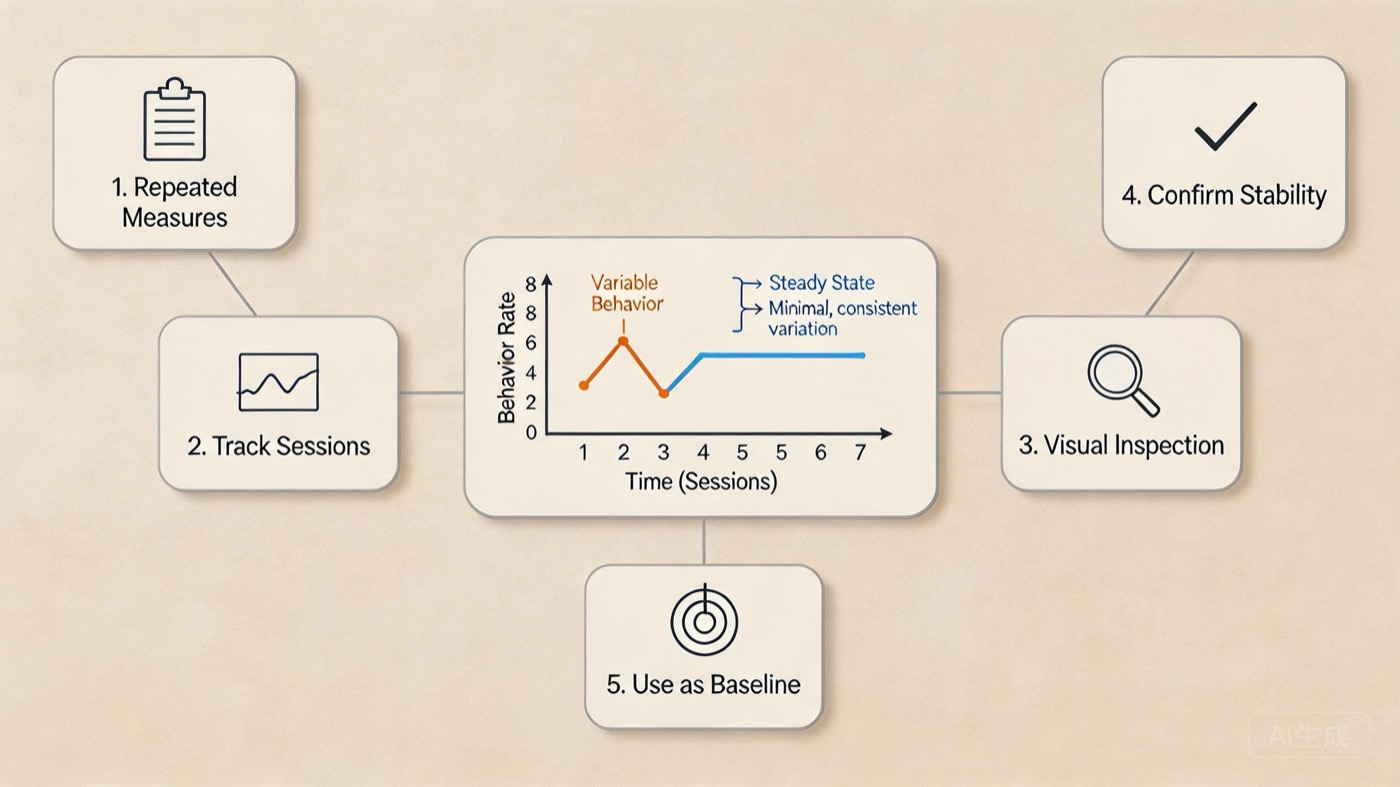
- Check for trend: Does the data path slope systematically upward or downward over at least three sessions? If yes, it is not yet steady.
- Evaluate variability: Are data points scattered widely around the mean? More than ~20% deviation may indicate instability.
- Confirm sufficient data points: Have at least three, preferably five, consecutive data points been collected under the same conditions?
- Rule out outliers: Is there a single extreme point that distorts the pattern? Consider whether it is due to an extraneous variable.
- Use your visual inspection skills: The overall data path should appear flat with minimal bounce. Practice with sample graphs to build fluency. Additionally, evaluate the range relative to the mean: if the range exceeds 50% of the mean, stability is questionable.
For additional guidance on interpreting graphs, visit our article on visual analysis in ABA.
Mastering the concept of steady state will help you answer BCBA exam questions accurately and apply this foundational principle in practice. Remember to focus on repeated measures, stability criteria, and the role of steady state in demonstrating experimental control.


