The 7 Dimensions of ABA: What They Really Mean and How to Use Them on the BCBA® Exam
By BCBA Mock Exam
If you’re studying for the BCBA® exam, you probably already memorized the list: Applied, Behavioral, Analytic, Technological, Conceptually Systematic, Effective, Generality.
But the exam doesn’t just test if you can recite those seven words.
It tests whether you can:
-
Recognize these dimensions in real scenarios
-
Spot what’s missing from a weak intervention
-
Choose the option that makes a plan more “ABA” and less vague
In this article, we’ll cover:
-
Plain-language definitions of each dimension
-
Simple clinical and exam-style examples
-
Common traps and misunderstandings
-
A few practice questions at the end
1. Quick Overview: What Are the 7 Dimensions of ABA?
The 7 dimensions come from Baer, Wolf, & Risley (1968). They describe what high-quality ABA should look like.
-
Applied – socially significant behavior
-
Behavioral – observable and measurable behavior
-
Analytic – demonstrates a functional relation
-
Technological – procedures are clearly described
-
Conceptually Systematic – rooted in behavioral principles
-
Effective – produces meaningful change
-
Generality – behavior change lasts and spreads
On the BCBA® exam, common question types are:
-
“Which dimension is BEST represented here?”
-
“Which dimension is missing?”
-
“What should the BCBA change to better align with ___ dimension?”
2. Applied: Is the Goal Socially Significant?
Core idea
Applied means we target behaviors that are important in real life, not just easy to measure.
Ask: “Does this matter to the client, family, school, or society?”
Examples
-
✅ Applied goals:
-
Reducing severe aggression toward siblings
-
Increasing independent toileting
-
Teaching a teenager to use public transportation safely
-
Increasing requests for help instead of self-injury
-
-
❌ Less applied goals:
-
Teaching a child to name all U.S. presidents when this has no academic or functional relevance
-
Increasing button-pressing on a toy just because it is easy to count
-
BCBA® exam tips
Look for words like:
-
“socially significant behavior”
-
“important to the client or caregivers”
-
“improves quality of life”
-
“clinically meaningful”
If one option shifts the target from something trivial to something that clearly improves the client’s life, that’s often the Applied answer.
The following image illustrates the concept of the Applied dimension, showing a child learning a socially significant skill.

3. Behavioral: Are We Measuring Actual Behavior?
Core idea
Behavioral means the focus is on observable, measurable behavior, not vague labels.
We don’t just say “improve attitude” — we define what that looks like in behavior.
Examples
-
✅ Behavioral targets:
-
Number of independent mands per hour
-
Frequency of hitting across the school day
-
Percentage of math problems completed correctly
-
Duration of screaming per episode
-
-
❌ Non-behavioral targets (until defined):
-
“Increase motivation”
-
“Improve self-esteem”
-
“Have a better attitude”
-
You can turn these into behavioral goals by defining what they look like:
-
“Completes assigned work within 10 minutes of instruction without prompts”
-
“Initiates conversation with peers at least 3 times per recess”
BCBA® exam tips
When a question mentions:
-
Vague traits (“lazy,” “unmotivated,” “disrespectful”)
-
Or a plan that “helps self-esteem” but never defines behavior
The best answer often involves:
-
“Define the target behavior in observable and measurable terms”
-
“Collect direct measures of the specific behavior of concern”
That’s the Behavioral dimension.
4. Analytic: Can We Show the Intervention Caused the Change?
Core idea
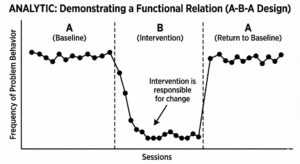
Analytic means we can show that our intervention is responsible for the behavior change — there is a functional relation.
This usually involves systematic manipulation of variables and the use of single-subject designs.
Examples
-
Using a reversal design (ABAB) to show that:
-
When the intervention is on → problem behavior decreases
-
When the intervention is off → problem behavior returns toward baseline
-
-
Using a multiple baseline across behaviors, settings, or people:
-
Behavior improves only when the intervention is introduced in that particular line
-
BCBA® exam tips
Watch for phrases like:
-
“demonstrate a functional relation”
-
“experimental control”
-
“systematically introduce and withdraw the intervention”
-
“use a multiple baseline design to show…”
If the question asks how to make a plan more analytic, the best answer usually suggests:
-
Collecting continuous data
-
Using a single-subject design
-
Systematically manipulating the independent variable
The following image illustrates the Analytic dimension, showing a graph that demonstrates a clear functional relation.
5. Technological: Could Another BCBA Reproduce This Plan?
Core idea
Technological means the procedures are described clearly and completely, so that someone else could implement them exactly the same way.
If you handed the plan to another BCBA or RBT, could they follow it without guessing?
Examples
-
❌ Not technological:
-
“Use positive reinforcement whenever the client is on-task.”
-
“Implement DRA to improve compliance.”
-
These are too vague. They leave questions like: What counts as “on-task”? What exactly is the reinforcer? How often? For how long?
-
-
✅ Technological:
-
“When the client starts the assigned worksheet within 10 seconds of instruction and continues working for 2 minutes without leaving their seat, immediately deliver specific labeled praise (‘Nice job getting started right away!’) and one point. After earning 5 points, allow a 3-minute break with a preferred activity.”
-
BCBA® exam tips
If a question describes a plan that is very general, the “technological” fix often is:
-
“Rewrite the plan with enough detail so that others can consistently implement it.”
-
“Specify the exact procedures, timing, prompts, and consequences.”
Look for “clear, complete, and replicable” — that’s Technological.
6. Conceptually Systematic: Are We Using Behavioral Principles?
Core idea
Conceptually Systematic means interventions are grounded in basic principles of behavior (e.g., reinforcement, extinction, stimulus control), not just a bag of disconnected techniques.
You should be able to explain why something works in terms of behavioral concepts, not just “we’ve seen it help before.”
Examples
-
✅ Conceptually systematic:
-
Explaining a token economy as an application of conditioned reinforcement and generalized conditioned reinforcers
-
Describing a differential reinforcement procedure using terms like DRA, DRO, DRI, and connecting them to reinforcement and extinction
-
-
❌ Not conceptually systematic:
-
Using a mix of “visual charts,” “reward boxes,” and “behavior games” with no reference to any behavioral principles
-
Picking strategies because “they seem fun” without tying them to concepts like MO, SD, reinforcement, punishment, extinction
-
BCBA® exam tips
When you see options like:
-
“Base interventions on empirically supported behavioral principles”
-
“Describe the procedure using behavior-analytic terminology”
-
“Align strategies with reinforcement, extinction, and stimulus control”
Those are typically pointing to the Conceptually Systematic dimension.
7. Effective: Does It Actually Work in a Meaningful Way?
Core idea
Effective means the intervention produces meaningful, socially important behavior change, not just a tiny shift that only shows up on a graph.
Ask: would the client, family, teacher, or employer say, “Yes, this helped”?
Examples
-
A plan to reduce severe self-injury that results in a 70% decrease and fewer ER visits
-
An academic intervention that allows the learner to participate independently in classroom activities
-
A communication program that leads to reliable functional communication instead of problem behavior
Sometimes a change is statistically noticeable but not socially significant. For example:
-
Reducing tantrums from 10 per day to 9 per day might not feel effective in real life.
BCBA® exam tips
Look for:
-
“meaningful change”
-
“clinically significant reduction”
-
“practically important improvement”
If a question asks what to do when data show only small, inconsistent change, the best “effective” answer may say:
-
“Modify the intervention to produce more substantial behavior change”
-
“Consider changing the schedule of reinforcement, prompts, or teaching format”
8. Generality: Does the Change Last and Spread?
Core idea
Generality (or “generalization”) means behavior change:
-
Occurs over time (maintenance)
-
Occurs across settings
-
Occurs with different people
-
Occurs with similar but untrained responses
An intervention isn’t complete if the new behavior only appears in one room, with one therapist, using one set of materials and disappears everywhere else.
Examples
-
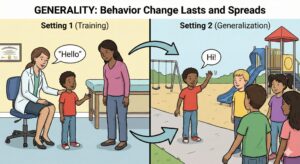
A learner who requests a break with a picture card:
-
In the therapy room
-
Later in the classroom
-
Later at home with parents
-
-
A learner who learns to greet one peer and then starts greeting other peers and adults without direct teaching
BCBA® exam tips
Generalization-related answers often mention:
-
Training across settings, people, and stimuli
-
Using programming common stimuli
-
Teaching multiple exemplars
-
Planning for maintenance (fading prompts, thinning reinforcement, scheduling follow-up probes)
If the current plan works only in a very narrow context, the “Generality” fix is to plan and program for generalization, not just “hope it happens.”
The following image illustrates the Generality dimension, showing a skill learned in therapy being used in a new, natural setting.
9. How the 7 Dimensions Show Up on the BCBA® Exam
Here are common patterns you’ll see:
-
“Which dimension is BEST illustrated?”
-
The question describes a scenario and asks you to pick the dimension.
-
Tip: more than one might be present, but they want the most salient one.
-
-
“What is missing from this intervention?”
-
Example: A highly detailed plan that uses reinforcement principles but targets trivial behavior → missing Applied.
-
Or a plan with a nice goal but vague procedures → missing Technological.
-
-
“How can the BCBA improve this plan according to the 7 dimensions?”
-
Options often correspond to different dimensions.
-
Choose the one that aligns with what the stem highlights as the main weakness.
-
-
Matching definitions with dimensions
-
More straightforward questions where you match “socially significant behavior” with Applied, “functional relation” with Analytic, etc.
-
10. Mini Practice Questions (With Explanations)
Question 1 A BCBA designs an intervention to help a client reduce the number of times they scream during community outings. Data show that screaming dropped from an average of 12 times per outing to 2 times per outing, and caregivers report that community trips are now “much easier and less stressful.” Which dimension is MOST clearly demonstrated?
A. Technological B. Effective C. Conceptually Systematic D. Generality
Correct Answer: B – Effective
Why?
The key point is that the intervention produced a large, meaningful reduction in screaming that caregivers clearly notice.
That aligns best with Effective.
The stem doesn’t emphasize clear procedural description (Technological), principle-based explanation (Conceptually Systematic), or generalization across settings/people (Generality).
Question 2 A treatment plan states: “Use positive reinforcement to increase on-task behavior in class.” There are no details about what counts as on-task behavior, what reinforcers will be used, or how and when they will be delivered. Which dimension is most clearly lacking?
A. Behavioral B. Applied C. Technological D. Analytic
Correct Answer: C – Technological
Why?
The problem is that the plan is not described with enough detail for another person to implement it consistently.
That is a Technological issue.
The target is vaguely described but still somewhat behavioral, and nothing is said about experimental control (Analytic) or social significance (Applied).
Question 3 A BCBA explains a token system to a teacher as: “Tokens work as generalized conditioned reinforcers because they are paired with backup reinforcers like iPad time, snacks, and games. We are using a fixed-ratio schedule to deliver tokens contingent on correct responses.” Which dimension does this explanation MOST clearly reflect?
A. Conceptually Systematic B. Applied C. Analytic D. Generality
Correct Answer: A – Conceptually Systematic
Why?
The BCBA is explicitly tying the procedure to behavioral principles: conditioned reinforcement, generalized reinforcers, and schedules of reinforcement.
That is exactly what Conceptually Systematic means.
11. Key Takeaways
-
The 7 dimensions are more than a list to memorize — they’re a quality checklist for ABA interventions.
-
On the BCBA® exam, ask yourself:
-
Is the goal socially significant? → Applied
-
Is the target observable and measurable? → Behavioral
-
Do we show a functional relation? → Analytic
-
Is the plan clear and replicable? → Technological
-
Is it tied to behavioral principles? → Conceptually Systematic
-
Does it produce meaningful change? → Effective
-
Does the change last and generalize? → Generality
-