7 Dimensions of ABA in Real-Life Cases: How to Recognize Them in BCBA® Exam Scenarios
By BCBA Mock Exam
Introduction
If you have spent any time with the Cooper book or BCBA® exam prep materials, you have seen the 7 dimensions of applied behavior analysis: Applied, Behavioral, Analytic, Technological, Conceptually Systematic, Effective, and Generality.
They were first described by Baer, Wolf, and Risley (1968), and they still show up repeatedly on the BCBA® exam today. The challenge for many candidates is not memorizing the list, but recognizing each dimension inside realistic case scenarios.
In this article, we will:
-
Briefly review each of the 7 dimensions
-
Connect them to everyday clinical examples
-
Show you how exam stems ‘hide’ these dimensions in the details
-
Give you mini practice questions to test your understanding
This guide will help you spot the 7 Dimensions of ABA quickly in both real-life programs and BCBA® exam questions. By the end, you should feel much more confident identifying the 7 dimensions in both real-life programs and BCBA® exam questions.
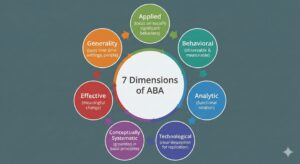
Infographic displaying the 7 Dimensions of ABA: Applied, Behavioral, Analytic, Technological, Conceptually Systematic, Effective, and Generality connected in a cycle.
1. Quick Overview: The 7 Dimensions of ABA
The 7 dimensions describe the core features that make an intervention truly behavior-analytic:
-
Applied: Focuses on socially significant behaviors
-
Behavioral: Targets observable and measurable behavior
-
Analytic: Demonstrates a functional relation between behavior and intervention
-
Technological: Procedures are described clearly and completely
-
Conceptually Systematic: Procedures are grounded in basic behavioral principles
-
Effective: Produces meaningful, socially significant change
-
Generality: Behavior change lasts over time, across settings, people, and behaviors
On the exam, you are often asked to select the BEST example of a given dimension or to identify which dimension is missing from a described program.
2. Applied: Is the Goal Socially Significant?
Definition: An intervention is applied when it focuses on behaviors that are important to the client and their stakeholders (family, teachers, employers, etc.), not just interesting to the practitioner.
Real-life example:
-
A BCBA works with a teenager on independent use of public transportation so they can get to work without relying on family.
-
A program targets getting dressed independently in the morning so a child can join peers and arrive at school on time.
Non-example:
-
Teaching a child to sort colored cards simply because it is easy to measure, even though no caregiver cares about that skill and it does not connect to broader goals.
Exam clues for ‘Applied’:
-
The stem emphasizes socially meaningful outcomes (safety, independence, communication, access to school/work, family priorities).
-
Caregiver or client goals are clearly described.
-
The behavior matters in the real world, not just in the clinic.
3. Behavioral: Is It Observable and Measurable?
Definition: Behavioral means the focus is on the individual’s observable and measurable behavior, not on internal states or vague traits.
Real-life example:
-
Instead of ‘reducing anxiety,’ the BCBA defines and measures ‘number of times the client leaves their seat and paces for more than 10 seconds during group instruction.’
-
Instead of ‘improve attitude,’ the program targets ‘number of completed assignments turned in on time.’
Non-example:
-
Writing a goal such as ‘client will feel more confident’ without any observable indicators.
Exam clues for ‘Behavioral’:
-
Definitions use clear, observable terms (says, touches, walks, completes, raises hand).
-
The stem mentions data collection (frequency, duration, percent, etc.).
-
You can picture what an observer would see and record.
4. Analytic: Did the Intervention Actually Cause the Change?
Definition: Analytic means the BCBA demonstrates a functional relation between the intervention and behavior change. In other words, there is convincing evidence that the procedure, not chance or other factors, produced the change.
Real-life example:
-
A BCBA uses a multiple baseline design across settings to show that a self-monitoring program only changes behavior when it is introduced in each setting.
-
In a reversal (ABAB) design, problem behavior decreases only during the intervention phases and returns when the intervention is withdrawn.
Non-example:
-
Implementing a new token system and assuming it worked just because behavior improved, without any baseline data or experimental control.
Exam clues for ‘Analytic’:
-
Mention of experimental designs (reversal, multiple baseline, changing criterion, etc.).
-
Clear comparison of behavior before and after the intervention.
-
Phrases such as ‘demonstrated a functional relation,’ ‘showed control,’ or ‘systematically manipulated.’
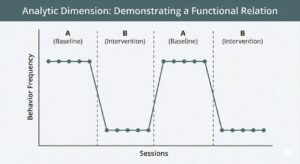
A line graph showing an ABAB Reversal Design, demonstrating the Analytic dimension by showing behavior change strictly correlated with the intervention phases.
5. Technological: Could Another BCBA Replicate This?
Definition: Technological means the intervention procedures are described in sufficient detail that another practitioner could replicate them exactly.
Real-life example:
-
The behavior plan specifies: exact prompts, word-for-word instructions, reinforcement schedules, criteria for fading prompts, and how to respond to errors.
-
A task analysis for handwashing includes each step, the type of prompt to use, and clear mastery criteria.
Non-example:
-
A plan that simply says ‘use differential reinforcement’ without saying:
-
Which behavior is being reinforced?
-
Which behavior is being placed on extinction?
-
How often is reinforcement delivered?
-
What specific reinforcers are used?
-
Exam clues for ‘Technological’:
-
Stems that mention vague plans that ‘lack enough detail for staff to implement consistently.’
-
Options that improve a plan by adding step-by-step procedures or clearer operational definitions.
6. Conceptually Systematic: Tied to Behavioral Principles
Definition: Conceptually systematic means interventions are described and chosen based on basic behavioral principles (reinforcement, punishment, stimulus control, motivating operations, extinction, etc.), rather than as a collection of unrelated techniques.
Real-life example:
-
A BCBA explains that their token economy uses conditioned reinforcement and schedules of reinforcement.
-
A plan for reducing problem behavior combines extinction with differential reinforcement of alternative behavior (DRA), and the BCBA labels these procedures explicitly.
Non-example:
-
A plan that says ‘we use a mix of strategies’ without connecting them to any behavioral concepts.
Exam clues for ‘Conceptually Systematic’:
-
Stems or answers that use technical language accurately (e.g., DRA, DRO, extinction, stimulus control).
-
Options that strengthen a plan by grounding it in clearly stated principles.
7. Effective: Does It Work in a Meaningful Way?
Definition: Effective means the intervention produces practical, meaningful improvements in behavior for the client and stakeholders.
Real-life example:
-
A reduction in self-injury from 20 episodes per hour to 1 per week.
-
An increase in independent toileting from 0% to 90% successful attempts across two months.
Non-example:
-
A tiny change that is statistically detectable but makes no noticeable difference to the client or family.
-
A plan that slightly improves behavior but still leaves the client unable to participate in school or community activities.
Exam clues for ‘Effective’:
-
Stems that mention ‘clinically significant,’ ‘socially meaningful,’ or ‘important to caregivers.’
-
Data graphs showing large, clear changes rather than minimal shifts.
-
Options that suggest revising or intensifying a plan when progress is too small.
8. Generality: Does Change Last and Spread?
Definition: Generality means behavior change maintains over time, appears in new settings or with new people, and spreads to related behaviors.
Real-life example:
-
A child learns to request a break with their BCBA in the clinic and later uses the same skill at school and home.
-
After learning to greet peers in a structured session, the client begins greeting peers spontaneously on the playground.
Non-example:
-
A skill that only occurs during 1:1 sessions with one therapist, when specific materials are present, and disappears elsewhere.
Exam clues for ‘Generality’:
-
Mention of maintenance probes weeks or months later.
-
Descriptions of behavior occurring with new people, in new settings, or with different materials.
-
Options that add programming for generalization (e.g., training across settings, people, and stimuli).
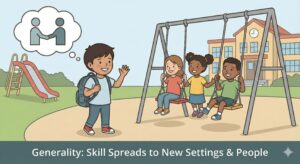
Illustration of the Generality dimension, showing a child using a communication skill learned in a classroom on a playground with new peers.
9. How BCBA® Exam Questions Mix the 7 Dimensions of ABA
On the BCBA® exam, you are rarely given a simple ‘Which dimension is this?’ question. More often, you see a scenario where several dimensions are present, and you are asked to:
-
Identify the dimension that is missing or weakest
-
Choose an action that strengthens a particular dimension
-
Decide whether a plan is ‘truly behavior analytic’ based on these features
Common patterns:
-
A highly detailed plan (technological) that targets trivial behaviors (not applied).
-
A socially important goal (applied) with vague procedures (not technological).
-
A well-implemented program with no follow-up data (weak on generality).
When you read a stem, ask yourself: “Which of the 7 dimensions is this question really testing?” Then look for the answer that best strengthens or exemplifies that dimension.
10. Common BCBA® Exam Traps with the 7 Dimensions
Trap 1 – Confusing ‘Applied’ with ‘Behavioral’
-
Applied is about importance of the target behavior.
-
Behavioral is about observability and measurability of the behavior.
Trap 2 – Thinking ‘Analytic’ Just Means ‘Data-Based’
-
Analytic requires evidence of a functional relation, not just any data collection.
Trap 3 – Mislabeling ‘Technological’ as ‘Conceptually Systematic’
-
Technological: enough detail to replicate.
-
Conceptually systematic: explicitly linked to behavioral principles.
Trap 4 – Ignoring ‘Effectiveness’ When Change Is Small
-
A slight improvement may still not be effective. The exam often expects you to revise interventions when change is not clinically meaningful.
Trap 5 – Forgetting ‘Generality’ After Short-Term Gains
-
Many stems show good immediate progress. The best answer often involves planning for maintenance and generalization.
11. Mini Practice Questions (With Explanations)
Question 1 – Which Dimension Is Missing?
A BCBA designs a detailed token economy plan to increase on-task behavior during math. The plan includes step-by-step instructions, a clear reinforcement schedule, and data collection procedures. However, the selected target behavior is whether the student taps their pencil exactly three times before starting work, which neither the teacher nor the parents see as important.
Which dimension is MOST clearly lacking?
-
A. Technological
-
B. Applied
-
C. Analytic
-
D. Conceptually Systematic
Correct Answer: B – Applied Explanation: The plan is highly technological (well described), but the target behavior is not socially significant.
Question 2 – Analytic vs Effective
A BCBA implements a behavior intervention plan to reduce aggression. Over 10 weeks, aggression decreases from 15 episodes per day to 2 per day. A reversal design shows aggression only decreases when the plan is in place and returns when it is removed.
Which statement is MOST accurate?
-
A. The intervention is analytic but not effective.
-
B. The intervention is effective but not analytic.
-
C. The intervention is both analytic and effective.
-
D. The intervention is neither analytic nor effective.
Correct Answer: C – Both analytic and effective Explanation: The design demonstrates experimental control (analytic) and the change is large and meaningful (effective).
Question 3 – Generality
A child learns to request help using a picture card during 1:1 sessions with their BCBA. Two months later, the BCBA observes that the child now uses the same picture card to request help from their classroom teacher and parent at home, even though no extra teaching was done in those settings.
Which dimension is BEST illustrated?
-
A. Technological
-
B. Conceptually Systematic
-
C. Generality
-
D. Behavioral
Correct Answer: C – Generality Explanation: The skill has generalized across people and settings and has maintained over time.
12. Key Takeaways
- The 7 Dimensions of ABA (Applied, Behavioral, Analytic, Technological, Conceptually Systematic, Effective, Generality) describe what makes ABA interventions truly behavior-analytic.
-
On the BCBA® exam, you will often be asked to identify which dimension is strongest or weakest in a scenario.
-
Focus on:
-
Applied: Is the behavior socially significant?
-
Behavioral: Is it observable and measurable?
-
Analytic: Is there evidence of a functional relation?
-
Technological: Could someone replicate the plan from the description?
-
Conceptually Systematic: Are procedures linked to behavioral principles?
-
Effective: Is the change meaningful for the client?
-
Generality: Does change last and spread?
-
Building fluency with these dimensions will not only help you pass the BCBA® exam, but also guide you in designing high-quality interventions in real practice.