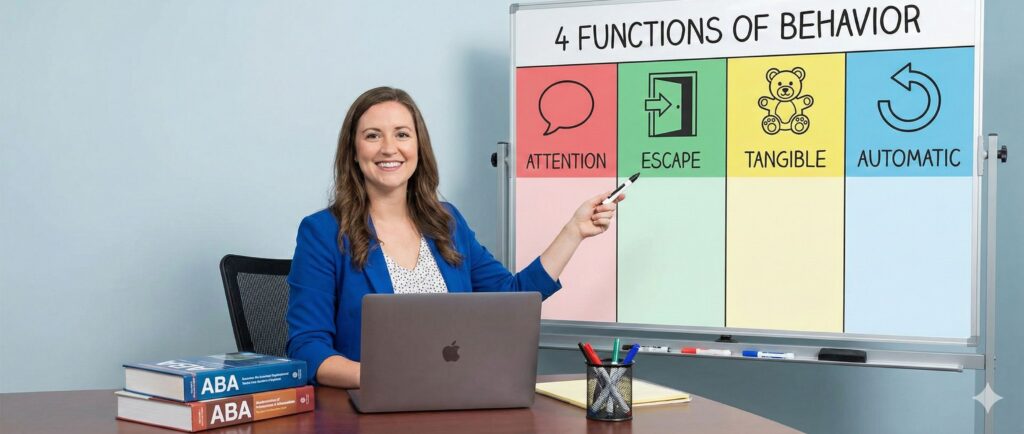
Using the 4 Functions of Behavior to Analyze BCBA® Exam Scenarios Step by Step
By BCBA Mock Exam
Introduction
If you’re preparing for the BCBA® exam, you already know that functions of behavior are everywhere:
-
In task list items
-
In mock exams
-
In real clinical decision-making
But on the exam, the challenge isn’t just memorizing “attention, escape, tangibles, automatic”—it’s being able to read a long scenario and quickly figure out which function (or functions) are most likely.
This article will walk you through a step-by-step way to analyze BCBA® exam stems using the 4 functions of behavior so you don’t get lost in the story details.
We’ll cover:
-
A quick review of the 4 functions
-
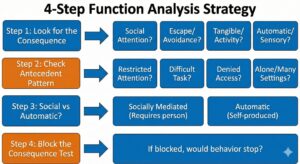
A simple 4-step reading strategy for exam scenarios
-
Realistic examples that look like test questions
-
Common traps (like confusing escape with automatic)
-
Mini practice questions with explanations
1. Quick Review: The 4 Functions of Behavior
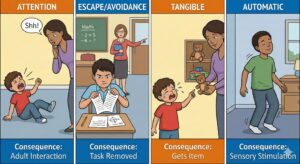
On the exam (and in real life), nearly all operant behaviors are maintained by one or more of these four functions:
-
Attention
-
Behavior produces social interaction (positive or negative): talking, scolding, eye contact, comfort, laughter.
-
Example: A child shouts jokes during circle time and peers laugh.
-
-
Escape / Avoidance
-
Behavior postpones, reduces, or ends demands or other aversive situations.
-
Example: A student rips up worksheets and is sent to the hallway.
-
-
Access to Tangibles / Activities
-
Behavior produces preferred items or activities.
-
Example: A child screams at the store and gets candy.
-
-
Automatic (Sensory) Reinforcement
-
Behavior is reinforced by stimulation produced by the behavior itself, not socially mediated.
-
Example: A child hand-flaps alone in bed even when no one responds.
-
Exam tip: Many stems include multiple functions. The exam often wants you to identify the most likely function based on the strongest pattern of consequences.
2. Step 1 – Ignore the Story (At First) and Find the Consequence
When you first read an exam scenario, it’s easy to get pulled into diagnoses, labels, or emotional descriptions. Instead, train yourself to look for one thing first:
👉 What consistently happens right after the behavior?
Ask:
-
Does the learner get attention (even scolding or lectures)?
-
Are demands removed, delayed, or reduced?
-
Does the learner gain access to items or activities?
-
Does the behavior occur even when no one is around or no one responds?
Make a very quick note in your head or margin: A, E, T, or Auto.
This “consequence-first” habit helps you avoid being distracted by extra details.
3. Step 2 – Check the Antecedent Pattern
Next, look at what tends to happen right before the behavior.
Ask:
-
Does the behavior occur mostly when attention is restricted (caregiver on the phone, teacher helping another student)?
-
Does it show up during difficult tasks, transitions, or nonpreferred activities (worksheet, writing, chores)?
-
Does it happen most often when the learner is denied access to something (tablet removed, store aisle with toys, sibling has the toy)?
-
Does it occur across many settings and activities, including times with no clear demands or people present?
Antecedent clues help you confirm (or question) your first guess about function. For example:
-
Problem behavior during work + escape from work afterward → likely escape.
-
Problem behavior mainly when denied items + items delivered afterward → likely tangible.
Antecedents plus consequences give you a functional pattern, not just a single event.
4. Step 3 – Look for Automatic vs Social Mediation
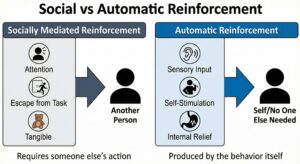
The exam often tests whether you can distinguish automatic reinforcement from socially mediated functions.
Ask yourself:
-
Is another person required for the consequence to occur?
-
If yes → likely attention, escape, or tangible.
-
If no (behavior persists when alone) → consider automatic.
-
-
Does the behavior occur:
-
When the learner is alone or not being observed?
-
Across many settings, not tied to specific people or tasks?
-
Even when it seems to produce no clear social consequence?
-
Automatic reinforcement is especially common for:
-
Stereotypy (hand-flapping, rocking)
-
Self-stimulation (humming, body-focused behaviors)
-
Some forms of self-injury (e.g., head-banging alone in bed)
Exam tip: If a stem clearly states that behavior occurs “in the absence of social consequences” or “even when the client is alone,” the exam is often pointing you toward automatic reinforcement.
5. Step 4 – Ask: What Would Happen If We Blocked One Consequence?
When stems are ambiguous, imagine changing the environment:
👉 If I blocked or removed one consequence consistently, what would likely happen?
Examples:
-
If I stop giving attention to the behavior but it still happens at the same rate, attention is probably not the main function.
-
If I prevent escape (tasks continue with support and breaks only for appropriate behavior) and problem behavior drops, then escape was likely maintaining it.
This mental experiment mirrors functional analysis logic (test vs control conditions) and can guide your answer when stems describe partial FA data or treatment outcomes.
6. Putting It Together: A Simple 4 Functions of Behavior Flow
Here’s a quick mental checklist when you read any problem behavior scenario on the exam:
1️⃣ What happens right after the behavior?
-
Social attention? → attention
-
Demands removed or postponed? → escape
-
Items/activities given or returned? → tangible
-
Nothing obvious, happens when alone too? → automatic
2️⃣ When does it usually occur?
-
During tasks or transitions? → escape
-
When denied, delayed, or interrupted access? → tangible
-
When others are busy or attention is not on learner? → attention
-
Across many situations, including alone? → automatic
3️⃣ Is someone else required to deliver the consequence?
-
Yes → attention, escape, or tangible
-
No → automatic more likely
4️⃣ What would happen if that consequence stopped?
-
If behavior would likely stop without that consequence, it’s probably the main function.
Use this flow repeatedly with practice questions until it feels automatic.
7. Example Walkthrough 1 – Attention vs Tangible
Scenario: During math centers, a student frequently calls out, “This is boring!” and throws pencils. Each time this happens, the teacher walks over, tells the student to calm down, and talks with them briefly about “making good choices.” Sometimes, to keep the peace, the teacher also lets the student switch to a preferred computer activity earlier than scheduled.
Step-by-step analysis:
-
Consequences:
-
Teacher attention (talking, proximity).
-
Occasional access to a preferred activity (tangible).
-
-
Antecedent:
-
Occurs during math centers, likely a nonpreferred or difficult task.
-
-
Social vs automatic:
-
Behavior clearly produces a social response and a change in activities.
-
-
Most likely function (for exam purposes):
-
If the pattern shows attention every time and the preferred activity only sometimes, exam questions will often point you toward attention as the primary function.
-
If the stem emphasizes “gets out of math” and “spends time on the computer instead,” escape to a preferred activity or tangible may be the better answer.
-
On the exam, look at which consequence is most consistent and clearly described as following the behavior.
8. Example Walkthrough 2 – Escape vs Automatic
Scenario: A teenager engages in loud humming and rocking in their chair during class and at home. The behavior occurs:
-
During difficult assignments
-
While watching TV alone
-
Late at night in bed with the lights off Teachers sometimes ask the teen to stop, but the behavior continues whether or not anyone responds.
Step-by-step analysis:
-
Consequences:
-
Sometimes gets teacher attention (prompts to stop), but behavior does not appear to depend on this.
-
No clear consistent social consequence.
-
-
Antecedents:
-
Occurs in many contexts: class, home, alone in bed.
-
-
Social vs automatic:
-
Behavior happens even when alone, and attention does not reliably change it.
-
-
Most likely function:
-
Automatic reinforcement (sensory).
-
Exam tip: When behavior persists across settings and in the absence of social consequences, automatic reinforcement is usually your best answer.
9. Common BCBA® Exam Traps When Using the 4 Functions
Trap 1 – Focusing on what adults “meant” to do
-
The function is about what actually happens, not intentions.
-
If yelling was meant as punishment but actually keeps the behavior going, the function is attention, not punishment.
Trap 2 – Ignoring the pattern across time
-
Don’t base your answer on a single event.
-
Look for repeated sequences: A → B → C happening again and again.
Trap 3 – Confusing attention with escape
-
If the behavior leads to the adult talking a lot while the work stops, you may have both attention and escape.
-
The exam will usually highlight one more clearly—pay attention to phrases like “work was postponed” or “the task was removed.”
Trap 4 – Assuming automatic just because behavior looks “sensory”
-
Rocking, flapping, or vocal stereotypy can be automatic—but if the stem shows that it only happens when adults respond a certain way, it might actually be attention-maintained.
Trap 5 – Forgetting multiple functions
-
The exam sometimes acknowledges multiple functions.
-
If an answer choice states “most likely maintained by multiple functions,” and the stem clearly supports that, it may be the best one.
10. Mini BCBA® Exam–Style Questions (With Explanations)
Question 1 – What’s the Most Likely Function? Whenever a teacher gives a worksheet, a student crumples it and throws it on the floor. The teacher usually sighs, says, “Fine, I’ll help you later,” and moves on to other students. The student then sits quietly and doodles.
What is the MOST likely function of the student’s behavior? A. Attention B. Escape from academic demands C. Access to tangibles D. Automatic reinforcement
Correct Answer: B – Escape from academic demands Explanation: The behavior consistently results in removal/postponement of the worksheet, which is an escape consequence.
Question 2 – Automatic or Attention? A child spins in circles and hums quietly in the corner of the playground. This occurs when adults are talking to each other and not interacting with the child. When a teacher walks over and asks the child to come play, the spinning stops briefly and then resumes after the teacher leaves.
What is the MOST likely function of the spinning? A. Attention B. Escape C. Tangible D. Automatic reinforcement
Correct Answer: D – Automatic reinforcement Explanation: The behavior occurs without social consequences and continues regardless of teacher interaction, suggesting automatic reinforcement.
Question 3 – Tangible or Attention? A caregiver reports that when a tablet is put away at night, the child screams, cries, and hits the couch. The caregiver often gives the tablet back for “five more minutes” to help the child calm down. Over time, these episodes become more frequent and intense.
What is the MOST likely function of the problem behavior? A. Attention B. Escape C. Tangible (access to the tablet) D. Automatic reinforcement
Correct Answer: C – Tangible Explanation: The behavior reliably results in regaining access to the tablet, a preferred item.
Question 4 – Multiple Functions A child runs out of the classroom during independent work. When this happens, the teacher and aide follow, talk with the child, and allow a short break outside the room before returning. Data show the child rarely runs during group games or recess.
What is the BEST description of the likely function(s) of running away? A. Primarily attention-maintained only B. Primarily escape-maintained only C. Likely both escape from work and access to adult attention D. Automatic reinforcement
Correct Answer: C – Both escape from work and access to adult attention Explanation: The behavior consistently leads to escape from independent work and intense adult attention. The pattern suggests multiple functions.
11. Key Takeaways
-
The 4 functions—attention, escape, tangibles, automatic—are a core lens for reading BCBA® exam scenarios.
-
Start by focusing on what consistently happens after the behavior, then confirm with antecedent patterns.
-
Distinguish automatic from social functions by asking whether another person is needed for the consequence.
-
Use a step-by-step checklist to avoid being distracted by nonfunctional details in long stems.
-
Remember that real behavior (and exam questions) can involve multiple functions, but there is usually enough information to identify the most likely function or functions.
With practice, using the 4 functions becomes an automatic part of how you read exam questions—and how you think about behavior in everyday clinical work.