

What Is an Acquisition Task? A Clear Guide for BCBA® Exam Prep
By BCBA Mock Exam
Acquisition tasks are one of the most fundamental yet often misunderstood concepts in Applied Behavior Analysis. If you are preparing for the BCBA® exam, you will encounter acquisition tasks across domains such as discrete trial training, verbal behavior, task analysis, and natural environment teaching. Understanding what an acquisition task is and what it is notis essential for both the exam and real-world application.
This guide breaks down the definition, function, common examples, teaching methods, and BCBA® exam implications of acquisition tasks using simple, test-aligned language.
Definition of Acquisition Task
An acquisition task refers to any instructional goal targeting a behavior that the learner does not yet perform independently or consistently. The purpose of an acquisition task is to teach a new skill or response through structured and planned instruction.
In behavior-analytic terms:
An acquisition task is a teaching objective designed to increase a specific behavior that is currently not part of the learner’s functional skill set.
This may include basic communication, self-help routines, academic responses, or complex social behaviors. Acquisition tasks differ from maintenance tasks because they involve active skill-building rather than generalization or fluency of previously mastered responses.
You can explore a professional glossary explanation of acquisition tasks at:
https://leafwingcenter.org/acquisition-task/
Core Components of an Acquisition Task
Every well-designed acquisition task is embedded within a larger Skill Acquisition Plan (SAP). A complete acquisition program typically includes:
- A clearly defined target behavior that is observable and measurable
- A teaching procedure (e.g., discrete trials, NET, chaining)
- A prompting and fading strategy
- A reinforcement plan
- Mastery criteria
- A plan for generalization and maintenance
This structure ensures consistency across implementers and sessions, and aligns the intervention with ethical best practices and the official BACB® Task List.
Reference: https://www.bacb.com/bcba/
Examples of Acquisition Tasks
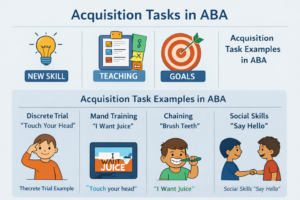
Acquisition tasks appear in every area of ABA practice. Below are examples across domains:
Discrete Trial Instruction
Target: Learner will tact body parts when asked (e.g., “Touch your head”)
Procedure: Therapist presents SD, learner responds, correct responses receive tokens
Mastery: 80 percent independent accuracy across three sessions
Mand Training
Target: Learner requests preferred item using a vocal mand or AAC device
Procedure: Use MO to evoke request, reinforce immediately with access
Mastery: Five independent mands per session over five days
Daily Living Skills
Target: Learner brushes teeth using a five-step visual sequence
Procedure: Total task chaining with gestural prompts
Mastery: Performs all five steps with no more than one prompt per session
Social Skills
Target: Learner initiates greetings with peers in classroom settings
Procedure: Natural environment teaching with embedded reinforcement
Mastery: Four independent initiations across two settings
Each of these examples focuses on teaching a new, non-mastered behavior with clear reinforcement and success criteria.
For more real-world examples of acquisition task implementation, visit:
https://www.connectncareaba.com/blog/skill-acquisition-program-aba-examples
Acquisition Tasks vs Maintenance Tasks
This distinction is frequently tested on the BCBA® exam. Acquisition tasks involve skills the learner is acquiring. Maintenance tasks involve previously mastered skills that are being practiced or generalized.
Example of acquisition: Teaching a child to ask for help using a communication device.
Example of maintenance: Practicing greetings with familiar peers during recess.
On the exam, you will often be asked to determine whether the behavior being targeted is part of acquisition or maintenance. Look for phrases such as “not yet mastered,” “emerging skill,” or “newly introduced” to identify acquisition tasks.
How Acquisition Tasks Appear on the BCBA® Exam
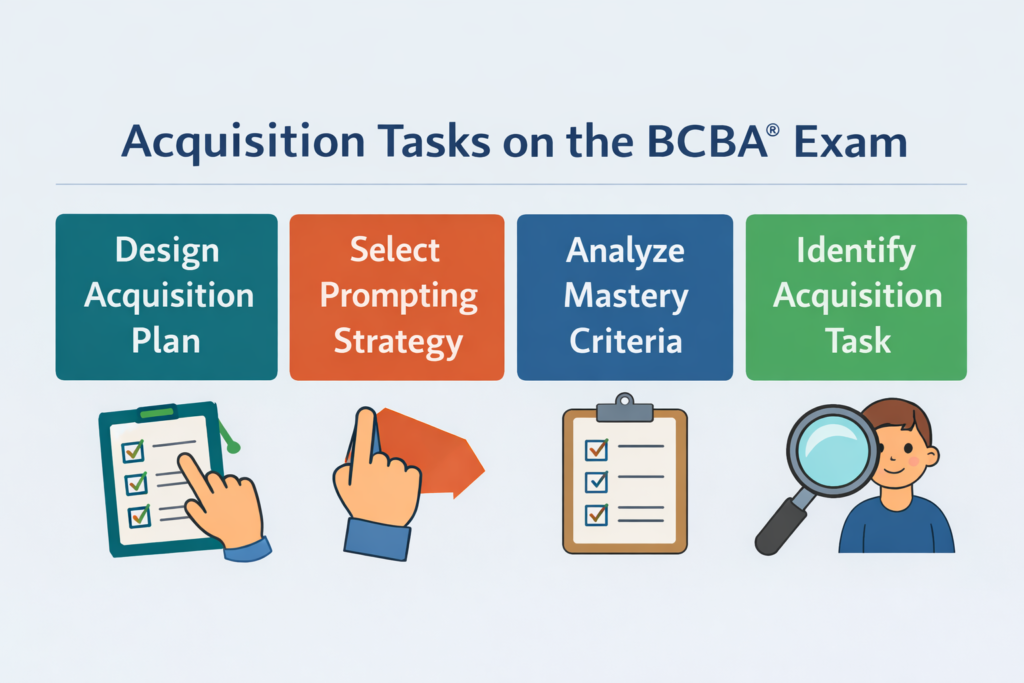
The BCBA® exam assesses acquisition task knowledge through multiple formats:
- Discrete trial and NET program design questions
- Prompting and fading scenario analysis
- Reinforcement plan development
- Task analysis and chaining application
- Mastery criteria evaluation
A common exam stem may ask:
“A learner is receiving instruction on matching identical objects. The behavior has not been observed in the natural environment. Which best describes this program?”
Correct response: An acquisition task.
You can read a comprehensive overview of skill acquisition in ABA and how it applies to program design and the BCBA® exam at:
https://www.behavioressentials.com/skill-acquisition-aba
Teaching Methods for Acquisition Tasks
Various evidence-based procedures support the acquisition of new skills. Your selection depends on the learner’s needs, the type of skill, and the teaching environment.
- Discrete Trial Training (DTT): Highly structured teaching of isolated skills using SD-response-consequence format
Learn more: https://en.wikipedia.org/wiki/Discrete_trial_training - Natural Environment Teaching (NET): Learner-initiated instruction embedded within typical routines
- Incidental Teaching: Instruction that capitalizes on naturally occurring opportunities
- Task Analysis and Chaining: Teaching multi-step functional skills through forward, backward, or total task chaining
- Shaping: Reinforcing successive approximations of the target behavior
Each of these methods aligns with the core elements of an acquisition task: structure, reinforcement, and progressive mastery.
Study Guide: Acquisition Tasks and the Task List
To ensure success on the BCBA® exam, you should be able to:
- Define acquisition tasks in your own words
- Distinguish acquisition from maintenance and generalization
- Identify acquisition strategies used in various settings
- Recognize when reinforcement is used to support skill development
- Understand how to set mastery criteria and fade prompts over time
- Analyze exam scenarios that involve teaching new skills
- Explain how acquisition tasks relate to reinforcement and prompting domains
If you want a broader foundation before studying acquisition tasks, review our article on Positive Reinforcement in ABA:
https://bcbamockexam.com/positive-reinforcement-aba/
And for deeper reinforcement-based strategies used during acquisition, visit:
https://bcbamockexam.com/differential-reinforcement-aba/
For structured practice, you can download our full BCBA® study guide here:
https://bcbamockexam.com/bcba-mock-exam-study-guide/
Final Thoughts
Acquisition tasks form the backbone of effective teaching in ABA. They represent intentional, evidence-based instructional goals focused on increasing new behaviors that support learner independence. Whether you are planning treatment or preparing for the BCBA® exam, mastering the concept of acquisition tasks helps you deliver meaningful instruction and answer Task List questions with precision.
When in doubt, return to this core question:
Is the learner acquiring a new behavior that is not yet independent or fluent?
If the answer is yes, you are working with an acquisition task.
To explore more examples and receive downloadable tools, visit:
https://bcbamockexam.com/bcba-mock-exam-study-guide/


