

A verbal prompt is one of the most frequently used teaching tools in applied behavior analysis, yet it’s often misunderstood or misapplied. This guide will clarify exactly what constitutes a verbal prompt in ABA, provide concrete examples you’ll encounter in practice, and prepare you for how this concept appears on the BCBA exam. Understanding the precise definition and ethical application of verbal prompts is crucial for both effective intervention and exam success.
Table of Contents
- verbal prompt ABA: Defining the Verbal Prompt in ABA
- Verbal Prompts in Practice: Worked Examples
- Verbal Prompts on the BCBA Exam
- Implementation and Fading Checklist
- Key Takeaways for Your Study
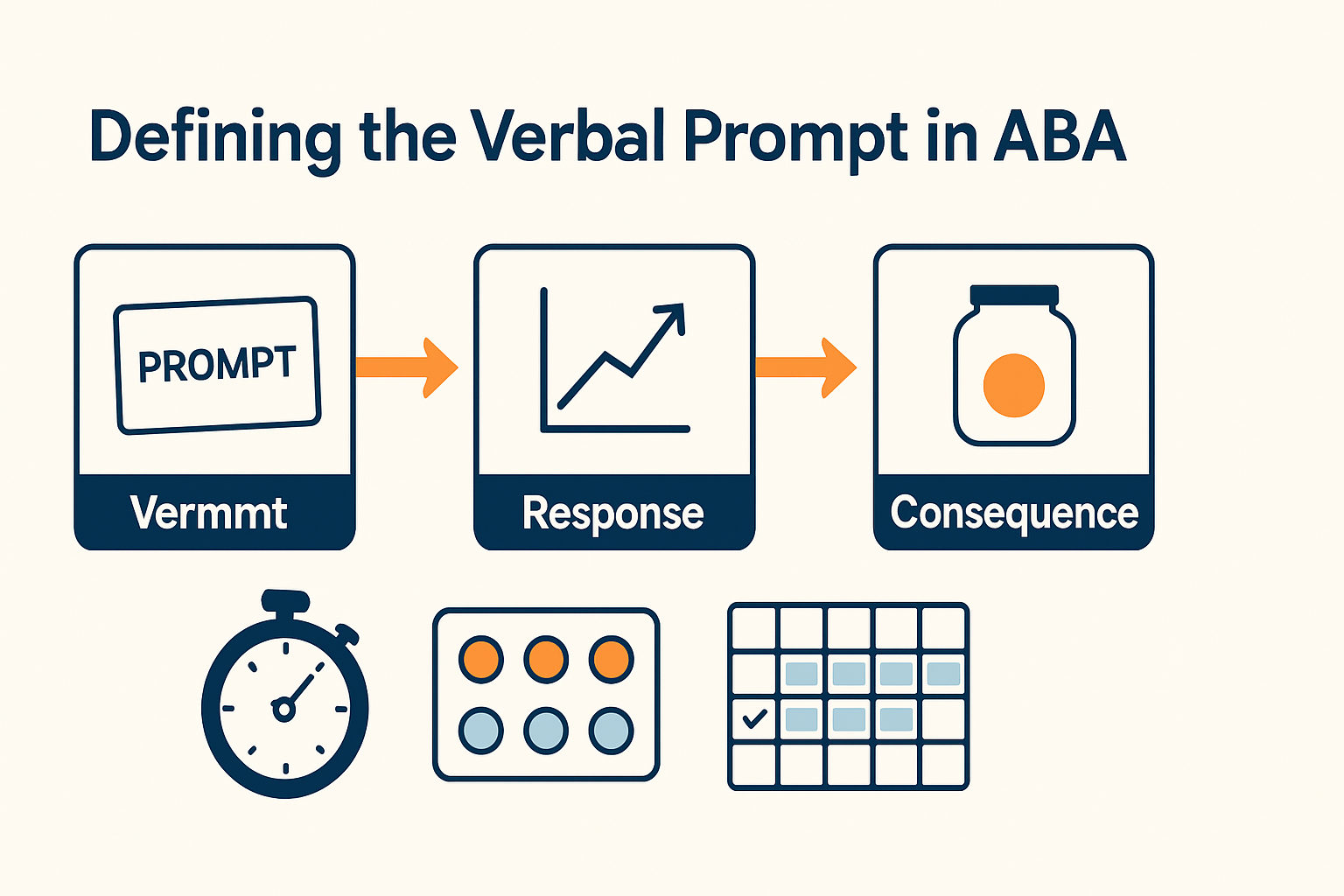
verbal prompt ABA: Defining the Verbal Prompt in ABA
At its core, a verbal prompt is an auditory antecedent that directly suggests the correct response. Unlike general instructions or discriminative stimuli, a verbal prompt provides specific information about what to do or say.
What Exactly is a Verbal Prompt?
A verbal prompt delivers auditory information that guides the learner toward the target behavior. It’s classified as a response prompt rather than a stimulus prompt because it directly assists with the response itself. The key distinction lies in its specificity—while an SD signals that reinforcement is available, a verbal prompt tells the learner exactly how to respond.
For example, saying ‘Put the red block here’ during a sorting task provides direct guidance, whereas ‘Sort the blocks’ is a general instruction that may function as an SD. This distinction matters greatly for both teaching effectiveness and exam questions.
Verbal Prompts vs. Other Prompt Types
Understanding how verbal prompts differ from other prompt types helps prevent confusion in both practice and exam scenarios:
- Verbal prompts provide auditory information (e.g., ‘Say hello’)
- Gestural prompts use visual cues like pointing or nodding
- Model prompts demonstrate the correct response
- Physical prompts involve physical guidance or touch
- Positional prompts arrange materials to cue the response
The critical differentiator is that verbal prompts rely on auditory information rather than visual or physical cues. This makes them particularly useful for teaching vocal responses but potentially problematic for non-verbal learners.
Verbal Prompts in Practice: Worked Examples
Seeing verbal prompts in action through concrete examples clarifies their application and potential pitfalls. Each example below follows the ABC framework to illustrate how prompts function within behavioral contingencies.
Example 1: Prompting a Social Initiation
Scenario: A child is playing alone during recess. The therapist wants to teach social initiation skills.
- Antecedent: Therapist says, ‘Say hi to your friend’
- Behavior: Child looks at peer and says ‘hi’
- Consequence: Peer smiles and says ‘hi’ back
The hypothesized function here is socially-mediated access to peer attention. For prompt fading, the therapist might later use a partial verbal prompt like ‘What do you say?’ This maintains the social context while reducing prompt dependency.
Example 2: Prompting a Self-Help Skill
Scenario: A teenager is learning to make a sandwich as part of daily living skills training.
- Antecedent: Parent says, ‘Next, put the turkey on the bread’
- Behavior: Teen places turkey slice on bread
- Consequence: Parent says ‘Great step!’ and the task advances
This example demonstrates verbal prompting within a task analysis chain. The function appears to be socially-mediated access to adult praise and task completion. Effective fading might involve moving to gestural prompts or reducing verbal specificity.
Example 3: The Ethical Pitfall – Over-Prompting
Scenario: An adult client with developmental disabilities is sorting mail into categories.
- Antecedent: Therapist repeatedly gives answers (‘That’s a bill, put it here’)
- Behavior: Client places items without looking at them
- Consequence: Task completes quickly with minimal effort
This illustrates prompt dependency and potential negative reinforcement. The client learns to wait for prompts rather than discriminate stimuli independently. This ethical concern directly relates to proper prompt fading procedures discussed in our prompt dependency guide.
Verbal Prompts on the BCBA Exam
The BCBA exam tests your understanding of verbal prompts through multiple question formats. Recognizing these patterns helps you approach questions strategically.
How the Exam Tests This Concept
Exam questions typically ask you to:
- Identify the type of prompt used in a scenario
- Select the most appropriate prompt for a given skill and learner
- Determine the next step in a prompt-fading sequence
- Identify ethical issues related to prompting procedures
These questions often integrate with other concepts like stimulus control and prompt fading hierarchies. Understanding the relationship between verbal prompts and other antecedent interventions is crucial.
Common Exam Traps and Misconceptions
Avoid these frequent errors that trip up candidates:
- Confusing a verbal prompt with an SD or rule
- Selecting verbal prompts for non-verbal learners when model or gestural prompts would be more appropriate
- Forgetting that prompt dependency is a primary ethical concern requiring systematic fading
- Misidentifying the prompt level within a hierarchy (most-to-least vs. least-to-most)
- Overlooking the importance of response latency in determining when to prompt
These traps often appear in questions that test your ability to apply concepts rather than just recall definitions. For more on avoiding common antecedent-related errors, see our antecedent exam traps guide.
Implementation and Fading Checklist
Use this actionable checklist for both exam scenarios and real-world application:
- Define the target behavior precisely before selecting prompts
- Choose prompt type based on learner characteristics and skill type
- Establish baseline to determine current skill level
- Select fading strategy (most-to-least or least-to-most) based on error tolerance
- Monitor prompt dependency through regular probe trials
- Adjust fading pace based on learner progress and error patterns
- Document procedures clearly for treatment integrity
- Evaluate social validity of prompting procedures with stakeholders
This systematic approach aligns with the seven dimensions of ABA and ensures ethical, effective intervention.
Key Takeaways for Your Study
Mastering verbal prompts requires understanding both conceptual definitions and practical applications. Remember these core points:
- Verbal prompts are auditory antecedents that directly suggest correct responses
- They differ from other prompts by providing specific auditory information
- Ethical use requires systematic prompt fading to avoid dependency
- Exam questions often integrate verbal prompts with stimulus control and prompt hierarchies
- Selection should consider learner characteristics and skill type
- Proper documentation and treatment integrity monitoring are essential
For authoritative guidance on prompting procedures, consult the BACB Ethics Code and research on effective prompting strategies. Understanding these concepts prepares you not only for exam success but for ethical, effective practice as a behavior analyst.


