
Understanding schedules of reinforcement is crucial for any behavior analyst, and the variable interval schedule represents one of the most practical yet frequently misunderstood concepts. This guide breaks down VI schedules with clear definitions, real-world applications, and essential exam strategies.
Table of Contents
- What is a Variable Interval Schedule?
- Variable Interval Schedules in Practice: ABA Examples
- Variable Interval on the BCBA Exam: What to Know
- Quick-Reference Checklist for Variable Interval
- Summary and Key Takeaways
- References
What is a Variable Interval Schedule?
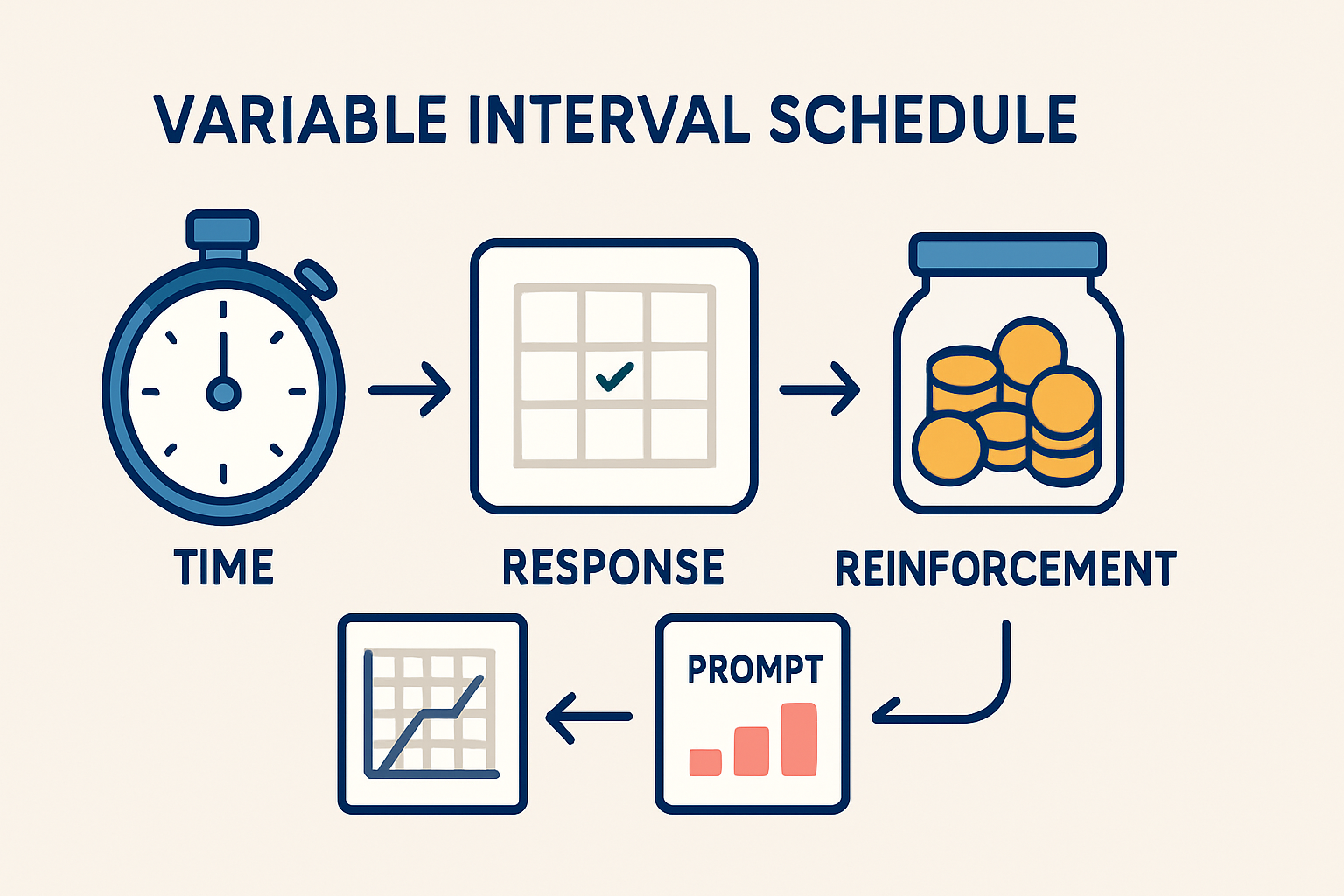
A variable interval schedule delivers reinforcement for the first response after an unpredictable amount of time has passed. The key components are time-based delivery and variability in the intervals between reinforcement opportunities.
The Core Definition and Formula
In a VI schedule, reinforcement becomes available after varying time intervals that average to a specific value. For example, VI-5min means reinforcement is delivered for the first response after intervals that average five minutes, but could be two minutes, eight minutes, or any other duration that averages to five.
The first response after criterion is essential—only the initial behavior following the interval’s completion earns reinforcement. This creates a steady, moderate response rate as learners cannot predict exactly when reinforcement will become available.
VI vs. FI: Spotting the Critical Difference
The primary distinction between variable interval and fixed interval schedules lies in predictability. FI schedules use consistent time intervals, while VI schedules use unpredictable intervals that average to a specific value.
- FI schedules produce a scalloped response pattern with pauses after reinforcement
- VI schedules generate steady, moderate responding throughout
- FI creates clock-watching behavior; VI prevents this predictability
- Both are time-based, but only VI maintains consistent performance
Variable Interval Schedules in Practice: ABA Examples
Real-world applications demonstrate how VI schedules create practical behavior change across different settings. These examples show the schedule’s versatility in clinical, educational, and workplace environments.
Example 1: Reducing Screen-Time Requests
A child repeatedly asks ‘Can I have the tablet?’ during homework time. The parent implements a VI-10min schedule where tablet access is granted for the first appropriate request after varying intervals averaging ten minutes.
- Antecedent: Child completes homework, parent present
- Behavior: Appropriate request for tablet access
- Consequence: Tablet granted on VI-10min schedule
- Function: Access to tangible/automatic reinforcement
- Expected pattern: Steady, moderate rate of appropriate requests
Example 2: Building On-Task Behavior in the Classroom
A student struggles with staying on-task during independent work. The teacher uses a VI-3min schedule to deliver praise or check-ins for on-task behavior, with intervals averaging three minutes but varying unpredictably.
- Antecedent: Independent work period begins
- Behavior: Student remains on-task with materials
- Consequence: Teacher praise/attention on VI-3min schedule
- Function: Access to adult attention/social reinforcement
- Key advantage: Prevents predictability and discourages clock-watching
This approach connects well with understanding positive reinforcement strategies in educational settings.
Example 3: Maintaining Workplace Safety Checks
Employees must complete safety observation logs but frequently forget. The supervisor implements a VI-2day schedule where positive feedback is provided for completed logs after varying intervals averaging two days.
- Antecedent: Safety log completion requirement
- Behavior: Employee submits completed safety log
- Consequence: Supervisor praise/recognition on VI-2day schedule
- Function: Access to social reinforcement/avoiding reprimand
- Notable feature: Creates resistance to extinction of safety behaviors
Variable Interval on the BCBA Exam: What to Know
Mastering VI schedules requires understanding both conceptual knowledge and practical application. The exam tests your ability to identify, apply, and analyze these schedules in various contexts.

How the BCBA Exam Tests VI Knowledge
Exam questions typically fall into three categories that require different analytical skills and conceptual understanding.
- Identification questions: Recognize VI from scenario descriptions
- Prediction questions: Forecast behavioral effects like response rate and pattern
- Application questions: Select VI for specific clinical goals like steady responding
- Analysis questions: Interpret data patterns from VI implementations
Common Exam Traps and How to Avoid Them
Several predictable errors trip up candidates on VI-related questions. Recognizing these traps improves your accuracy and confidence.
- VI vs. VR confusion: Remember VI is time-based; VR is response-based
- Missing ‘first response’ criterion: Reinforcement only for first response after interval
- Variable time schedule misidentification: VT delivers non-contingent reinforcement
- Average interval misunderstanding: Individual intervals vary around the average
For more on distinguishing reinforcement schedules, see our guide on compound vs simple schedules.
Quick-Reference Checklist for Variable Interval
Use this actionable summary for last-minute review and clinical decision-making. Each item represents a critical concept or application step.
- Verify time-based delivery: Reinforcement depends on elapsed time, not responses
- Check variability: Intervals must be unpredictable but average to specific value
- Confirm ‘first response’ rule: Only initial behavior after interval earns reinforcement
- Predict steady responding: VI produces moderate, consistent response rates
- Assess extinction resistance: Variable schedules create persistence
- Select appropriate goals: Use VI for maintaining behaviors, not acquisition
- Monitor implementation: Track intervals to ensure proper variability
Summary and Key Takeaways
Variable interval schedules represent a powerful tool for maintaining behaviors and creating steady response patterns. Their clinical utility stems from the unpredictable nature of reinforcement delivery.
The unpredictable timing prevents learners from developing scalloped response patterns or clock-watching behaviors. This makes VI particularly effective for maintaining already-established behaviors across various settings.
For exam success, focus on distinguishing VI from other interval and ratio schedules. Remember that VI produces steady moderate responding with good resistance to extinction, making it ideal for maintenance phases of behavior plans.
Clinical applications should consider the balance between predictability and reinforcement density. VI schedules work best when you want to maintain behavior while gradually thinning reinforcement schedules toward more natural maintaining contingencies.
For additional resources on reinforcement strategies, explore the BACB Task List 6th Edition guide for comprehensive exam preparation materials.


