
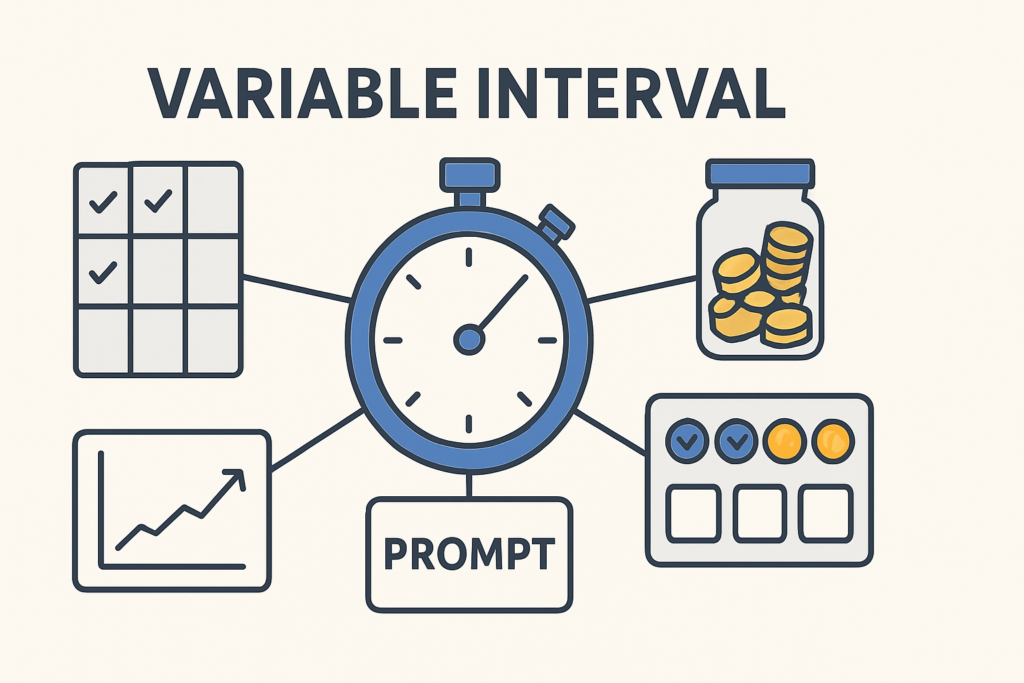
What is a Variable Interval Schedule?
A Variable Interval schedule (VI) is a type of reinforcement schedule where reinforcement is delivered for the first response after an unpredictable amount of time has passed. This schedule produces a steady, moderate rate of responding and is known for being resistant to extinction.
Table of Contents
- What is a Variable Interval Schedule?
- Variable Interval Schedule Examples in ABA Practice
- Variable Interval Schedules on the BCBA Exam
- Quick-Reference Checklist and Summary
The Defining Rule and Key Characteristics
The core rule of VI schedules is simple: reinforcement becomes available after variable time intervals, and only the first response after that interval is reinforced. The intervals vary around an average, creating unpredictability.
Key characteristics include:
- Time-based reinforcement: Reinforcement depends on time passing, not number of responses
- Unpredictable intervals: Time between reinforcement opportunities varies around an average
- Steady responding: Produces consistent, moderate response rates without post-reinforcement pauses
- Resistance to extinction: Behavior persists longer when reinforcement stops compared to fixed schedules
Variable Interval Schedule Examples in ABA Practice
Understanding VI schedules requires seeing them in action. These practical examples demonstrate how time-based reinforcement works in real settings.
Example 1: Reducing Screen-Time Requests
A parent implements a VI 5-minute schedule to manage their child’s tablet requests. The parent checks email at unpredictable intervals (averaging 5 minutes, ranging 2-8 minutes) and only responds to requests occurring after the interval has passed.
ABC Analysis:
- Antecedent: Variable time since last email check
- Behavior: Child requests tablet access
- Consequence: Access granted only if interval has passed
This creates paced requesting rather than constant nagging. The child learns to make requests steadily but not excessively, as reinforcement timing is unpredictable.
Example 2: Maintaining On-Task Behavior in a Classroom
A teacher uses a VI 3-minute schedule to deliver praise for on-task behavior. The teacher checks students’ work at variable intervals, creating a pop quiz effect that maintains consistent work habits.
ABC Analysis:
- Antecedent: Unpredictable time intervals
- Behavior: Student works independently
- Consequence: Teacher attention and praise
This approach is more effective than fixed schedules because students work steadily, knowing reinforcement could come at any time. For more on classroom applications, see our guide to Behavior Skills Training.
Example 3: Workplace Productivity
A manager walks by cubicles on a VI 15-minute schedule to offer assistance. Employees learn to work consistently, as help could arrive at any unpredictable time.
This demonstrates generalized conditioned reinforcement in action. The unpredictable availability of assistance maintains steady productivity without the post-reinforcement pauses seen with fixed schedules.
Variable Interval Schedules on the BCBA Exam
VI schedules appear frequently on the BCBA exam, often testing your ability to distinguish them from other reinforcement schedules. Understanding the time-based nature is crucial for accurate identification.
Common Exam Traps and How to Avoid Them
Several common traps can lead to incorrect answers on VI schedule questions:
- Confusing VI with VR: Remember VI is time-based, while Variable Ratio (VR) is response-based
- Mistaking ‘variable’ for ‘random’: VI has structured unpredictability around an average, not complete randomness
- Overlooking the ‘first response’ rule: Reinforcement only follows the first response after the interval
- Misidentifying real-world scenarios: Look for time-based, not response-based, reinforcement contingencies
Practice Recognizing VI in Question Stems
Exam questions often describe scenarios where reinforcement becomes available after unpredictable time intervals. Look for keywords like “after varying amounts of time,” “unpredictable timing,” or “average interval.”
For example: “A teacher checks student work at unpredictable times averaging 4 minutes. The student receives praise for on-task behavior when checked.” This clearly describes a VI 4-minute schedule.
Quick-Reference Checklist and Summary
Use this checklist to quickly identify VI schedules in practice and on exams.
VI Schedule Self-Check
- Is reinforcement time-based rather than response-based?
- Are intervals unpredictable but averaged around a specific time?
- Is reinforcement delivered for the first response after the interval?
- Does the behavior pattern show steady, moderate responding?
- Is the schedule resistant to extinction compared to fixed schedules?
Key Takeaways for Your Study Notes
Variable Interval schedules reinforce the first response after unpredictable time intervals. They produce steady response rates and are highly resistant to extinction. These schedules are ideal for maintaining established behaviors where consistent performance is desired.
On the BCBA exam, focus on distinguishing VI from other schedules by remembering its time-based nature. For more reinforcement schedule comparisons, see our guide to Compound vs Simple Schedules.
Understanding VI schedules is essential for both exam success and effective practice. The BACB Ethics Code emphasizes using evidence-based procedures, and VI schedules represent a well-established reinforcement strategy. For authoritative information, refer to the BACB Ethics Codes and peer-reviewed literature on reinforcement schedules.


