

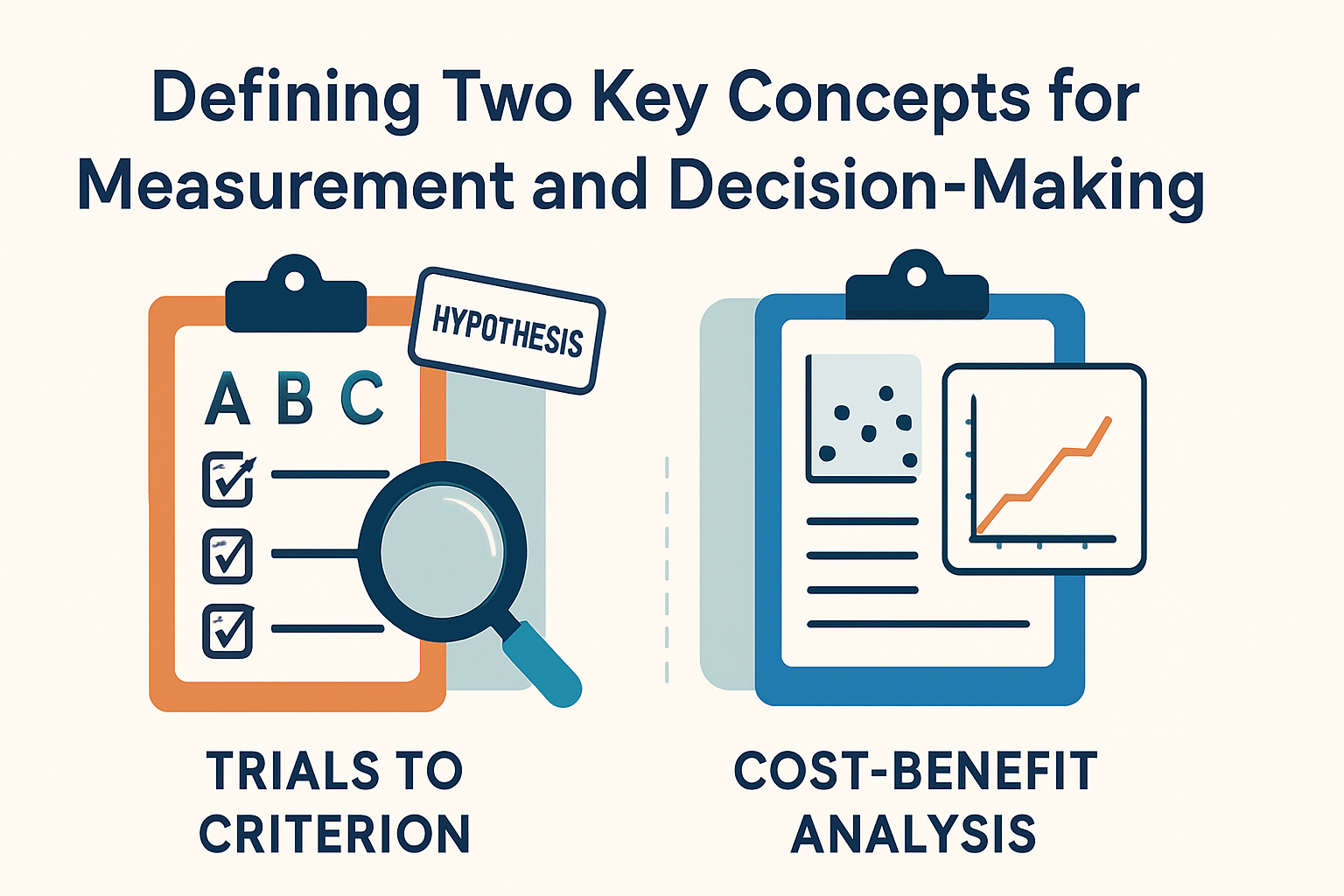
Trials to Criterion and Cost-Benefit Analysis: Defining Two Key Concepts for Measurement a
Two essential analytical tools in applied behavior analysis serve different but complementary purposes in clinical practice. Understanding when and how to apply each concept is crucial for both effective intervention and BCBA exam success.
Table of Contents
- Trials to Criterion and Cost-Benefit Analysis: Defining Two Key Concepts for Measurement a
- Applied Examples: From Data Collection to Clinical Decision
- BCBA Exam Focus: Recognizing and Applying the Concepts
- Quick-Reference Study Checklist
- Summary and Key Takeaways
What is Trials to Criterion?
Trials to criterion is a measurement strategy that counts the number of practice attempts needed for a learner to reach a pre-set performance level. This approach assesses skill acquisition efficiency and helps determine when a skill has reached mastery. Unlike percentage-based measures, trials to criterion specifically tracks how quickly a learner achieves fluency with minimal errors.
The criterion is typically defined as a specific performance standard, such as independent correct responses across multiple sessions or settings. This measurement provides valuable data about the learning rate and helps clinicians make data-driven decisions about when to move to maintenance or generalization phases.
What is Cost-Benefit Analysis?
Cost-benefit analysis is an evaluative framework for comparing the resources required against the potential outcomes of an intervention. In ABA practice, this systematic approach helps clinicians select the most appropriate intervention by weighing various factors before implementation.
The analysis considers both tangible and intangible factors, including staff training time, material costs, response effort, potential risks, and expected benefits like behavior reduction or skill acquisition. This decision-making tool ensures that chosen interventions are not only effective but also practical and sustainable in real-world settings.
Applied Examples: From Data Collection to Clinical Decision
Moving from theory to practice, these examples demonstrate how each concept operates in actual ABA programming scenarios.
Example 1: Teaching Manding with Trials to Criterion
Consider a learner with limited vocal mands who needs to request preferred items. The target behavior is saying ‘cookie’ when presented with the item and given the instruction ‘What do you want?’
The mastery criterion is set at: independent mand across 3 different people in 2 different settings for 3 consecutive sessions. Data collection tracks:
- Session 1: 12 trials to first independent response
- Session 2: 8 trials to independent response
- Session 3: 4 trials to independent response
- Session 4: 2 trials to independent response across all conditions
This decreasing trials count shows improving efficiency, indicating the skill is being acquired effectively. When the criterion is met, the clinician can confidently move to maintenance programming.
Example 2: Conducting a Cost-Benefit Analysis for a Behavior Intervention Plan
A child engages in elopement behavior in the classroom. Two potential interventions are being considered:
- Option A: Functional Communication Training (FCT) combined with blocking
- Option B: Noncontingent Reinforcement (NCR) with enriched environment
The cost-benefit analysis examines:
- Cost factors: Staff training requirements, material preparation time, ongoing supervision needs, potential disruption to classroom routine
- Benefit factors: Expected reduction rate, skill acquisition potential, generalization likelihood, caregiver satisfaction, long-term maintenance
After systematic comparison, Option A might be selected if it offers better long-term outcomes despite higher initial training costs, while Option B could be chosen if immediate reduction is critical with available resources.
When to Use Which Tool: A Side-by-Side Comparison
Understanding the appropriate application context for each concept prevents misuse in clinical practice and on the BCBA exam.
- Trials to Criterion: Used AFTER starting teaching to measure progress toward mastery. Focuses on skill acquisition efficiency and determines when to advance programming.
- Cost-Benefit Analysis: Used BEFORE choosing an intervention to compare options. Focuses on resource allocation and practical implementation considerations.
- Timing difference: Trials to criterion is ongoing measurement; cost-benefit is pre-intervention planning.
- Purpose distinction: One measures learning efficiency; the other evaluates intervention feasibility.
BCBA Exam Focus: Recognizing and Applying the Concepts
Exam questions often test your ability to distinguish between these concepts and apply them appropriately in various scenarios.
Common Exam Traps and Distractors
Several common misunderstandings can lead to incorrect answers on BCBA exam questions:
- Confusing trials to criterion with percentage of correct responses or rate measures
- Mistaking cost-benefit analysis for purely financial considerations rather than comprehensive resource evaluation
- Applying cost-benefit analysis as a post-hoc evaluation rather than a pre-implementation decision tool
- Overlooking that trials to criterion specifically measures acquisition efficiency, not just mastery achievement
- Failing to recognize keywords like ‘efficiency,’ ‘compare resources,’ or ‘before implementing’ that signal which concept applies
Sample Practice Scenarios
Test your understanding with these exam-style vignettes:
Scenario 1: A BCBA is tracking how many teaching trials it takes for a learner to independently tie shoes across three consecutive sessions. Which measurement strategy is being used?
Scenario 2: Before implementing a new self-monitoring system, a behavior analyst compares the staff training requirements, material costs, and expected outcomes of two different approaches. Which analytical framework is being applied?
Scenario 3: A clinician wants to determine which of three prompting strategies will be most practical given current staffing constraints and client needs. Should they use trials to criterion or cost-benefit analysis?
Answers: 1) Trials to criterion, 2) Cost-benefit analysis, 3) Cost-benefit analysis (pre-implementation decision).
Quick-Reference Study Checklist
Use this checklist to reinforce your understanding and prepare for exam questions:
- ✓ Define trials to criterion as counting practice attempts to reach mastery
- ✓ Recognize trials to criterion measures skill acquisition efficiency
- ✓ Identify cost-benefit analysis as comparing resources vs. outcomes BEFORE implementation
- ✓ Remember cost-benefit includes both tangible and intangible factors
- ✓ Practice distinguishing exam keywords: ‘efficiency’ vs. ‘compare options’
- ✓ Review examples of each concept in different clinical scenarios
- ✓ Test yourself with mixed practice questions to avoid confusion
Summary and Key Takeaways
Mastering trials to criterion and cost-benefit analysis requires understanding their distinct purposes in ABA practice. Trials to criterion provides valuable data about learning efficiency and helps determine when skills are ready for advancement. Cost-benefit analysis offers a systematic framework for making informed intervention choices based on practical considerations.
For BCBA exam preparation, focus on recognizing the contextual cues that indicate which concept applies. Remember that trials to criterion is about measurement during teaching, while cost-benefit analysis is about decision-making before implementation. Both concepts reflect the data-driven, systematic approach that characterizes effective applied behavior analysis.
For more information on related measurement concepts, see our guide on data collection methods in ABA. To understand how these concepts fit within the broader framework of behavior analysis, explore the seven dimensions of ABA. For authoritative information on behavior analysis standards, refer to the Behavior Analyst Certification Board website.


