
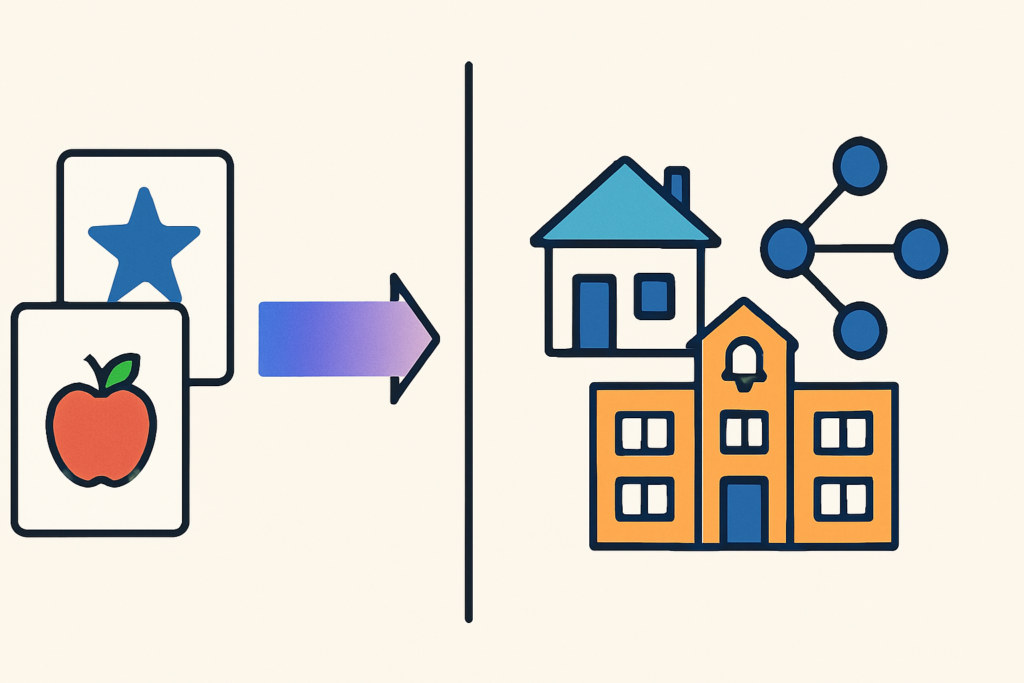
Transferring stimulus control is a fundamental skill acquisition procedure in applied behavior analysis. This process involves shifting control of a behavior from artificial prompts to natural environmental cues. For BCBA candidates, understanding this concept is essential for both clinical practice and exam success.
Table of Contents
- What is Transferring Stimulus Control?
- Key Procedures for Transferring Control
- Transferring Stimulus Control in Action: ABA Examples
- BCBA Exam Focus and Common Traps
- Quick-Reference Implementation Checklist
- Summary and Key Takeaways
What is Transferring Stimulus Control?
In ABA, transferring stimulus control refers to systematically moving control of a target behavior from temporary prompts to the natural discriminative stimulus (Sd). This aligns with Section G-9 of the BCBA Task List, which covers stimulus control procedures. The procedure ensures that learners respond appropriately to environmental cues without artificial support.
The Goal: From Prompt to Natural Cue
The primary objective is to transition from artificial prompts like verbal instructions or physical guidance to the natural Sd that should evoke the behavior. This differs from stimulus generalization, which involves responding to novel but similar stimuli. Transferring control focuses specifically on moving from prompts to the intended Sd.
Consider this distinction: When teaching a child to wash hands, we might start with a verbal prompt (‘Wash your hands’). The goal is to transfer control to the natural cue of dirty hands or before-meal routines.
Key Procedures for Transferring Control
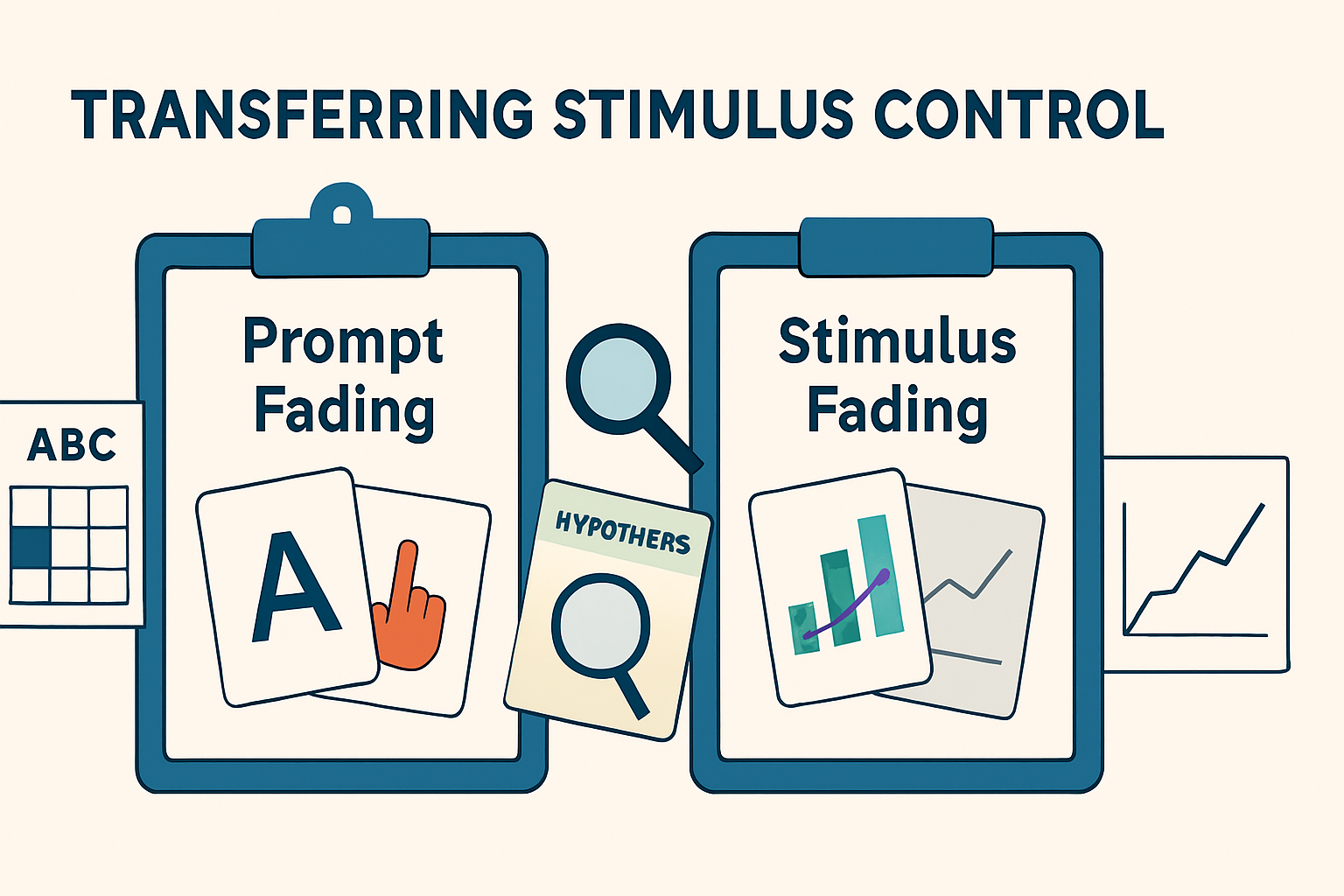
Several evidence-based methods facilitate transferring stimulus control. Each approach has specific applications based on learner needs and target skills.
Most-to-Least vs. Least-to-Most Prompt Fading
These two fading strategies represent different approaches to transferring control:
- Most-to-least prompting begins with the most intrusive prompt needed for correct responding, then systematically reduces prompt intensity. This approach supports errorless learning and is ideal for new or complex skills.
- Least-to-most prompting starts with minimal assistance, increasing only if errors occur. This builds independence and problem-solving skills, suitable for learners with some existing skill components.
Selection factors include learner history, error tolerance, and the skill’s complexity. Most-to-least often works better for acquisition tasks, while least-to-most may suit maintenance or generalization phases.
Using Time Delay Procedures
Time delay inserts a pause between the Sd and prompt, encouraging independent responding. Two main types exist:
- Constant time delay maintains a fixed interval (e.g., always 3 seconds) between Sd presentation and prompt delivery.
- Progressive time delay gradually increases the delay interval across trials or sessions, systematically transferring control.
Both methods teach learners to respond during the delay period, effectively transferring control from the prompt to the natural Sd.
Transferring Stimulus Control in Action: ABA Examples
Real-world examples illustrate how these procedures work in practice. Each scenario includes ABC analysis and functional considerations.
Example 1: Teaching a Child to Hang a Coat
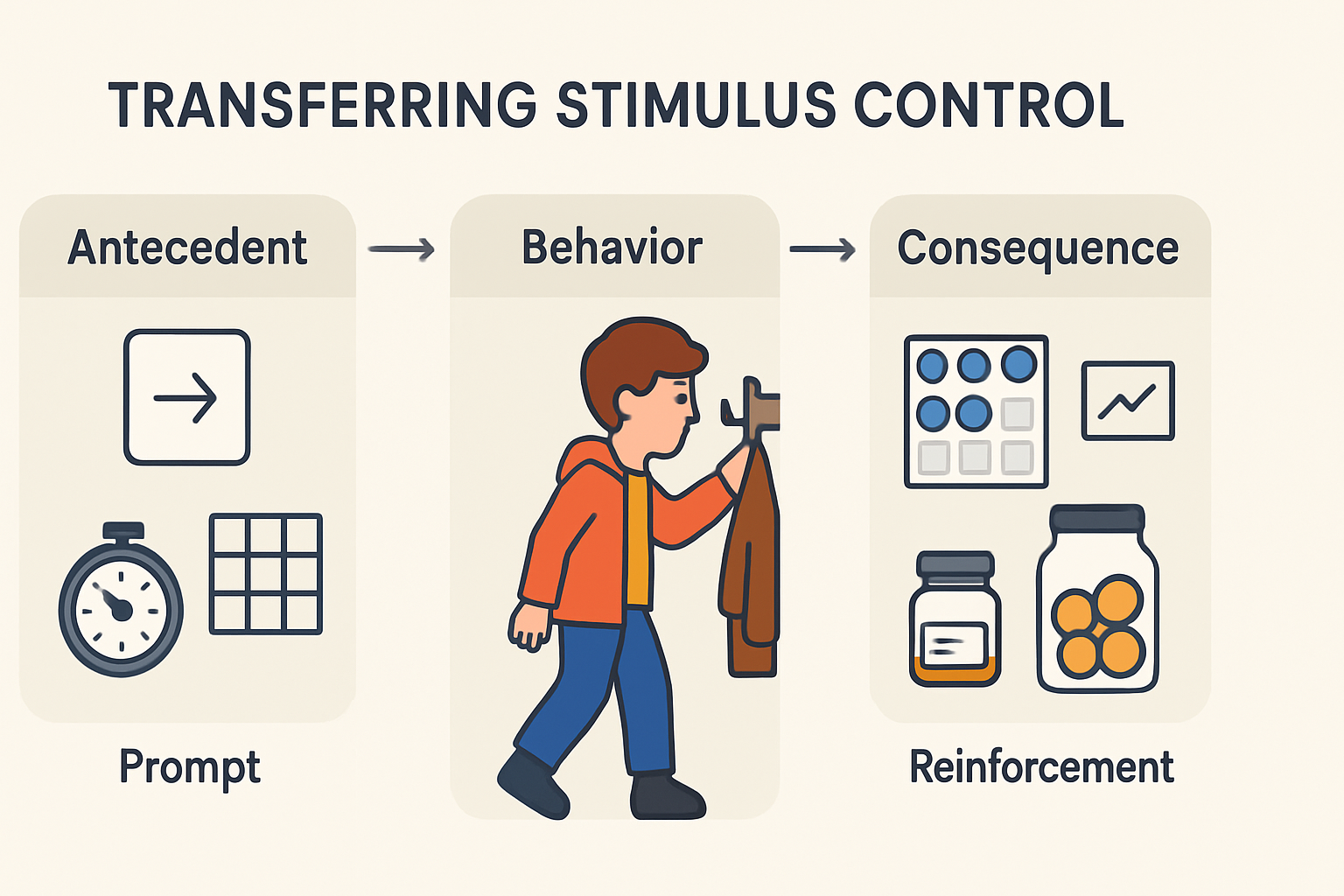
Scenario: A 5-year-old does not hang their coat upon entering the classroom. We implement a most-to-least prompt fading plan with physical guidance.
Initial ABC Analysis:
- Antecedent: Child enters classroom with coat on
- Behavior: Stands by door (no coat hanging)
- Consequence: Teacher provides full physical prompt to hang coat
Final Step ABC Analysis:
- Antecedent: Child enters classroom with coat on
- Behavior: Hangs coat independently on hook
- Consequence: Access to preferred classroom activity
The hypothesized function is access to reinforcement (next activity) contingent on completing the behavior chain. The natural Sd becomes the classroom entry routine.
Example 2: Teaching an Adult to Use a Public Kiosk
Scenario: An adult with ASD learning to order food from a touchscreen kiosk. We use progressive time delay with gestural prompts.
Initial Trial:
- Antecedent: Kiosk screen shows food options (Sd)
- Behavior: No response within 0-second delay
- Consequence: Immediate gestural prompt to touch screen
Later Trial:
- Antecedent: Kiosk screen shows food options (Sd)
- Behavior: Independent touch selection after 4-second delay
- Consequence: Food order processes, social praise from companion
The function involves access to tangibles (food) and social reinforcement. Control transfers from the gestural prompt to the kiosk screen itself.
BCBA Exam Focus and Common Traps
Exam questions often test your ability to distinguish between related concepts and select appropriate procedures. Understanding these distinctions is crucial for clinical decision-making.
Don’t Confuse These Related Concepts
Several concepts frequently appear together on exams:
- Transferring stimulus control vs. stimulus generalization: The former moves from prompts to Sd, while the latter involves responding to novel stimuli.
- Prompt fading vs. shaping: Fading reduces prompts; shaping reinforces successive approximations of a target behavior.
- Most-to-least vs. least-to-most contexts: Consider error history and skill complexity when selecting approaches.
Exam questions may present scenarios requiring you to identify which procedure is being implemented or which would be most appropriate. Always consider the learner’s current performance and the target skill’s characteristics.
Quick-Reference Implementation Checklist
Follow this systematic approach when planning to transfer stimulus control:
- Identify the natural discriminative stimulus that should eventually control the behavior
- Select appropriate prompting procedures based on learner characteristics and skill complexity
- Establish clear prompt fading criteria for moving between prompt levels
- Monitor response independence through systematic data collection
- Program for generalization across settings, people, and materials
- Address potential prompt dependency through careful fading schedules
- Ensure treatment integrity by training staff on prompt delivery and fading procedures
For more on related concepts, see our guide on SD vs MO differences and stimulus generalization.
Summary and Key Takeaways
Transferring stimulus control is essential for building independent, functional behaviors. Remember these critical points:
- The goal is always to move from artificial prompts to natural environmental cues
- Select procedures based on learner characteristics and skill requirements
- Systematic data collection guides prompt fading decisions
- Avoid common confusions with related concepts like stimulus generalization
- Always program for maintenance and generalization from the beginning
For authoritative information on behavior analysis procedures, consult the BACB Task List and peer-reviewed journals. Mastery of transferring stimulus control not only prepares you for exam questions but also enhances your clinical effectiveness in promoting meaningful behavior change.


