
Total task chaining is a systematic teaching procedure where learners attempt every step of a complex skill during each teaching trial. This approach differs from other chaining methods by presenting the entire task analysis from start to finish, with prompts provided only for steps the learner cannot complete independently.
Table of Contents
- What is Total Task Chaining? Definition and Key Features
- Total Task Chaining in Practice: ABA Examples with Data
- Exam Relevance, Common Traps, and Decision-Making
- Quick Implementation Checklist for Practitioners
- Summary and Key Takeaways
- References
What is Total Task Chaining? Definition and Key Features
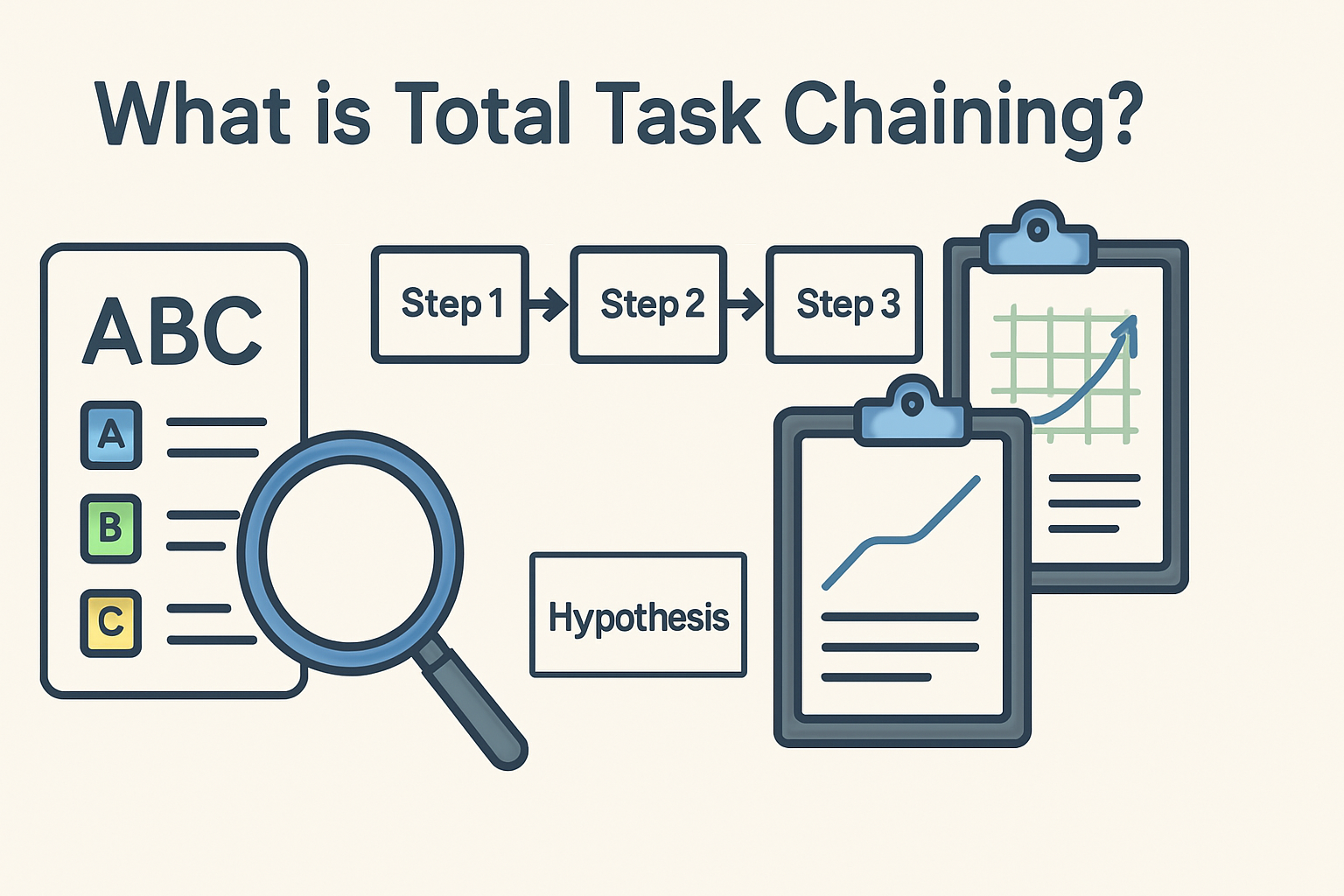
Total task chaining represents one of three primary chaining procedures in applied behavior analysis. Unlike forward or backward chaining, this method requires the learner to attempt all steps of a multi-step skill during every teaching opportunity.
The Core Procedure: Learning Every Step, Every Time
In total task chaining, the practitioner presents the complete behavior chain during each session. The learner attempts every step in sequence, receiving prompting procedures only for steps where independent performance falters. Reinforcement typically follows successful completion of the final step.
This contrasts with forward chaining, which teaches the first step first, and backward chaining, which begins with the last step. Total task chaining assumes the learner has some prerequisite skills or can benefit from seeing the entire sequence.
- Complete task analysis presented each trial
- Prompts provided as needed for specific steps
- Reinforcement delivered after final step completion
- Requires detailed task analysis development
- Effective for learners with partial skill mastery
Total Task Chaining in Practice: ABA Examples with Data
Understanding total task chaining requires examining concrete applications with ABC data collection. These examples demonstrate how practitioners implement this procedure while tracking progress systematically.
Example 1: Teaching Hand Washing to a Young Child
A 6-step task analysis guides hand washing instruction. Each teaching trial presents all steps, with data collected on independent versus prompted performance.
Task Analysis Steps:
- Turn on water
- Wet hands completely
- Apply soap (1 pump)
- Rub hands for 20 seconds
- Rinse thoroughly
- Dry hands with towel
For the ‘apply soap’ step, ABC data reveals: Antecedent = wet hands, Behavior = staring at soap dispenser for 5+ seconds, Consequence = gestural prompt. The hypothesized function is escape from demand due to lack of fluency with pump mechanism.
The prompt fading strategy involves moving from gestural to verbal to independent performance through systematic prompt hierarchy implementation.
Example 2: Vocational Skill: Assembling a Product Kit
An 8-step assembly task demonstrates total task chaining in vocational settings. The procedure supports skill acquisition for employment readiness.
Task Analysis Steps:
- Open box lid
- Remove component A
- Place component A in slot 1
- Remove component B
- Place component B in slot 2
- Attach fastener clip
- Apply quality sticker
- Close box lid
For the ‘place component B in slot’ step, ABC data shows: Antecedent = correct placement of component A, Behavior = placing B incorrectly, Consequence = physical prompt and corrective feedback. The function appears to be skill deficit in discrimination between similar components.
The error correction procedure involves immediate physical guidance followed by errorless learning trials to build discrimination skills. For more on discrimination training, see our guide on SD vs S-delta discrimination.
Exam Relevance, Common Traps, and Decision-Making
BCBA exam questions often test your ability to select appropriate chaining procedures based on learner characteristics and task requirements. Understanding when to use total task chaining versus other methods is crucial.
When to Choose Total Task Chaining Over Other Methods
Select total task chaining when specific conditions align with this procedure’s strengths. Consider these decision factors carefully.
- Learner has partial mastery of some chain steps
- Task complexity is moderate, not overwhelming
- Learner tolerates longer response chains
- Natural teaching context supports complete sequence presentation
- Prompt hierarchy can be systematically faded
Forward chaining works better when no steps are mastered, while backward chaining suits tasks where final step reinforcement is particularly motivating. For related teaching procedures, explore behavior skills training methods.
Frequent Exam Pitfalls and How to Avoid Them
Several common mistakes appear regularly on BCBA exams. Recognizing these traps improves your selection accuracy.
- Confusing total task with whole task presentation (which uses no prompts)
- Forgetting that reinforcement typically follows only the final step
- Selecting total task when learner has zero step mastery
- Overlooking the need for detailed task analysis before implementation
- Failing to consider learner’s tolerance for longer chains
Remember that total task chaining requires prompting for unmastered steps, while whole task presentation expects independent performance throughout.
Quick Implementation Checklist for Practitioners
Follow this actionable checklist to implement total task chaining with procedural integrity. Each step ensures proper application of this teaching strategy.
- Develop comprehensive task analysis with observable, measurable steps
- Assess learner’s current performance on each step
- Select appropriate prompt hierarchy (most-to-least or least-to-most)
- Establish clear reinforcement contingency for final step completion
- Collect baseline data on independent versus prompted steps
- Implement systematic prompt fading procedures
- Monitor progress through ongoing data collection
- Adjust teaching based on performance trends
For more on data collection methods, review our data collection guide with practical examples.
Summary and Key Takeaways
Total task chaining represents a valuable teaching procedure within the chaining continuum. This method presents complete task analyses during each teaching trial, with prompts provided for unmastered steps.
Key characteristics include presentation of all steps, prompting as needed, and reinforcement following final step completion. The procedure works best when learners have partial skill mastery and can tolerate longer response chains.
For BCBA exam preparation, focus on distinguishing total task chaining from forward and backward chaining. Remember common pitfalls like confusing it with whole task presentation or selecting it when no steps are mastered. Always consider the learner’s existing repertoire and the task’s natural context when choosing chaining procedures.
Successful implementation requires detailed task analysis, systematic prompting, and ongoing data collection to guide instructional decisions. When applied correctly, total task chaining effectively teaches complex skills while maintaining the natural sequence of behaviors.



