

A token economy system is one of the most versatile and effective behavior change tools in applied behavior analysis. This comprehensive guide breaks down how these systems work, provides practical examples, and prepares you for related questions on the BCBA exam.
Table of Contents
- What is a Token Economy System in ABA?
- Implementing a Token Economy: Worked Examples
- Token Economies on the BCBA Exam: Key Points and Common Traps
- Ethical Implementation and a Quick-Start Checklist
What is a Token Economy System in ABA?
A token economy is a structured reinforcement system where individuals earn tokens for engaging in target behaviors. These tokens function as conditioned reinforcers that can later be exchanged for preferred items or activities.
The system’s power comes from its flexibility and ability to bridge the gap between behavior and reinforcement.
Core Components and Behavioral Rationale
Every token economy consists of four essential elements that work together systematically.
- Tokens: Physical or symbolic items (stickers, points, checkmarks) that serve as conditioned generalized reinforcers through pairing with backup reinforcers
- Backup Reinforcers: The actual items, activities, or privileges that tokens can be exchanged for, which must be highly preferred by the individual
- Exchange Rate: The predetermined ratio specifying how many tokens are needed to obtain each backup reinforcer, which can be fixed or variable
- Reinforcement Menu: A visual display of available backup reinforcers and their corresponding token costs, providing clear choice opportunities

Implementing a Token Economy: Worked Examples
Moving from theory to practice, here are two detailed scenarios showing how token economies can address different behavioral functions and settings.
Example 1: Increasing Academic Engagement in a Classroom
Client: 8-year-old student with escape-maintained off-task behavior during independent work time.
Target Behavior: Remaining on-task for 5-minute intervals during math worksheets.
Hypothesized Function: Escape from academic demands maintained by negative reinforcement.
ABC Breakdown:
- Antecedent: Math worksheet presented, teacher gives instruction to begin
- Behavior: Student looks around, plays with pencil, talks to peers
- Consequence: Teacher redirects, sometimes allows break after protest
Token System Design:
- Student earns one token for each 5-minute interval of on-task behavior
- Tokens are immediate conditioned reinforcers paired with verbal praise
- Exchange options: 3 tokens = 5-minute break (negative reinforcement), 5 tokens = choice from prize box (positive reinforcement)
- System includes response cost component: tokens removed for major disruptions
Example 2: Building Self-Care Routines at Home
Client: 6-year-old child with limited motivation for morning routine completion.
Target Behavior: Independently completing four-step morning routine (brush teeth, get dressed, eat breakfast, pack backpack).
Hypothesized Function: Access to preferred activities (playing) maintained by positive reinforcement.
ABC Breakdown:
- Antecedent: Morning routine checklist presented visually
- Behavior: Child delays, requires multiple prompts, engages in protest behaviors
- Consequence: Parent eventually assists with tasks, child gets to play after much delay
Token System Design:
- Each completed routine step earns one token on a visual token board
- All four tokens earned = immediate access to special afternoon activity
- System includes generalization programming: tokens gradually faded as routine becomes established
- Parent training on consistent implementation and prompt fading procedures
Token Economies on the BCBA Exam: Key Points and Common Traps
Token economy questions appear across multiple domains of the BCBA exam. Understanding these systems requires grasping both conceptual foundations and practical applications.
Essential Terminology and Exam Links
Several key concepts frequently appear in exam questions about token economies.
- Conditioned Reinforcer: Tokens gain reinforcing properties through pairing with backup reinforcers (Task List B-8)
- Generalized Reinforcer: Tokens maintain reinforcing value across multiple motivational conditions (Task List B-5)
- Backup Reinforcer: The actual items or activities that maintain the token’s value
- Exchange Schedule: The contingency governing when tokens can be traded (fixed vs. variable ratio)
- Response Cost: A punishment procedure involving token removal for inappropriate behaviors
For more on reinforcement principles, see our guide on reinforcement in ABA.
Frequently Missed Questions and How to Avoid Them
Exam candidates often stumble on subtle distinctions in token economy questions.
- Trap 1: Confusing tokens (conditioned reinforcers) with backup reinforcers (primary/secondary). Remember: tokens are means to an end, not the end itself
- Trap 2: Misidentifying the reinforcement schedule. The exchange typically follows a fixed ratio schedule, while token earning might use interval or ratio schedules
- Trap 3: Overlooking ethical considerations. Always consider client assent, choice, and dignity in system design
- Trap 4: Forgetting that tokens must be paired with backup reinforcers to maintain their conditioned reinforcing value
For ethical guidance, review our article on ethics in ABA practice.
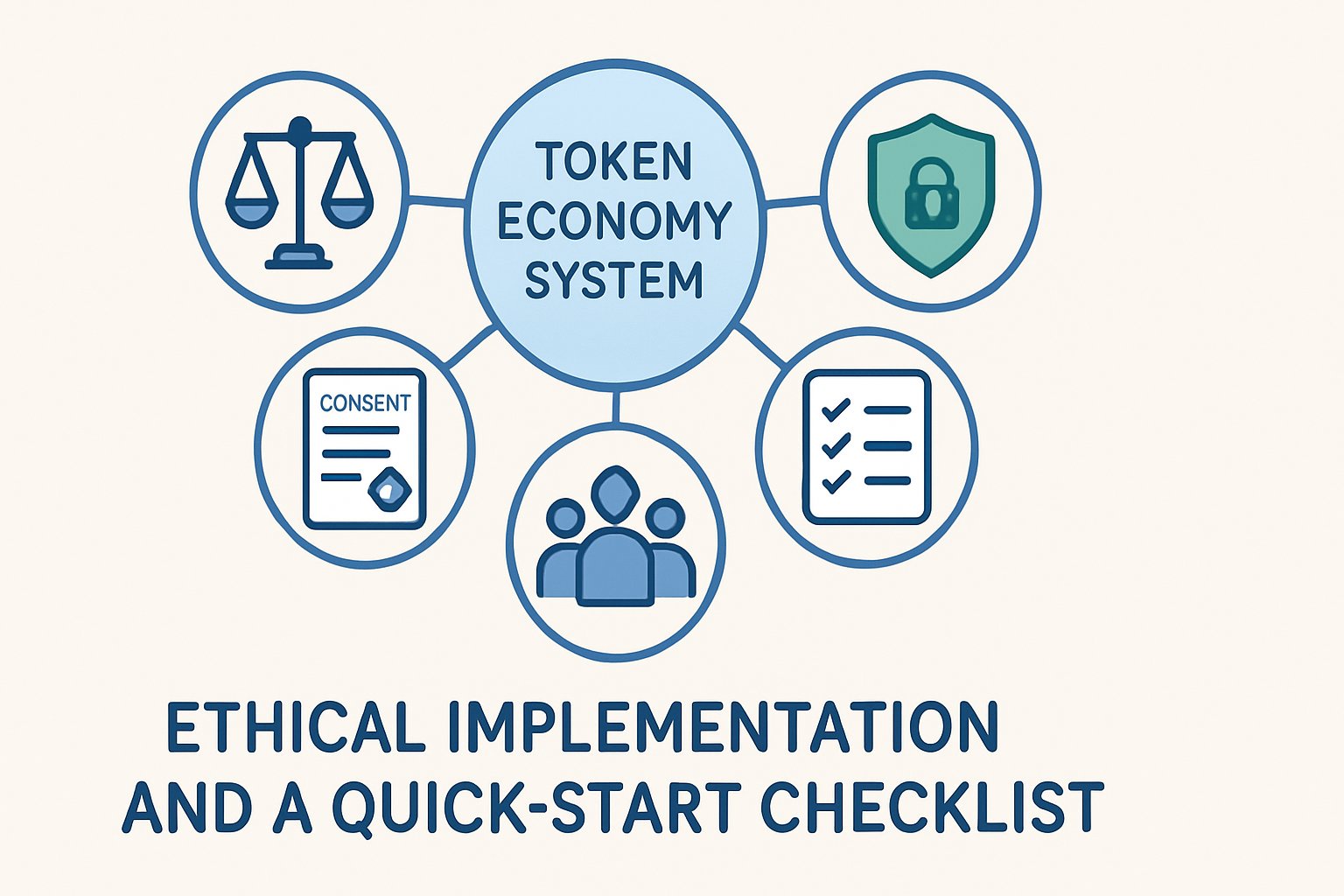
Ethical Implementation and a Quick-Start Checklist
Effective token economies balance behavioral effectiveness with respect for individual autonomy and dignity. Ethical implementation requires careful planning and ongoing monitoring.
Follow this checklist when designing or implementing a token economy system:
- Conduct a thorough preference assessment to identify meaningful backup reinforcers
- Ensure the individual understands the contingency relationship between behavior, tokens, and backup reinforcers
- Start with a rich schedule of reinforcement (easy to earn tokens) to establish the system
- Gradually increase the response requirement as the individual becomes successful
- Provide frequent opportunities for choice and control within the system
- Monitor for satiation effects and rotate backup reinforcers regularly
- Include a systematic fading plan to promote natural reinforcement and maintenance
- Collect ongoing data on effectiveness and social validity from all stakeholders
For more on assessment procedures, see our guide to preference assessments.
Token economy systems represent a powerful application of behavioral principles that can be tailored to diverse populations and settings. When implemented ethically and systematically, they promote skill acquisition, increase motivation, and teach valuable self-management skills. The BACB Ethics Code emphasizes the importance of using the least restrictive effective procedures, making token economies a valuable tool when natural contingencies are insufficient.
For authoritative guidance on behavior analytic procedures, consult the Behavior Analyst Certification Board resources and peer-reviewed literature on token economy applications.


