
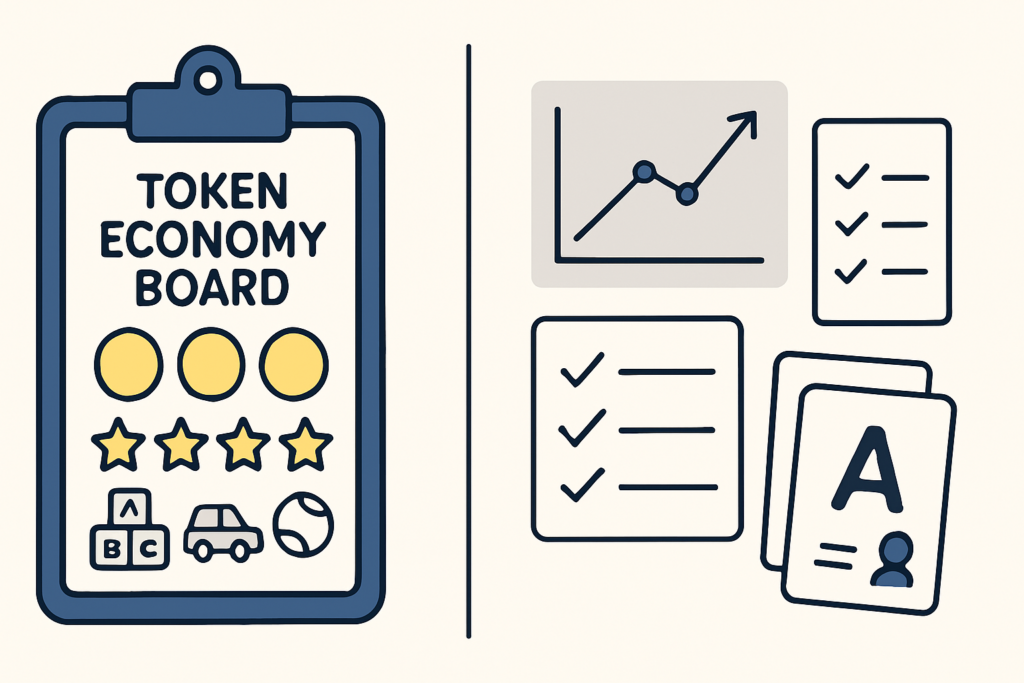
A token economy board is a systematic reinforcement procedure used in ABA therapy to increase desirable behaviors through conditioned reinforcers. This guide explains how these visual systems work, provides practical implementation steps, and addresses ethical considerations essential for BCBA exam preparation.
Table of Contents
- What is a Token Economy Board? Defining the System
- Implementing a Token Economy Board: A Step-by-Step Guide with Examples
- Ethical Considerations and Common Clinical Pitfalls
- Token Economy Boards on the BCBA Exam: What to Know
- References
What is a Token Economy Board? Defining the System
A token economy board represents a structured reinforcement system where clients earn tokens for specific target behaviors. These tokens function as conditioned generalized reinforcers that can later be exchanged for preferred items or activities.
Core Components and Behavioral Principles
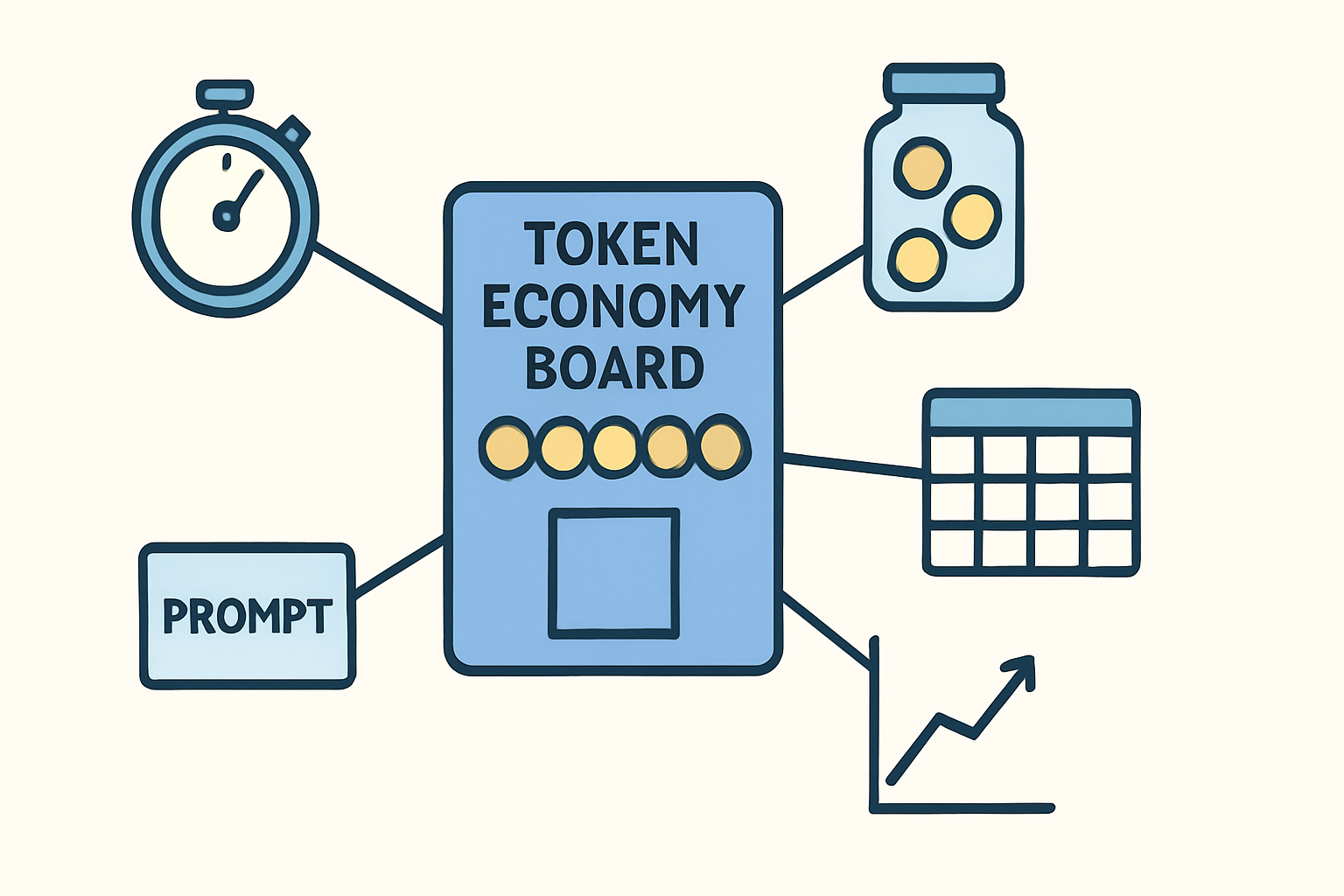
Every token economy system contains three essential elements working together to shape behavior effectively.
- Tokens serve as conditioned reinforcers that gain value through pairing with backup reinforcers
- The visual board provides immediate feedback and serves as a discriminative stimulus for reinforcement availability
- Backup reinforcers maintain the system’s effectiveness through established preference assessments
- The exchange system establishes clear criteria for token redemption
Tokens function as generalized conditioned reinforcers because they maintain reinforcing properties across multiple contexts. The board itself serves as a visual prompt and discriminative stimulus signaling when reinforcement is available. Understanding these components is crucial for both clinical implementation and BCBA exam questions about reinforcement systems.
Implementing a Token Economy Board: A Step-by-Step Guide with Examples
Effective implementation requires systematic planning and consideration of behavioral functions. Follow these steps to create clinically sound token economy systems.
Example 1: Increasing Task Completion (Escape-Maintained Behavior)
This scenario addresses academic avoidance through positive reinforcement of task engagement.
- Antecedent: Present a math worksheet divided into 5 sections
- Target behavior: Complete one section of the worksheet independently
- Consequence: Place one token on the board immediately after completion
- Hypothesized function: Escape from academic demands
- Exchange criteria: 5 tokens = 5-minute break from academic tasks
This intervention addresses escape-maintained behavior by providing a structured way to earn breaks. The token board makes reinforcement immediate and visible, bridging the delay between task completion and the earned break. This approach aligns with principles of positive reinforcement while systematically reducing escape behaviors.
Example 2: Building Social Skills (Attention-Maintained Behavior)
This system targets social skill deficits by reinforcing appropriate peer interactions.
- Antecedent: Structured play opportunity with peers
- Target behavior: Share a toy or material without prompting
- Consequence: Token delivery paired with specific social praise
- Hypothesized function: Attention and social interaction
- Exchange criteria: 3 tokens = choice of preferred group activity
This example demonstrates how token systems can address attention-maintained behaviors by providing both immediate token reinforcement and natural social consequences. The pairing of tokens with social praise helps establish social interactions as reinforcing in themselves. This approach supports the development of socially significant behaviors that generalize beyond the token system.
Ethical Considerations and Common Clinical Pitfalls
Token economy systems require careful ethical implementation to ensure client dignity and long-term effectiveness. Common mistakes can undermine both clinical outcomes and ethical standards.
Ensuring Client Dignity and Autonomy Within the System
Ethical implementation begins with respecting client preferences and maintaining human dignity throughout the reinforcement process.
- Involve clients in selecting tokens and backup reinforcers through preference assessments
- Use age-appropriate, non-stigmatizing boards that respect client dignity
- Pair token delivery with natural reinforcement to promote generalization
- Obtain client assent when appropriate and respect withdrawal of consent
These practices align with BACB Ethics Code requirements for client dignity and choice. Token systems should never feel punitive or demeaning. Instead, they should function as transparent, collaborative tools for skill development. For more on ethical considerations in ABA practice, see our guide on ethics in ABA practice.
Avoiding Satiation and Ensuring Fading Plans
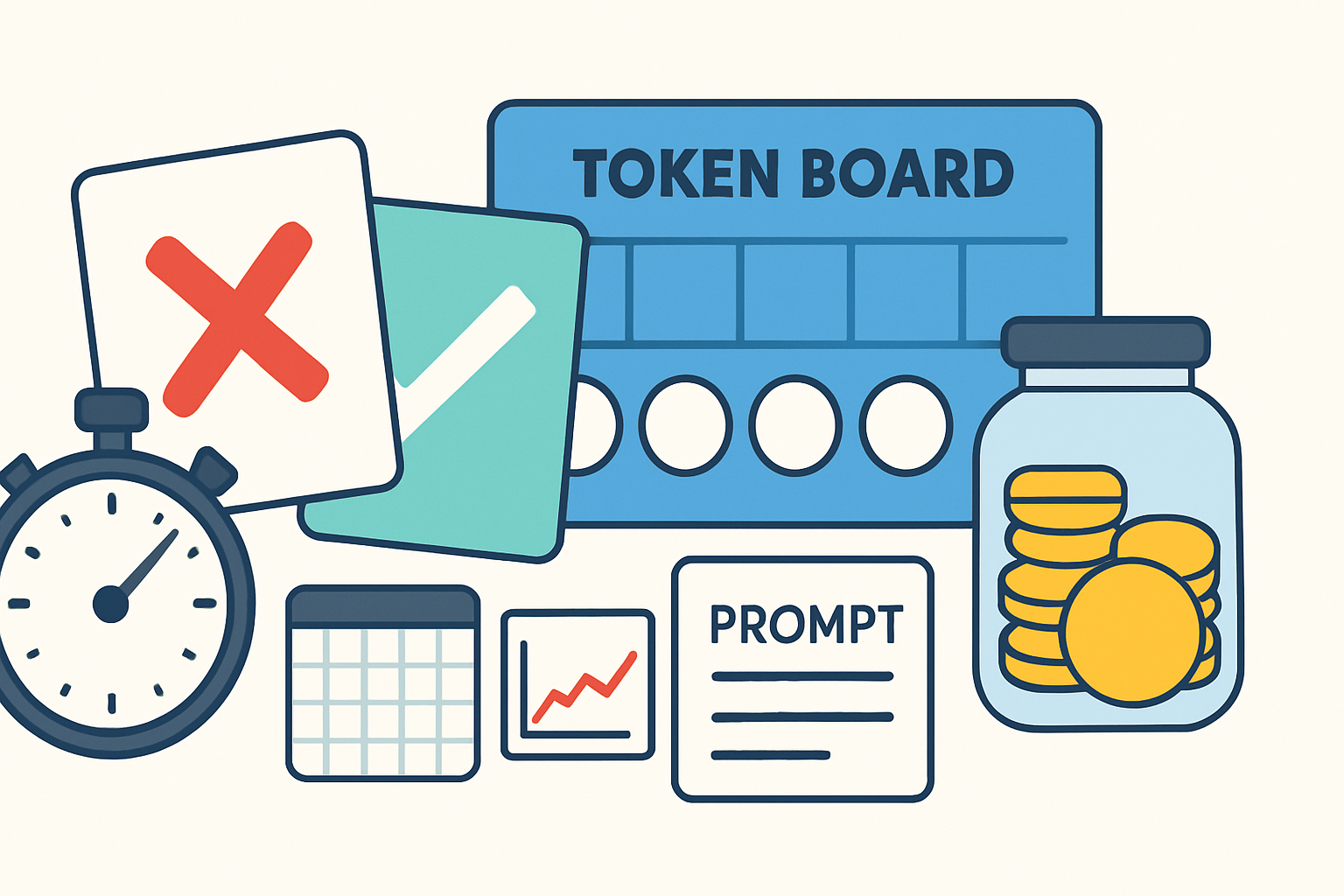
Clinical effectiveness depends on systematic reinforcement thinning and generalization planning from the outset.
- Begin with continuous reinforcement (FR1) for initial acquisition
- Systematically thin to intermittent schedules to promote maintenance
- Develop explicit fading procedures before implementation begins
- Plan for generalization across settings, people, and materials
Failure to plan for fading represents a common clinical error and exam trap. Without systematic thinning, clients may become dependent on token systems. Effective practitioners design fading from the beginning, using techniques like increasing response requirements or delaying token delivery. For more on reinforcement schedules, see our article on compound vs simple schedules of reinforcement.
Token Economy Boards on the BCBA Exam: What to Know
BCBA exam questions about token economies test both conceptual understanding and practical application skills. Focus on these key areas for exam readiness.
Master these essential concepts for token economy questions:
- Conditioned generalized reinforcer – the behavioral principle underlying token effectiveness
- Backup reinforcer – maintains token value through established preferences
- Exchange criteria – specific requirements for token redemption
- Satiation – loss of reinforcing effectiveness through overuse
- Fading procedures – systematic reduction of reinforcement dependence
Common exam distractors include confusing tokens with primary reinforcers or misunderstanding their function as discriminative stimuli. Remember that tokens gain value through pairing, not through inherent properties. Exam questions often test your ability to identify when a token system is appropriate and how to implement it ethically.
For comprehensive exam preparation, explore our BCBA exam prep guide covering all essential domains. Understanding token economy systems requires integrating knowledge of reinforcement principles, ethical implementation, and practical clinical skills – all critical areas for BCBA certification success.


