

teaching by reinforcing sequential: What is Teaching by Reinforcing the Sequential? Defini
Teaching by reinforcing the sequential refers to chaining procedures in applied behavior analysis. This method involves breaking complex behaviors into smaller, teachable steps and reinforcing their completion in sequence. The core concept centers on building behavior chains where each step serves as both a response and a discriminative stimulus for the next action.
Table of Contents
- teaching by reinforcing sequential: What is Teaching by Reinforcing the Sequential? Defini
- Teaching by Reinforcing the Sequential in Practice: Worked Examples
- Exam Relevance and Common Traps for BCBA Candidates
- Quick-Reference Checklist for Implementing Chaining
- Summary: Mastering Sequential Reinforcement
Chaining transforms multi-step tasks into manageable components, making them accessible for learners with various skill levels. This approach is particularly effective for teaching daily living skills, vocational tasks, and academic routines that require specific sequences.
The Link Between Task Analysis and Chaining
Effective chaining cannot exist without a proper task analysis. A behavior chain consists of a sequence where completion of one step serves as the discriminative stimulus (SD) for the next response. Each component must be clearly defined, observable, and measurable.
The relationship between task analysis and chaining is fundamental. The task analysis provides the blueprint, while chaining provides the teaching methodology. Without accurate task analysis, chaining procedures lack precision and effectiveness.
The Three Types of Chaining Procedures
ABA practitioners use three primary chaining methods, each with distinct advantages for different learning scenarios.
- Forward chaining teaches steps in natural order, beginning with the first step and adding subsequent steps as mastery occurs
- Backward chaining starts with the final step, with the practitioner completing all prior steps until the learner masters the sequence
- Total task chaining involves teaching all steps simultaneously, with prompting and reinforcement throughout the entire sequence
Each method delivers reinforcement at different points in the chain, affecting learning efficiency and motivation.
Teaching by Reinforcing the Sequential in Practice: Worked Examples
Understanding chaining procedures requires examining concrete examples using the ABC model. These practical scenarios demonstrate how reinforcement operates at different points in behavioral sequences.
Example 1: Forward Chaining for Hand Washing
Consider a 5-step handwashing task analysis: (1) turn on water, (2) wet hands, (3) apply soap, (4) scrub for 20 seconds, (5) rinse and dry. In forward chaining, teaching begins with the first step.
- Antecedent: SD “Time to wash hands”
- Behavior: Learner turns on water (step 1)
- Consequence: Immediate reinforcement (praise, token)
The practitioner completes steps 2-5 initially. As the learner masters step 1, step 2 becomes the target behavior, with reinforcement now contingent on completing both steps 1 and 2. This gradual stepwise progression continues until the entire chain is mastered.
Example 2: Backward Chaining for Putting on a Jacket
For a jacket-donning sequence: (1) lay jacket flat, (2) insert arms, (3) pull over shoulders, (4) zip up. Backward chaining starts with the final step.
- Antecedent: Practitioner completes steps 1-3, presents jacket ready for zipping
- Behavior: Learner zips jacket (step 4)
- Consequence: Natural reinforcement (warmth, outdoor play access)
This approach capitalizes on natural reinforcement contingencies at the chain’s end. As the learner masters zipping, step 3 becomes the new target, with the practitioner completing only steps 1-2. The sequence teaches backward until independence is achieved.
Example 3: Total Task Chaining for Making a Sandwich
For sandwich-making: (1) get bread, (2) spread condiment, (3) add filling, (4) close sandwich, (5) take bite. Total task chaining involves attempting all steps with support.
- Antecedent: SD “Make your sandwich” with materials available
- Behavior: Learner attempts all five steps with prompting as needed
- Consequence: Reinforcement only upon final step completion (eating the sandwich)
This method provides distributed practice across the entire sequence. Prompting is faded systematically, and reinforcement maintains the complete behavioral chain rather than individual components.
Exam Relevance and Common Traps for BCBA Candidates
Chaining procedures frequently appear on the BCBA exam, often testing subtle distinctions between procedures and their appropriate applications. Understanding these nuances is crucial for exam success.
Key Distinctions: Chaining vs. Shaping
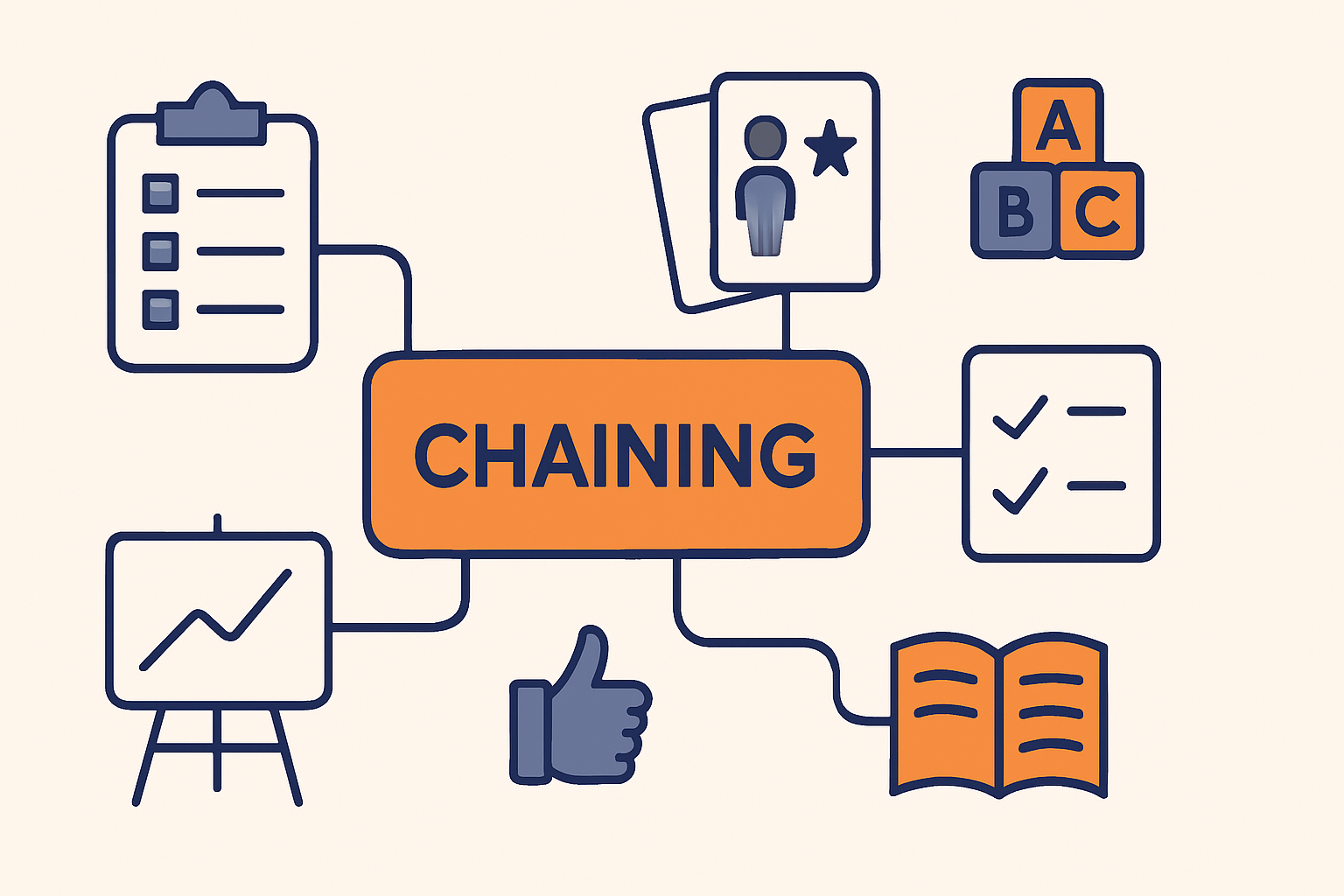
Many candidates confuse chaining with shaping, though they target fundamentally different behavioral dimensions.
- Shaping differentially reinforces successive approximations of a single target behavior
- Chaining reinforces completion of specific, discrete steps in a predetermined sequence
- Shaping modifies response topography, while chaining establishes response sequences
- Shaping typically targets one behavior; chaining always involves multiple behaviors in order
This distinction is critical for exam questions asking which procedure to use for teaching complex multi-step tasks versus refining a single skill.
Choosing the Right Chaining Procedure
Clinical decision-making requires considering multiple factors when selecting a chaining method. Each approach has specific advantages for different learner profiles and task characteristics.
- Learner skill level: Beginners often benefit from backward chaining’s immediate success experiences
- Task complexity: Simple chains may suit total task chaining; complex chains often need forward or backward approaches
- Reinforcement type: Backward chaining leverages natural reinforcement at chain completion
- Error patterns: Forward chaining helps prevent error chains in early steps
Understanding these factors helps answer scenario-based exam questions about procedure selection. For more on reinforcement strategies, see our guide on reinforcement in ABA.
Quick-Reference Checklist for Implementing Chaining
Use this actionable checklist for clinical implementation and exam problem-solving. Each step represents a critical component of effective chaining procedures.
- Conduct thorough task analysis – Break target behavior into observable, measurable steps
- Select appropriate chaining method – Consider learner skills, task complexity, and reinforcement type
- Establish baseline performance – Determine which steps require teaching
- Implement prompting strategy – Use least-to-most or most-to-least prompting as appropriate
- Deliver reinforcement strategically – Place reinforcement according to chosen chaining procedure
- Fade prompts systematically – Gradually reduce support as steps are mastered
- Monitor progress data – Track step mastery and chain completion rates
- Program for generalization – Teach across settings, materials, and people
This checklist ensures comprehensive implementation and helps identify missing components in exam scenarios. For related teaching strategies, explore shaping behavior in ABA.
Summary: Mastering Sequential Reinforcement
Teaching by reinforcing the sequential through chaining procedures represents a fundamental ABA methodology for building complex behavioral repertoires. Mastery requires understanding three core procedures, their appropriate applications, and the critical role of task analysis.
Forward chaining builds sequences from beginning to end, backward chaining leverages terminal reinforcement, and total task chaining provides distributed practice. Each method serves specific clinical purposes based on learner characteristics and task demands.
For BCBA exam preparation, focus on distinguishing chaining from shaping, selecting appropriate procedures based on scenario details, and understanding reinforcement placement within behavioral chains. These concepts frequently appear in exam questions testing application and analysis skills.
Remember that effective chaining always begins with precise task analysis and requires systematic prompt fading and reinforcement delivery. For comprehensive exam preparation strategies, review our BCBA exam prep guide and the official BACB Task List for current standards.


