
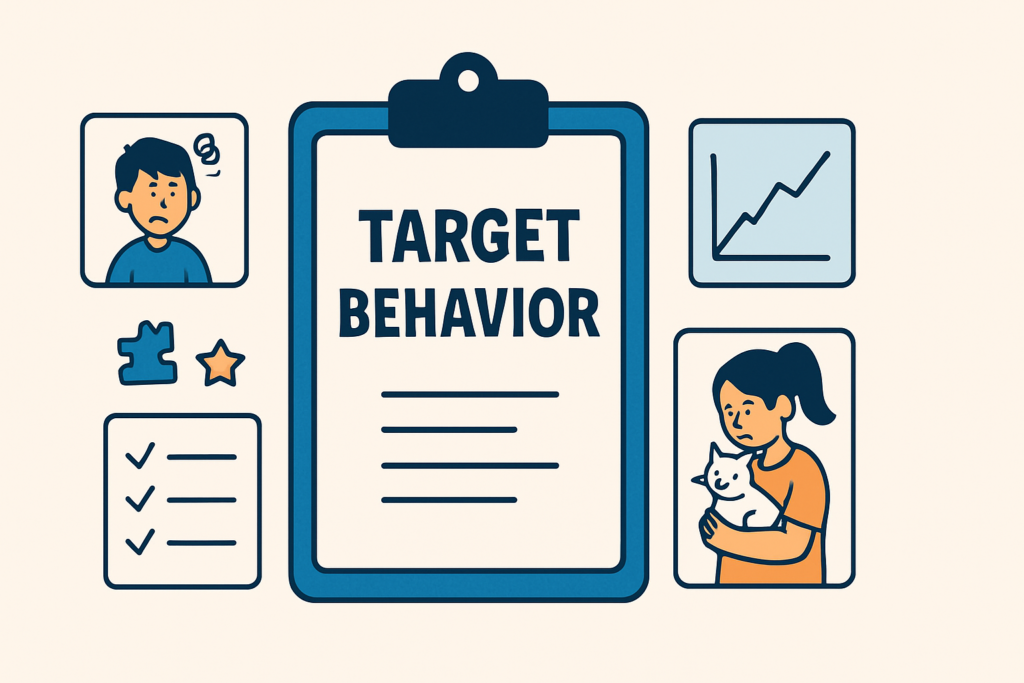
What is a Target Behavior? The Foundation of Intervention
In applied behavior analysis, a target behavior is the specific, measurable action that becomes the focus of assessment and intervention. Unlike general descriptions, it serves as the precise unit of analysis that allows behavior analysts to track progress and evaluate effectiveness. This fundamental concept transforms vague concerns into actionable data points.
Table of Contents
- What is a Target Behavior? The Foundation of Intervention
- Analyzing Target Behavior Examples: From Observation to Hypothesis
- Target Behaviors on the BCBA Exam: Common Traps and Tips
- Quick Checklist for Defining Any Target Behavior
- Summary: From Example to Expertise
Every successful intervention begins with clearly identifying what needs to change. The operational definition you create determines everything that follows—from data collection methods to intervention strategies.
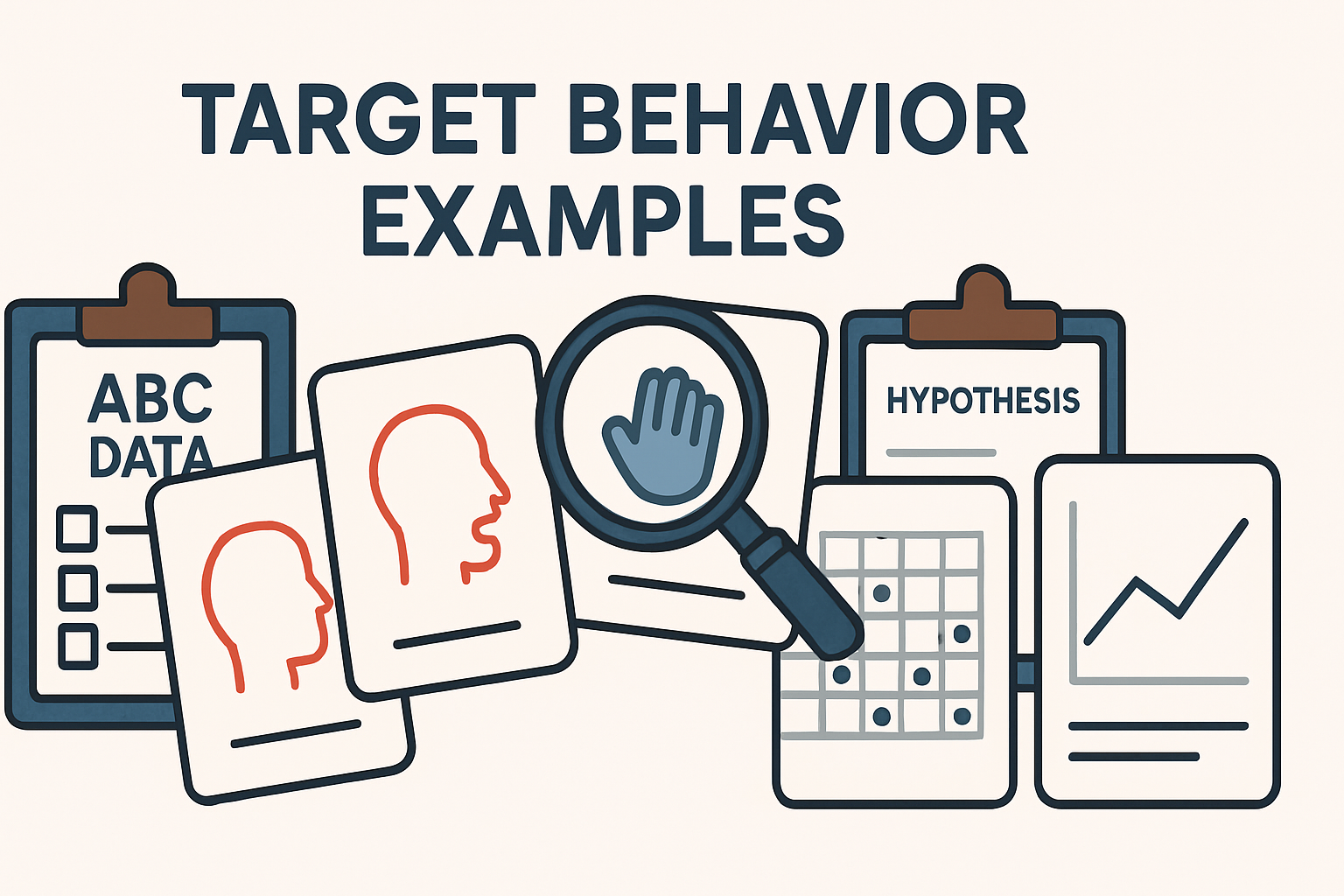
Crafting a Precise Operational Definition
An effective operational definition meets three critical criteria. First, it must be observable—anyone watching should be able to see the behavior occur. Second, it must be measurable—you can count it, time it, or otherwise quantify it. Third, it must be clear—multiple observers would agree when the behavior happens.
Consider this contrast: ‘Being aggressive’ versus ‘Hitting with an open hand that makes audible contact with another person’s body.’ The first is vague and subjective; the second provides specific parameters for reliable measurement. Poor definitions lead to inconsistent data and questionable outcomes.
Why Specificity Matters for Data and Ethics
Precise definitions directly impact both data reliability and ethical practice. When definitions are clear, different observers can collect consistent data, creating a valid baseline for comparison. This reliability is essential for evaluating whether interventions actually work.
From an ethical standpoint, vague definitions can lead to inappropriate interventions targeting behaviors that don’t actually occur or missing behaviors that should be addressed. The BACB Ethics Code emphasizes using evidence-based practices, which requires accurate measurement starting with proper operational definitions.
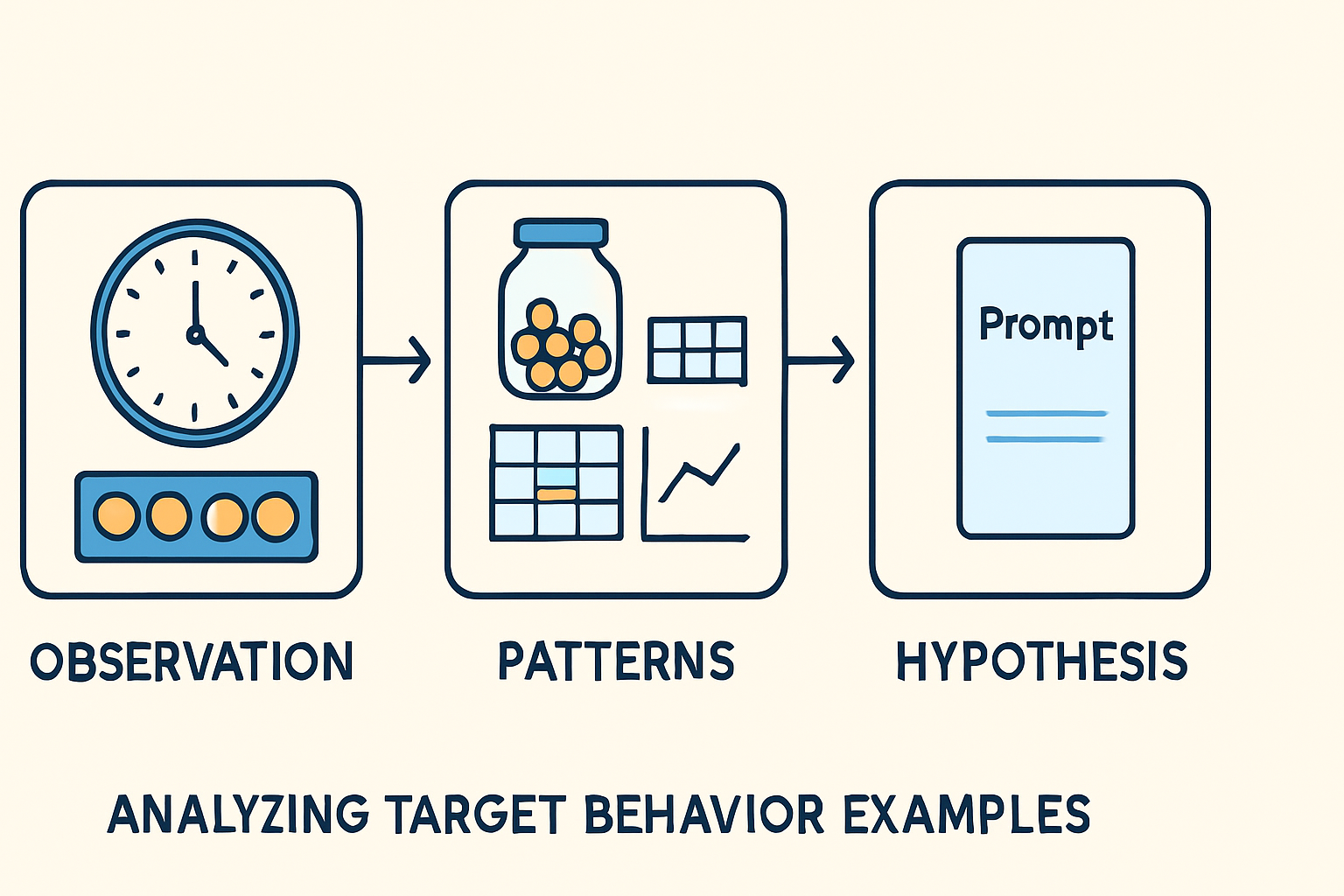
Analyzing Target Behavior Examples: From Observation to Hypothesis
Once you’ve defined a target behavior clearly, the next step involves analyzing patterns to understand its function. This process transforms raw observations into actionable hypotheses about why behaviors occur. Let’s examine several target behavior examples that illustrate this analytical journey.
Example 1: Escape-Maintained Elopement
Consider a 7-year-old student during independent math work. The operational definition: ‘Elopement occurs when the student rises from their chair and moves more than 3 feet from their desk without permission during academic tasks.’
ABC data reveals a consistent pattern: Antecedent—teacher presents math worksheet; Behavior—student leaves desk; Consequence—teacher redirects to hallway for 5-minute break. The functional relationship suggests escape from academic demands. This hypothesis guides intervention toward modifying task difficulty or teaching alternative escape requests.
Example 2: Attention-Maintained Vocal Stereotypy
For a 9-year-old in a small group setting: ‘Vocal stereotypy is defined as non-contextual humming or vocalizations lasting 3 seconds or longer that are not in response to environmental stimuli.’
Data collection shows the behavior occurs most frequently when the classroom aide is attending to other students. The pattern: Antecedent—aide turns attention to peer; Behavior—vocal stereotypy; Consequence—aide provides verbal redirection. This suggests attention-seeking function, pointing toward interventions that teach appropriate attention-getting skills.
Example 3: Tangible-Maintained Property Destruction
With a 6-year-old during free play: ‘Property destruction includes tearing paper materials with enough force to create two separate pieces or throwing toys with sufficient force to break plastic components.’
ABC analysis reveals: Antecedent—tablet time ends; Behavior—throws toy; Consequence—given tablet back to ‘calm down.’ This demonstrates a tangible access function, indicating the need for interventions focused on teaching waiting skills and alternative requests for preferred items.
Target Behaviors on the BCBA Exam: Common Traps and Tips
The BCBA exam frequently tests your ability to identify well-defined behaviors and analyze their functions. Understanding common pitfalls can significantly improve your performance. These questions often present scenarios requiring you to select the best operational definition or hypothesize function from ABC data.
Spotting Poorly Operationalized Definitions
Exam questions may include multiple definitions where you must identify the most appropriate one. Watch for these red flags:
- Mentalistic terms like ‘frustrated,’ ‘angry,’ or ‘anxious’ that describe internal states rather than observable actions
- Definitions requiring inferences about intent or motivation
- Lack of measurability—no way to count, time, or otherwise quantify the behavior
- Vague descriptors like ‘inappropriate’ or ‘disruptive’ without specific parameters
When presented with options, choose definitions that are objective, measurable, and clear enough for multiple observers to agree on occurrences.
Matching Data to Function: A Critical Skill
Exam questions often provide brief ABC data snippets and ask for the hypothesized function. Recognize these patterns:
- Behavior occurs after demands → consider escape/avoidance
- Behavior occurs when attention is diverted → consider attention-seeking
- Behavior follows denied access to items → consider tangible access
- Behavior occurs across various conditions without clear social consequences → consider automatic reinforcement
Remember that the same topography can serve different functions across contexts. Always analyze the specific ABC pattern presented rather than making assumptions based on behavior type alone.
Quick Checklist for Defining Any Target Behavior
Use this practical tool when creating or evaluating operational definitions. Each item represents a critical component of effective behavior definition.
- Observable: Can you see or hear it happening without inferring internal states?
- Measurable: Can you count occurrences, duration, intensity, or latency?
- Clear boundaries: Does it specify what is and isn’t included in the definition?
- Context specified: Are relevant environmental conditions noted if they affect occurrence?
- Reliable: Would multiple observers agree when the behavior occurs?
- Socially significant: Does changing this behavior improve quality of life?
- Ethically sound: Does the definition respect client dignity and avoid stigmatizing language?
This checklist aligns with the seven dimensions of ABA, particularly applied, behavioral, and analytic dimensions.
Summary: From Example to Expertise
Mastering target behavior examples transforms theoretical knowledge into practical skill. The journey begins with crafting precise operational definitions that are observable, measurable, and clear. Through analyzing ABC patterns, you develop hypotheses about behavioral functions that guide effective interventions.
On the BCBA exam, this foundational skill appears in multiple question formats—from selecting appropriate definitions to analyzing functional relationships. By understanding common traps and using systematic approaches like the checklist provided, you build confidence in both exam performance and clinical practice.
Remember that well-defined target behaviors serve as the cornerstone of ethical, effective behavior analysis. They ensure interventions target meaningful change while maintaining measurement integrity. As you continue your preparation, practice applying these principles to diverse scenarios to strengthen your analytical skills. For additional practice with behavioral concepts, explore our guide to functional assessment methods and review the BACB Ethics Code for guidance on ethical measurement practices.


