
Stimulus and Response Generalization is explained with practical steps and examples.
Core Definitions: What Are Stimulus and Response Generalization?
Understanding the distinction between stimulus generalization and response generalization is fundamental for behavior analysts and critical for BCBA exam success. Both concepts describe how learned behaviors transfer beyond their original training context, but they operate through different mechanisms that you must distinguish clearly.
These generalization processes represent the ultimate goal of applied behavior analysis: ensuring that skills learned in therapy sessions actually work in the real world. Without effective generalization, interventions remain limited to specific contexts and fail to produce meaningful, lasting change in clients’ lives.
Stimulus Generalization: When the Same Behavior Occurs in New Situations
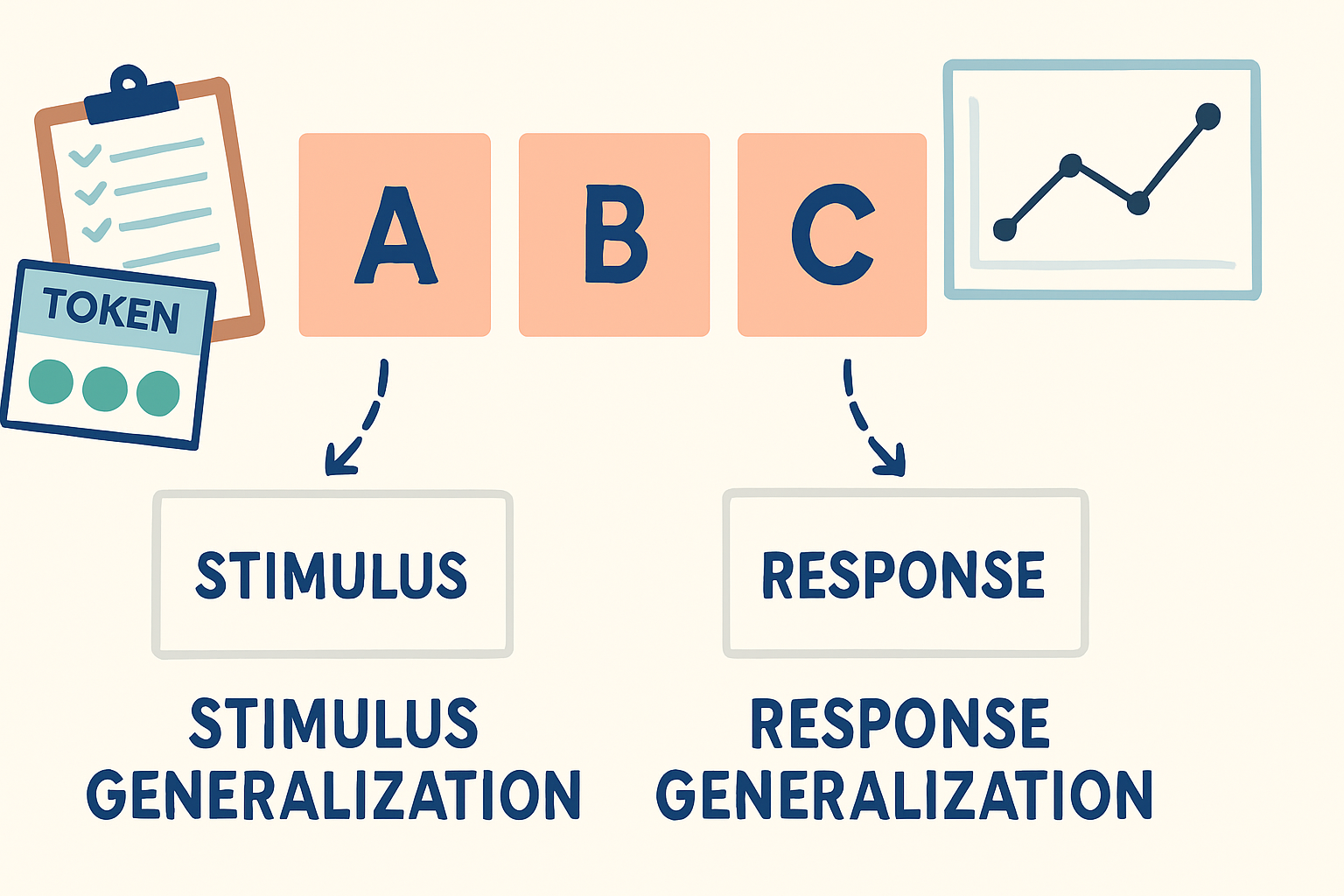
Stimulus generalization occurs when a behavior trained in the presence of one specific stimulus (the discriminative stimulus or SD) begins to occur in the presence of similar, but not identical, stimuli. The key feature is that the response topography (the physical form of the behavior) remains essentially unchanged while the antecedent conditions vary.
This process involves stimuli that share common features or belong to the same stimulus class. For example, if a child learns to say ‘hello’ when their therapist greets them, stimulus generalization occurs when they also say ‘hello’ to their parents, classmates, or strangers. The behavior (saying ‘hello’) stays the same, but the people (stimuli) change.
Stimulus generalization demonstrates that learning has transferred across different environmental contexts. This is particularly important for ensuring that skills learned in clinical settings actually work in natural environments like homes, schools, and communities.
Response Generalization: When a New Behavior Achieves the Same Function
Response generalization involves the emergence of variations of a trained behavior that serve the same function or produce the same outcome. Here, the antecedent conditions remain relatively constant, but the response topography changes while maintaining the same functional relationship with consequences.
This concept relates to behaviors that belong to the same response class – different behaviors that achieve the same result. For instance, if a child learns to request a toy by pointing, response generalization might include them later requesting by saying ‘toy please,’ signing ‘toy,’ or bringing a picture of the toy.
Response generalization is crucial for building behavioral flexibility and ensuring clients have multiple ways to achieve their goals. It reflects the development of a repertoire of functionally equivalent behaviors rather than rigid, single-response patterns.
Applied Examples: Seeing Generalization in Action
Real-world examples make these abstract concepts concrete. Let’s examine two common scenarios that clearly illustrate the difference between stimulus and response generalization in applied settings.
Example 1: Greeting a Friend (Stimulus vs. Response)
Consider a child learning social greeting skills. In the first scenario, the child is taught to say ‘Hi’ when their therapist says ‘hello’ (the SD). After successful training, the child begins saying ‘Hi’ to their parents, siblings, and even strangers who greet them. This is stimulus generalization: the same behavior (saying ‘Hi’) occurs across different people (stimuli).
In the second scenario, the child learns to wave when greeted. Later, when greeted by the same therapist, the child might give a high-five, smile, or nod instead of waving. This demonstrates response generalization: different greeting behaviors occur in response to the same stimulus (being greeted).
The critical distinction lies in what changes: with stimulus generalization, the antecedent stimuli vary while the response stays constant; with response generalization, the behavior topography varies while the antecedent remains similar.
Example 2: Requesting a Break in the Classroom
A student with autism is taught to request a break by handing a ‘break’ card to their primary teacher. After mastering this skill, the student begins handing the break card to substitute teachers, paraprofessionals, and even the school principal. This represents stimulus generalization – the same behavior (handing the card) occurs with different people.
Now consider response generalization: The same student, when needing a break, might sign ‘break,’ say ‘I need a pause,’ point to a break area, or use a tablet communication app instead of using the break card. These are all different behaviors serving the same function of requesting a break.
Both types of generalization are essential for functional communication. Stimulus generalization ensures the skill works with different people, while response generalization provides multiple ways to communicate the same need, increasing the student’s independence and flexibility.
Exam Relevance and Common Traps
BCBA exam questions on generalization often test your ability to distinguish between stimulus and response generalization in applied scenarios. Understanding common traps can help you avoid costly mistakes on test day.
The ‘Topography vs. Function’ Distractor
Many exam questions include distractors that focus on the physical form of behavior when you should be analyzing functional relationships. Remember: stimulus generalization involves the same behavior across different situations, while response generalization involves different behaviors in similar situations.
A common trap presents scenarios where both the stimulus and response change slightly. In these cases, you must determine which element shows more significant variation. Look for the primary change: if the behavior stays essentially the same but occurs with new people, places, or materials, it’s likely stimulus generalization.
Another frequent mistake involves confusing generalization with other concepts like maintenance or discrimination. Remember that generalization specifically involves transfer to new conditions, not just persistence over time or differentiation between stimuli.
Scenario Analysis: A Step-by-Step Approach
Use this systematic approach when analyzing exam scenarios: First, identify the target behavior and its function. Second, compare the training condition to the generalization condition. Third, ask: ‘What has changed more significantly – the antecedent or the response?’
If the behavior occurs with different people, in different settings, or with different materials, but the response looks essentially the same, you’re likely dealing with stimulus generalization. The behavior has transferred across stimulus conditions.
If the behavior occurs in similar situations but takes a different form while achieving the same outcome, you’re likely seeing response generalization. The client has developed alternative ways to achieve the same result.
For more practice with these types of questions, check our ABA concepts practice section and exam strategies guide.
Study Checklist and Summary
Use this checklist to ensure you’ve mastered stimulus and response generalization concepts for your BCBA exam preparation:
- Define stimulus generalization accurately: same behavior occurs with different, similar stimuli
- Define response generalization correctly: different behaviors serve the same function in similar situations
- Identify examples of stimulus classes and response classes in applied scenarios
- Distinguish generalization from maintenance (persistence over time) and discrimination (differentiation between stimuli)
- Apply the step-by-step analysis method to exam scenarios systematically
- Recognize common exam traps focusing on topography rather than functional relationships
- Understand why both types of generalization are treatment goals in applied behavior analysis
Remember that stimulus generalization involves the transfer of behavior across different antecedent conditions while maintaining response consistency. In contrast, response generalization involves the emergence of behavior variations that achieve the same functional outcome in similar situations.
Both processes are essential for ensuring that skills learned in therapy actually work in clients’ natural environments. For further reading on generalization principles, refer to the Behavior Analyst Certification Board resources and seminal works on generalization in applied settings.
Mastering these concepts will not only help you pass the BCBA exam but also design more effective interventions that promote meaningful, lasting behavior change for your clients.


