
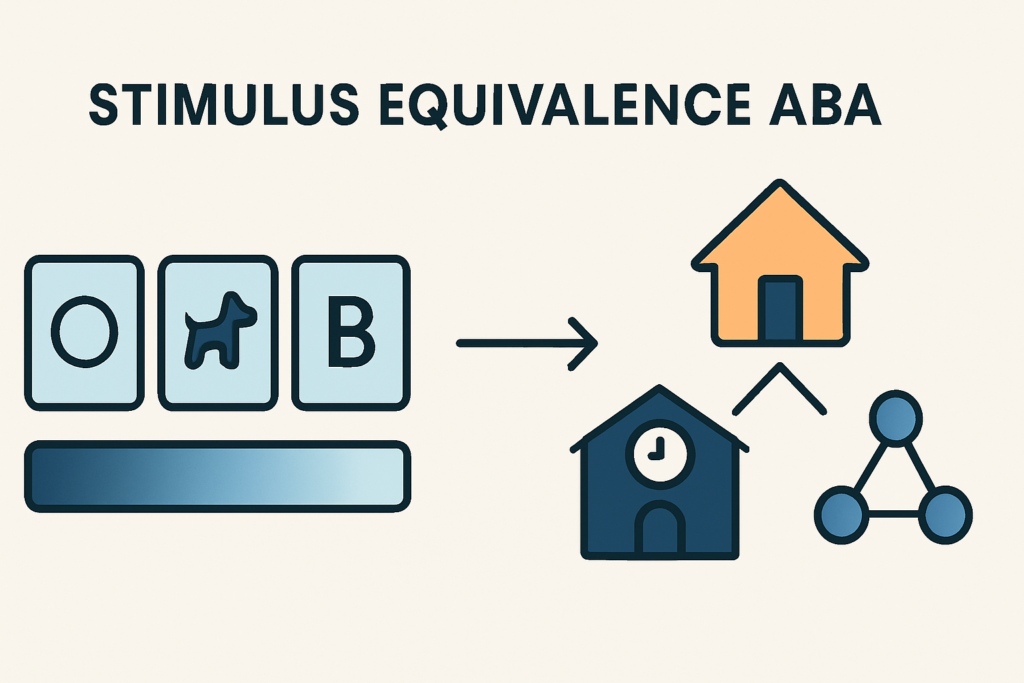
Understanding stimulus equivalence is essential for behavior analysts working with complex verbal behavior and relational learning. This concept represents a sophisticated form of derived stimulus relations that goes beyond simple discrimination training. In applied behavior analysis, stimulus equivalence helps explain how individuals learn relationships between stimuli without direct training, making it crucial for language development and academic skills.
Table of Contents
- Stimulus Equivalence ABA: What Is Stimulus Equivalence?
- The Three Properties of Stimulus Equivalence
- Practical ABA Examples of Stimulus Equivalence
- BCBA Exam Relevance and Application
- Common Exam Traps and Mistakes
- Quick Checklist for Identifying Stimulus Equivalence
- Teaching Strategies for Establishing Equivalence
- Final Summary and Key Takeaways
The stimulus equivalence ABA framework consists of three fundamental properties that define when stimuli become functionally equivalent. Mastering these properties not only enhances clinical practice but also prepares candidates for challenging questions on the BCBA examination.
Stimulus Equivalence ABA: What Is Stimulus Equivalence?
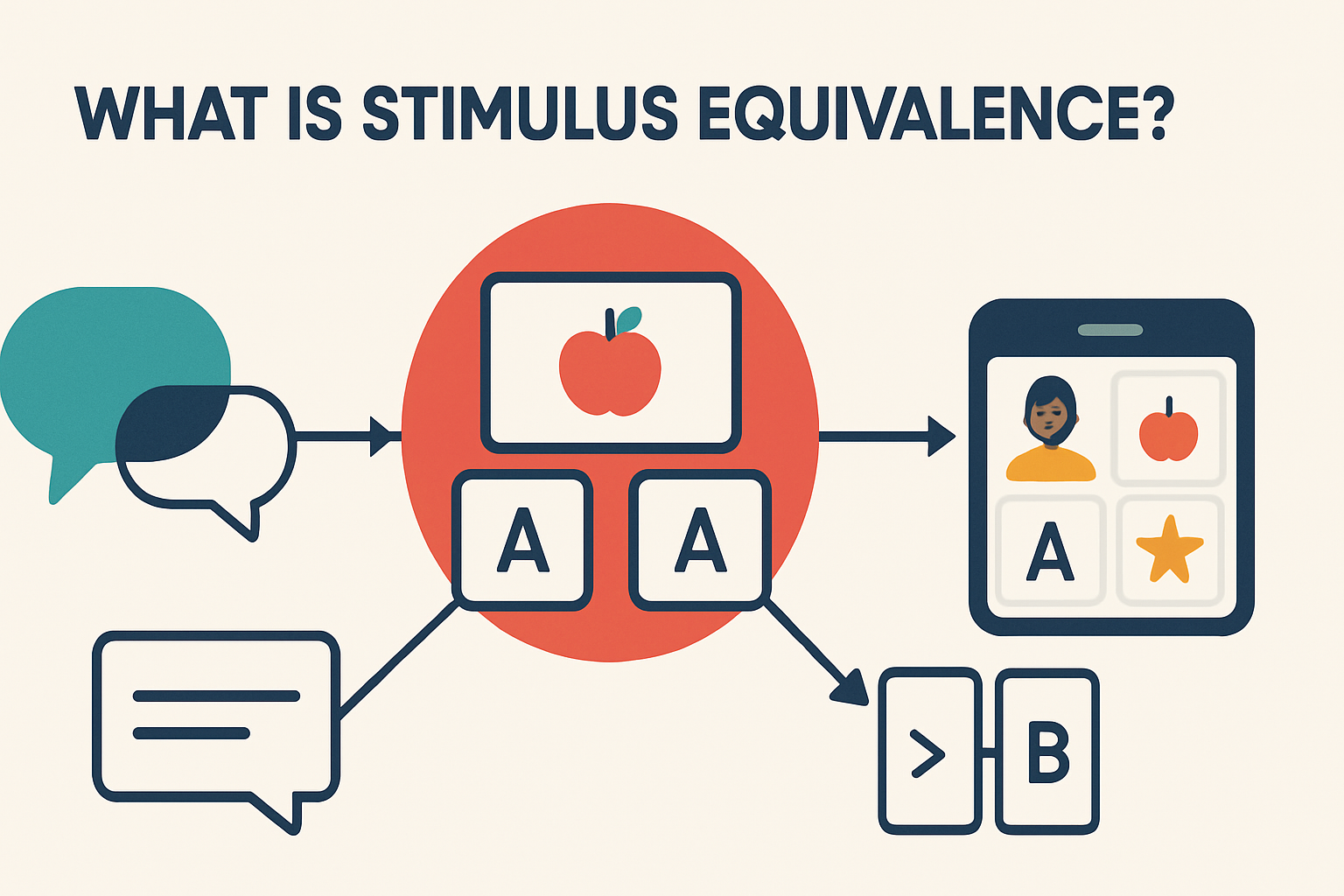
Stimulus equivalence describes a phenomenon where stimuli become interchangeable through derived relations. Unlike direct reinforcement of specific responses, equivalence emerges from relational learning. This occurs when an individual demonstrates three specific properties without additional training.
The concept originated from Sidman’s research on matching-to-sample procedures and has since become integral to understanding complex human behavior. It explains how we learn relationships between words, symbols, and their referents.
The Three Properties of Stimulus Equivalence
For true stimulus equivalence to exist, all three properties must be demonstrated. These properties form a logical system that defines equivalence relations in behavior analysis.
Reflexivity (A=A)
Reflexivity represents the simplest property where a stimulus matches itself. In practical terms, this means an individual can match identical stimuli without explicit training. For example, when shown a picture of a dog and asked to select the matching picture from an array, the individual chooses the identical dog picture.
This property demonstrates identity matching and serves as the foundation for more complex relations. It’s often tested through matching-to-sample tasks where the sample and correct comparison are physically identical.
Symmetry (If A=B, then B=A)
Symmetry involves bidirectional relationships between stimuli. When trained that A relates to B, the individual spontaneously demonstrates that B relates to A. This bidirectional relation emerges without direct reinforcement of the reverse direction.
For instance, if taught that “apple” matches with a picture of an apple, symmetry occurs when the individual can match the picture back to the word “apple” without additional training. This property is crucial for verbal behavior development.
Transitivity (If A=B and B=C, then A=C)
Transitivity represents the most complex property, involving derived relations across multiple stimuli. When trained that A relates to B and B relates to C, the individual demonstrates that A relates to C. This derived relation completes the equivalence class.
This property enables individuals to make connections between stimuli that were never directly paired. It’s essential for concept formation and complex reasoning skills in educational settings.
Practical ABA Examples of Stimulus Equivalence
Understanding stimulus equivalence becomes clearer through real-world applications. These examples demonstrate how the properties manifest in clinical practice and educational settings.
- Language Development: Teaching a child that the spoken word “ball” (A) matches a picture of a ball (B). Through symmetry, the child learns to say “ball” when shown the picture. Through transitivity, when taught that the written word BALL (C) matches the picture, the child can read “ball” when hearing the spoken word.
- Academic Skills: Teaching mathematical equivalence where 2+2 (A) equals 4 (B), and 4 (B) equals two squared (C). The student then understands that 2+2 equals two squared through transitivity, demonstrating mathematical reasoning.
- Social Skills: Teaching that a facial expression (A) represents “happy” (B), and the word “happy” (B) matches a scenario description (C). The individual then associates the facial expression with the scenario through derived relations.
BCBA Exam Relevance and Application
Stimulus equivalence questions frequently appear on the BCBA examination, particularly in sections covering verbal behavior and advanced principles. Understanding these concepts helps candidates analyze complex scenarios and select appropriate interventions.
Exam questions often present matching-to-sample scenarios and ask candidates to identify which equivalence property is being demonstrated. Other questions may require analyzing whether equivalence classes have formed based on given data.
- Identify which property (reflexivity, symmetry, or transitivity) is demonstrated in a given scenario
- Determine if stimulus equivalence has been established based on behavioral data
- Select appropriate teaching procedures to establish equivalence relations
- Analyze whether derived stimulus relations have emerged without direct training
- Apply equivalence concepts to verbal operants and language development
Common Exam Traps and Mistakes
Many candidates struggle with stimulus equivalence questions due to subtle distinctions between properties. Recognizing these common pitfalls can prevent errors on the examination.
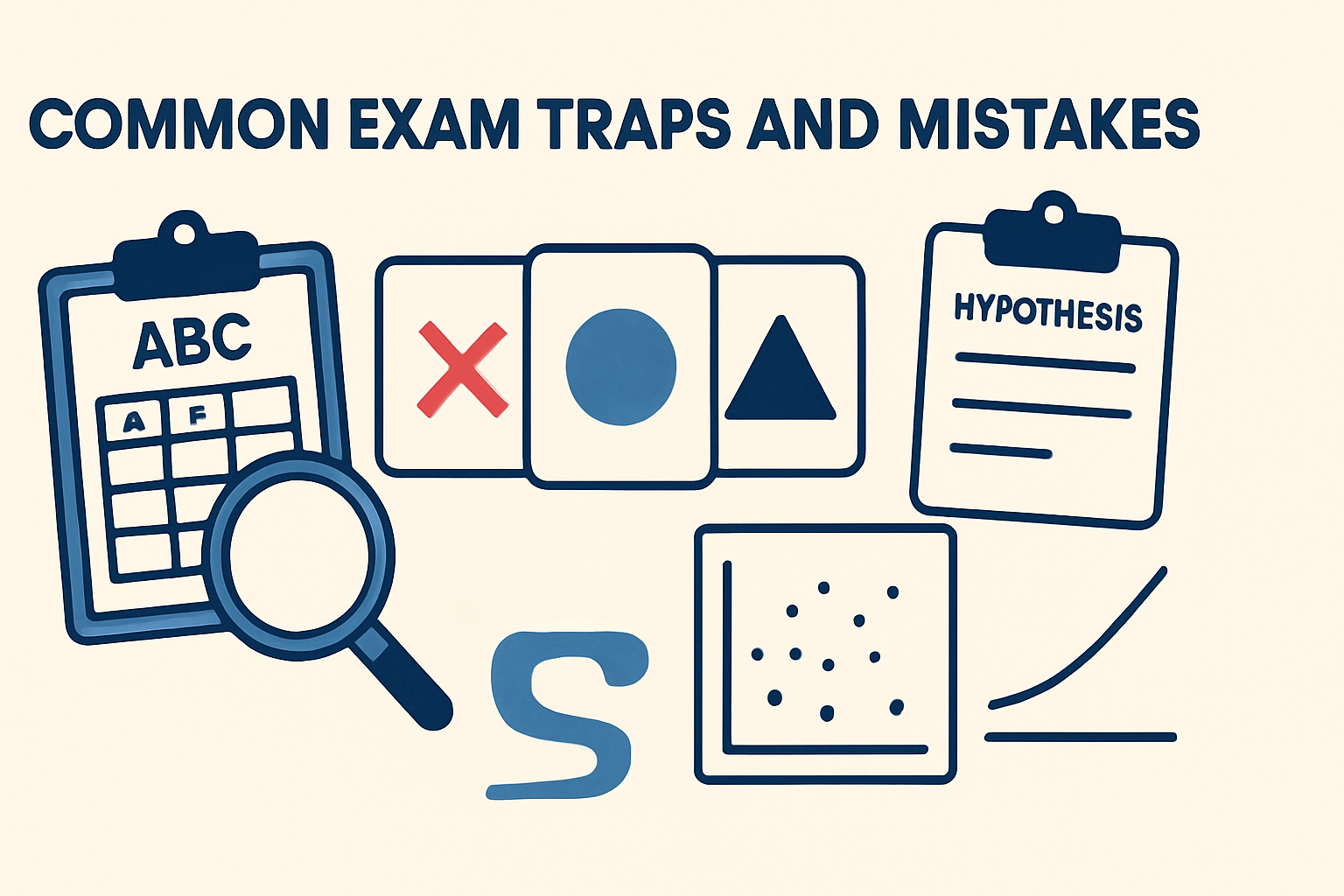
- Confusing symmetry with transitivity: Symmetry involves bidirectional relations between two stimuli, while transitivity involves derived relations across three or more stimuli
- Overlooking reflexivity requirements: True equivalence classes require all three properties, not just symmetry and transitivity
- Mistaking conditional discrimination for equivalence: Simple matching doesn’t guarantee equivalence relations have formed
- Assuming all derived relations indicate equivalence: Other relational frames exist beyond the three equivalence properties
- Neglecting testing procedures: Equivalence must be demonstrated through appropriate assessment methods, not assumed
Quick Checklist for Identifying Stimulus Equivalence
Use this practical checklist when analyzing whether stimulus equivalence has been established in clinical or exam scenarios.
- Check if reflexivity is demonstrated through identity matching tasks
- Verify symmetry by testing bidirectional relations between trained pairs
- Confirm transitivity by assessing derived relations across stimulus sets
- Ensure all three properties are present for true equivalence classification
- Document the emergence of untrained relations as evidence of equivalence
- Consider using stimulus equivalence testing procedures for accurate assessment
Teaching Strategies for Establishing Equivalence
Effective teaching of stimulus equivalence requires systematic procedures. These strategies help establish equivalence classes in educational and therapeutic settings.
Begin with matching-to-sample training for baseline relations. Use consistent reinforcement for correct responses while gradually introducing novel relations. Monitor for the emergence of untrained relations as evidence of equivalence formation.
Incorporate multiple exemplar training to promote generalization across stimuli. This approach helps establish robust equivalence classes that transfer to novel situations. For more on teaching complex relations, explore our guide on verbal operants.
Final Summary and Key Takeaways
Stimulus equivalence represents a sophisticated aspect of human learning with significant implications for applied behavior analysis. The three properties—reflexivity, symmetry, and transitivity—define when stimuli become functionally equivalent through derived relations.
Mastering these concepts enhances both clinical practice and exam performance. Remember that true equivalence requires demonstration of all three properties through appropriate assessment procedures. For comprehensive exam preparation, consider using our BCBA mock exam resources to practice these concepts.
Understanding stimulus equivalence helps behavior analysts design more effective interventions for language development, academic skills, and complex concept formation. These principles continue to evolve through research published in journals like the Journal of Applied Behavior Analysis and the Behavior Analyst Certification Board resources.


