
skill maintenance ABA: What Skill Maintenance Means in Applied Behavior Analysis
Skill maintenance represents the enduring performance of a target behavior after intervention components have been systematically reduced or withdrawn. This concept goes beyond initial learning to ensure lasting behavior change that persists in natural environments.
Table of Contents
- skill maintenance ABA: What Skill Maintenance Means in Applied Behavior Analysis
- Programming for Maintenance: Key Procedures and Schedules
- Skill Maintenance in Practice: Worked ABA Examples
- Skill Maintenance on the BCBA Exam: Common Traps and How to Avoid Them
- Quick Checklist: Are You Programming for Skill Maintenance?
- Final Summary: Ensuring Lasting Change
- References
Understanding skill maintenance is essential for effective applied behavior analysis practice and represents a critical component of socially significant outcomes.
The Operational Definition and Key Distinctions
Operationally, skill maintenance refers to the extent to which a learner continues to perform a target behavior after intervention has been partially or completely terminated. This differs from other phases of learning that BCBAs must distinguish:
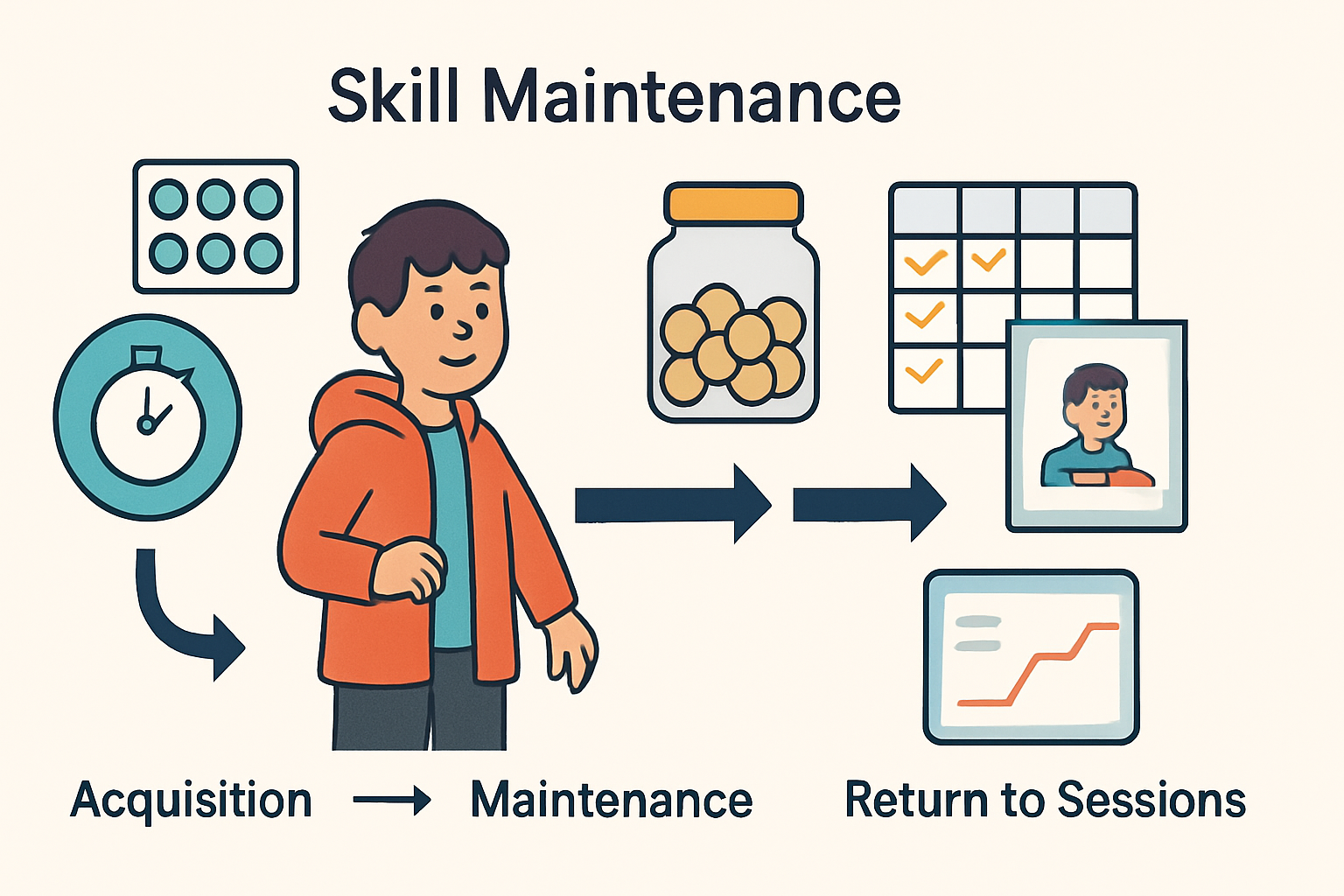
- Acquisition Phase: Initial learning period with intensive teaching and high-density reinforcement
- Generalization: Performance across different settings, people, or materials
- Maintenance: Performance over time after intervention reduction
Proper programming requires planning for all three phases from the beginning of intervention design.
Why Maintenance is an Ethical Imperative
The BACB Ethics Code (Section 2.09) explicitly requires behavior analysts to evaluate treatment efficacy, which includes ensuring skills maintain over time. Failing to program for maintenance violates several ethical principles:
- Wastes client resources and time
- Undermines client dignity through repeated re-teaching
- Fails to achieve socially significant behavior change
- Violates the principle of beneficence
Effective skill maintenance ABA programming is not optional—it’s an ethical responsibility that distinguishes competent practice.
Programming for Maintenance: Key Procedures and Schedules
Effective maintenance programming requires systematic planning and implementation of specific behavioral strategies. These procedures ensure skills transfer from artificial teaching contexts to natural environments.
Thinning Reinforcement Schedules: From CRF to Intermittent
The primary behavioral strategy for building maintenance involves systematically thinning reinforcement schedules. This process moves from continuous reinforcement (CRF) to intermittent schedules that better match natural contingencies.
- Start with continuous reinforcement during acquisition
- Gradually introduce variable-ratio (VR) schedules for response-based behaviors
- Use variable-interval (VI) schedules for time-based behaviors
- Avoid fixed schedules that create predictable patterns
Variable schedules create resistance to extinction and better prepare behaviors for natural reinforcement contingencies.
The Role of Natural Maintaining Contingencies
Successful maintenance requires transferring control from artificial reinforcers to natural maintaining contingencies that exist in the learner’s environment. This involves identifying and programming for:
- Social reinforcement (praise, attention, interaction)
- Intrinsic reinforcement (enjoyment, satisfaction, completion)
- Functional outcomes (access to preferred activities, task completion)
- Automatic reinforcement (sensory feedback, self-stimulation)
This transition links maintenance directly with generalization programming and ensures skills remain functional across contexts.
Designing a Maintenance Probe Schedule
Data-based decision making requires systematic maintenance probes to evaluate skill retention over time. A well-designed probe schedule includes:
- Initial probe 1-2 weeks after mastery criteria met
- Follow-up probes at 1 month, 3 months, and 6 months
- Annual checks for critical life skills
- Probes conducted in natural environments when possible
These probes provide objective data on skill retention and inform decisions about booster sessions or programming adjustments.
Skill Maintenance in Practice: Worked ABA Examples
Practical application demonstrates how maintenance principles work in real scenarios. These examples show both successful programming and common pitfalls.
Example 1: Maintaining Self-Help Skills
Scenario: A child learned to put on their coat independently during 1:1 sessions with edible reinforcement. Post-mastery, the skill is not maintained at home.
ABC Analysis: Antecedent = Parent says ‘time to go’, Behavior = whining/crying, Consequence = parent helps put coat on.
Hypothesized Function: Access to tangible (help) or escape from task demand.
Analysis: The reinforcement schedule was not properly thinned, and control was not transferred to natural contingencies (going outside to play). The artificial edible reinforcement created dependency rather than building maintenance through natural outcomes.
Example 2: Maintaining Vocational Task Completion
Scenario: An adult learner mastered a sorting task in a training setting with frequent praise. On the job site, accuracy declines significantly.
ABC Analysis: Antecedent = Presented with large batch to sort, Behavior = slow pace/increased errors, Consequence = supervisor takes over part of the task.
Hypothesized Function: Escape from difficult work demands.
Analysis: Thinning occurred too abruptly, natural reinforcement (paycheck, completion satisfaction) was not established, and task demands in the natural setting were not accounted for during training. The response maintenance plan failed to consider environmental differences.
Skill Maintenance on the BCBA Exam: Common Traps and How to Avoid Them
Exam questions often test subtle distinctions between maintenance and related concepts. Understanding these traps improves exam performance and clinical practice.
Trap 1: Confusing Maintenance with Generalization
Many candidates struggle to distinguish these related but distinct concepts. Remember this key difference:
- Maintenance = Performance over TIME after intervention reduction
- Generalization = Performance across SETTINGS, PEOPLE, or MATERIALS
Exam questions often ask “What is needed?” after a skill is mastered in one setting. If the issue is performance over time, think maintenance; if it’s performance in new contexts, think generalization.
Trap 2: Misidentifying the Appropriate Schedule
Candidates may select fixed schedules (FR, FI) for maintenance when variable schedules (VR, VI) are more appropriate. Key rule: Variable schedules create greater resistance to extinction and better simulate natural reinforcement patterns.
For response-based behaviors, use VR schedules; for time-based behaviors, use VI schedules. Fixed schedules create predictable patterns that don’t match most natural environments.
Trap 3: Overlooking the Ethical Dimension
Questions may frame maintenance failures as client or parent “non-compliance” issues. The correct analysis often points to the behavior analyst’s responsibility to program for maintenance and evaluate long-term outcomes.
Remember that according to the BACB Ethics Code, behavior analysts must ensure treatments produce lasting change. Maintenance programming is not optional—it’s an ethical requirement for effective practice.
Quick Checklist: Are You Programming for Skill Maintenance?
Use this actionable checklist to audit your maintenance programming and ensure lasting behavior change:
- Did you plan maintenance from the beginning of intervention design?
- Have you systematically thinned reinforcement schedules from CRF to variable schedules?
- Have you identified and programmed for natural maintaining contingencies?
- Have you scheduled regular maintenance probes (1 week, 1 month, 3 months post-mastery)?
- Have you trained stakeholders (parents, teachers, staff) to maintain skills naturally?
- Have you considered environmental modifications to support maintenance?
- Does your data show skill retention over time, not just initial acquisition?
- Have you linked maintenance programming to generalization goals?
- Have you documented your maintenance plan in the behavior intervention plan?
- Have you evaluated maintenance outcomes as part of treatment efficacy assessment?
Final Summary: Ensuring Lasting Change
Skill maintenance represents the culmination of effective applied behavior analysis programming. It transforms temporary learning into lasting behavior change that improves quality of life. Successful maintenance requires:
- Systematic planning from intervention onset
- Gradual fading of artificial supports
- Transfer to natural reinforcement contingencies
- Regular data collection through maintenance probes
- Ethical commitment to lasting outcomes
By mastering these principles, BCBAs ensure their interventions produce meaningful, enduring change that respects client dignity and maximizes treatment effectiveness. For more on related concepts, explore our guide on generalization and maintenance or learn about the seven dimensions of ABA that guide effective practice.
Remember that skill maintenance is not merely a technical procedure—it’s an ethical imperative that distinguishes competent behavior analysis from temporary behavior modification. By programming for maintenance, you ensure your interventions create lasting improvements in your clients’ lives.


