
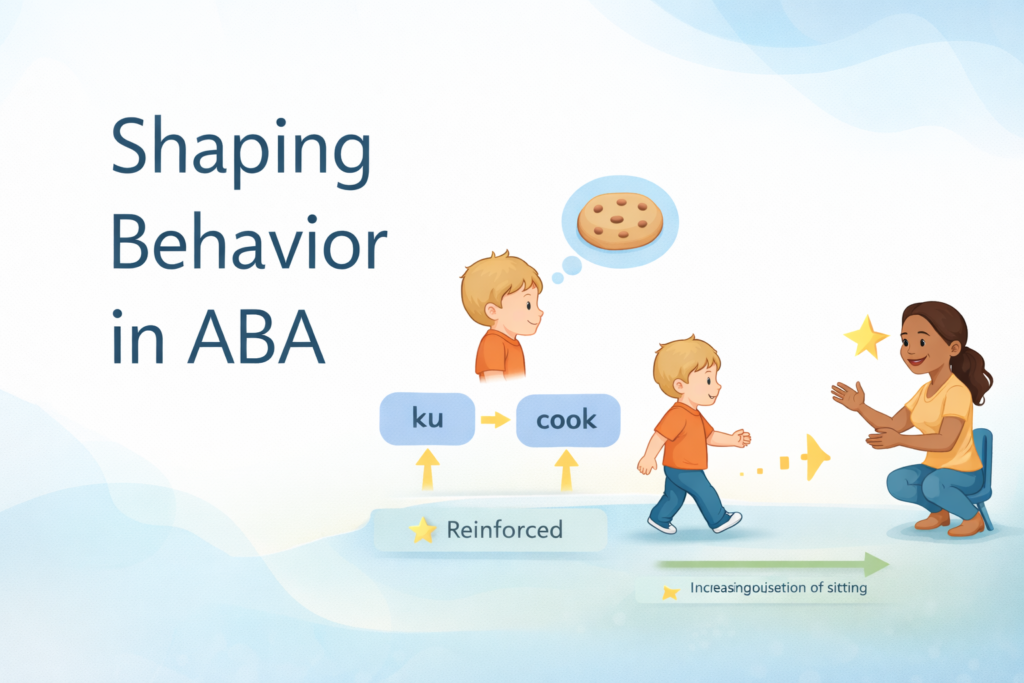
Shaping Behavior in ABA: Simple Definition & Examples
Shaping is a core teaching procedure in Applied Behavior Analysis (ABA) and a high-yield concept on the BCBA® exam.
Many BCBA candidates can recite the definition of shaping, but still miss exam questions because they confuse shaping with prompting, reinforcement, or chaining. In ABA, shaping has a precise, technical meaning. According to the BACB® Task List, shaping is a core skill acquisition procedure used to build new behavior gradually.
This guide explains shaping behavior in ABA using clear language, real-world examples, and BCBA exam tips. You can use it to study for the exam, design teaching programs, and explain shaping to parents or staff.
What Is Shaping Behavior in ABA?
Definition (task-list style):
Shaping is a procedure in which successive approximations of a target behavior are differentially reinforced until the final behavior is acquired.
In shaping:
-
Only behaviors that are closer to the target behavior contact reinforcement
-
Earlier responses are no longer reinforced
If all responses continue to receive reinforcement, shaping is not occurring.
Breaking Down the Definition
For BCBA exam questions, every part of the definition matters.
Successive approximations
These are behaviors that gradually resemble the target behavior more and more.
Differential reinforcement
Some responses are reinforced, while others are not.
Target behavior
The final, clearly defined behavior you want the learner to perform.
📌 Exam rule:
If reinforcement is not being shifted across responses, the procedure is not shaping.
Basic Pattern of Shaping in ABA
In operant conditioning terms, shaping follows this pattern:
-
A learner emits a response
-
Responses closer to the target contact reinforcement
-
Responses farther from the target stop contacting reinforcement
-
Over time, the target behavior emerges
ABA focuses on what happens to behavior over time, not on whether the procedure sounds supportive or encouraging.
Everyday Examples of Shaping Behavior in ABA
1. Teaching vocal requests
Target behavior:
Child says “cookie” clearly to request a snack.
Successive approximations might include:
-
Any vocal sound
-
“ku”
-
“cook”
-
“cookie”
Each step receives reinforcement only until the next approximation is introduced.
→ If all vocalizations continue to receive reinforcement, shaping has stopped.
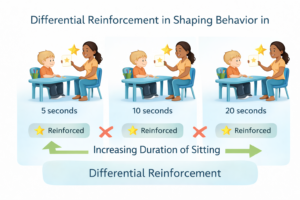
2. Shaping sitting behavior
Target behavior:
Student sits in chair for 5 minutes during group instruction.
Approximations:
-
Standing near the chair
-
Sitting for 10 seconds
-
Sitting for 1 minute
-
Sitting for 5 minutes
Reinforcement shifts as expectations increase.
3. BCBA-style exam example
A learner currently crawls to desired items. The BCBA wants to teach walking.
The therapist reinforces:
-
Standing independently
-
Taking one step
-
Taking several steps
-
Walking across the room
→ This is shaping, because reinforcement is delivered for progressively closer forms of the target response.
Shaping Behavior in ABA vs Prompting and Chaining
Shaping and prompting are often confused on the BCBA exam.
Shaping
-
No physical or verbal assistance is required
-
Behavior changes due to reinforcement history
-
Builds a new behavior gradually
Prompting
-
Involves external assistance (verbal, gestural, physical)
-
Used to evoke a response the learner can already perform
📌 Exam tip:
If the adult is helping the learner perform the response, the answer is likely prompting, not shaping.
Shaping vs Chaining
Another common trap.
-
Shaping builds the form of a behavior
-
Chaining links behaviors that already exist into a sequence
If the learner already knows each step but needs help performing them in order → chaining
If the learner does not yet produce the behavior → shaping
Common Mistakes When Using Shaping Behavior in ABA
❌ Reinforcing too many approximations at once
❌ Failing to define the target behavior
❌ Confusing shaping with reinforcement alone
❌ Continuing to reinforce early responses
BCBA exam questions often ask:
“Which response should be reinforced next?”
If you cannot answer that, the shaping procedure is incomplete.
When Should Shaping Be Used?
Shaping is appropriate when:
-
The learner does not currently emit the target behavior
-
The behavior is complex or effortful
-
Gradual acquisition is necessary
Shaping is not necessary when:
-
The behavior already occurs
-
Prompting or instructions would be more efficient
How Shaping Appears on the BCBA® Exam
Look for these cues in exam questions:
-
The behavior changes gradually over time
-
Reinforcement criteria shift across responses
-
The stem asks which response to reinforce next
-
Incorrect answers reinforce all responses
When in doubt, ask:
“Is reinforcement being delivered differently as behavior improves?”
If yes → shaping.
Quick Study Checklist
Before the exam, make sure you can:
-
Define shaping using task-list language
-
Identify successive approximations
-
Distinguish shaping from prompting and chaining
-
Explain why reinforcing all responses is incorrect
-
Select the correct next approximation in scenarios
Final Thoughts
Shaping behavior in ABA is not just “reinforcing effort.” It is a precise, systematic procedure for building new behavior.
When used correctly, shaping allows learners to contact reinforcement while gradually moving toward meaningful, functional skills. When misunderstood, it becomes ineffective and confusing.
For BCBA candidates, mastering shaping means more than memorizing a definition. It means understanding how reinforcement changes across time—the skill that ABA exams are designed to test.


