
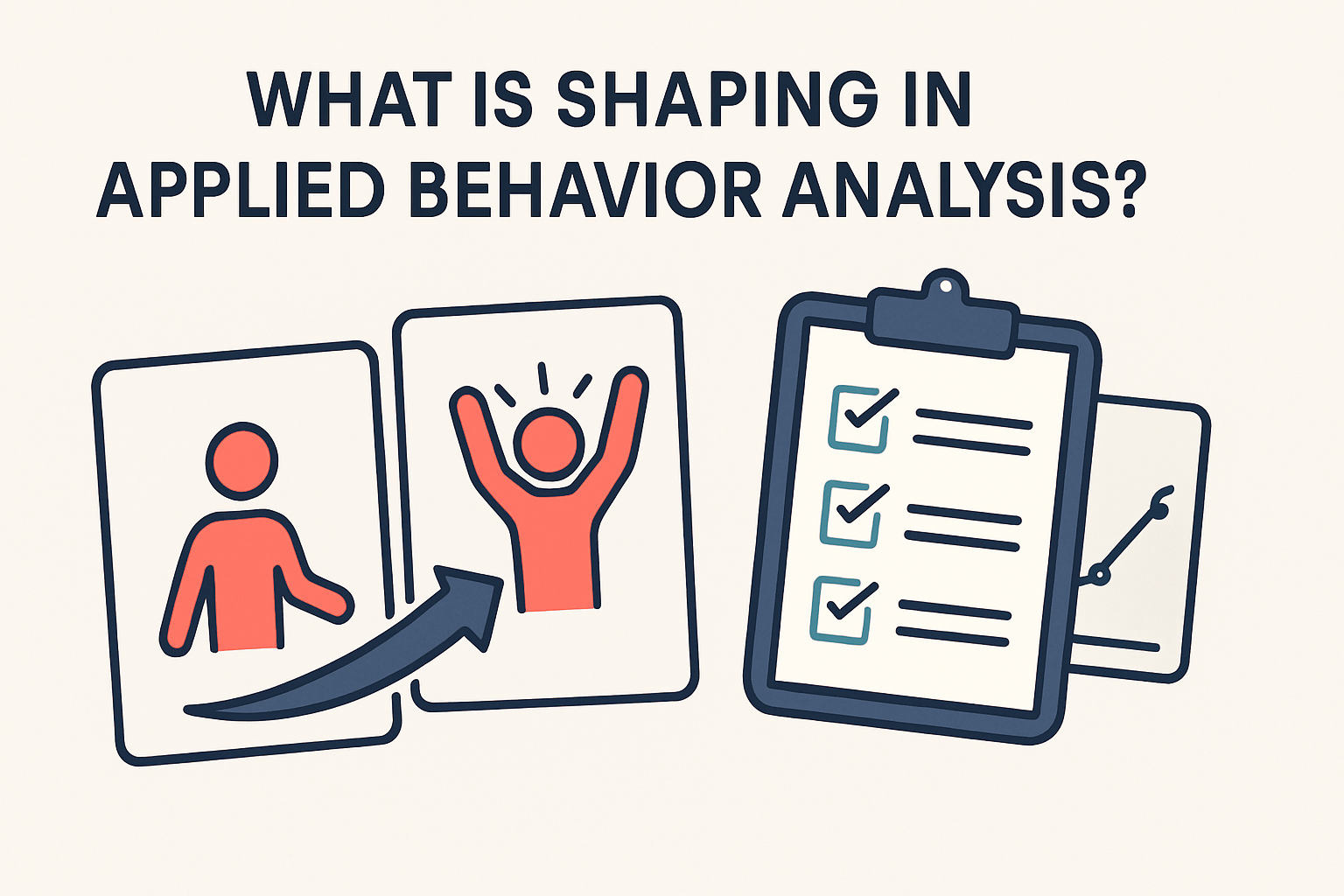
shaping behavior: What is Shaping in Applied Behavior Analysis?
Shaping behavior is a fundamental behavior change procedure in applied behavior analysis that involves reinforcing successive approximations toward a target behavior. This method systematically builds new behaviors by starting with what the learner can already do and gradually requiring closer approximations to the desired terminal behavior.
Table of Contents
- shaping behavior: What is Shaping in Applied Behavior Analysis?
- Implementing Shaping: Worked Examples from Simple to Complex
- Shaping on the BCBA Exam: Common Traps and How to Avoid Them
- Quick-Reference Checklist for Effective Shaping
- Final Summary and Exam Strategy
Core Definition and Key Characteristics
The formal definition of shaping involves differential reinforcement of successive approximations of a target behavior. This means you reinforce behaviors that are increasingly similar to your goal while putting previous approximations on extinction.
Three essential components define shaping:
- Starting behavior: The initial behavior that already occurs in the learner’s repertoire
- Successive approximations: The intermediate steps that gradually move toward the terminal behavior
- Terminal behavior: The final goal behavior you want to establish
Shaping vs. Chaining: A Critical Distinction
Many BCBA exam questions test your ability to distinguish between shaping and chaining. Shaping creates a new behavior form by modifying existing behavior through differential reinforcement. In contrast, chaining links together a sequence of already established behaviors to form a complex skill.
For example, shaping might teach a child to say ‘water’ when they previously only made vowel sounds. Chaining would teach them to wash hands by linking turning on water, applying soap, rubbing hands, and drying – each step already exists independently.
Implementing Shaping: Worked Examples from Simple to Complex
Understanding shaping behavior requires seeing it in action. These practical examples demonstrate how to apply shaping across different domains.
Example 1: Shaping Vocalizations in a Young Learner
Target behavior: Saying ‘ball’ clearly. Starting behavior: Any vocalization. The shaping process involves several successive approximations:
- Step 1: Reinforce any vocal sound (even ‘ah’)
- Step 2: Reinforce only sounds with lip movement
- Step 3: Reinforce only /b/ sounds specifically
- Step 4: Reinforce ‘ba’ sound combinations
- Step 5: Reinforce ‘ball’ with clear articulation
The hypothesized function is social positive reinforcement through attention and praise. Each step uses differential reinforcement, where only the current approximation receives reinforcement while previous ones are placed on extinction.
Example 2: Shaping Tolerance for Hair Brushing
Target behavior: Sitting calmly for 2 minutes of hair brushing. Starting behavior: Tolerating the brush in the same room. This example demonstrates shaping to reduce escape-maintained behavior:
- Approximation 1: Brush in room, no approach required
- Approximation 2: Brush on table within 3 feet
- Approximation 3: Brief touch to hair with brush
- Approximation 4: One stroke through hair
- Approximation 5: Multiple strokes with brief duration
- Terminal behavior: Full 2-minute brushing session
Reinforcement might include preferred items or activities following each successful approximation, gradually building tolerance through positive reinforcement of successive approximations.
Example 3: Shaping Complex Play Skills
Target behavior: Building a 3-block tower independently. Starting behavior: Touching a single block. This example shows how shaping often combines with other procedures:
- Initial behavior: Touch any block (reinforced)
- Approximation 1: Pick up one block (reinforced)
- Approximation 2: Place block on table (reinforced)
- Approximation 3: Stack two blocks with minimal assistance
- Terminal behavior: Independently stack three blocks
This process might incorporate prompting strategies like physical guidance that are faded as the behavior develops. The reinforcement schedule gradually thins as the skill becomes more established.
Shaping on the BCBA Exam: Common Traps and How to Avoid Them
BCBA exam questions about shaping behavior often test nuanced understanding. Recognizing these common traps can significantly improve your exam performance.
Trap 1: Confusing the Starting Point
The starting behavior must already occur at some level in the learner’s repertoire. Exam questions may present scenarios where a behavior never occurs and ask if shaping is appropriate – the answer is typically no. Shaping requires something to shape from.
For example, if a child has never made any vocal sounds, you cannot shape speech sounds. You would need to establish some vocal behavior first through other means before shaping can begin.
Trap 2: Moving Too Fast or Too Slow
Effective shaping requires careful progression through approximations. Moving too quickly can lead to ratio strain or extinction, while moving too slowly creates inefficiency. The key is monitoring client progress and adjusting criteria appropriately.
Look for exam questions that describe shaping steps that are either too large (causing frustration) or too small (wasting time). The ideal progression maintains momentum while ensuring success at each step.
Trap 3: Overlooking the Role of Differential Reinforcement
Shaping fundamentally relies on differential reinforcement – reinforcing only the current approximation while placing previous ones on extinction. Exam questions may test whether you understand this selective reinforcement process.
Remember: If you continue reinforcing earlier approximations, you’re not shaping effectively. The extinction component is crucial for moving behavior toward the terminal goal. This concept connects to broader principles of differential reinforcement procedures in ABA.
Quick-Reference Checklist for Effective Shaping
Use this practical checklist to implement shaping correctly and answer related BCBA exam questions accurately.
- Identify terminal behavior: Clearly define what you want the learner to do
- Determine starting behavior: Identify what the learner already does that approximates the goal
- Plan successive approximations: Break down the path from start to finish into manageable steps
- Establish reinforcement criteria: Define exactly what earns reinforcement at each step
- Implement differential reinforcement: Reinforce only the current approximation
- Monitor progress closely: Track frequency and quality of approximations
- Adjust criteria as needed: Move forward when ready, or step back if needed
- Fade reinforcement gradually: Thin the schedule as behavior becomes established
- Program for generalization: Ensure the behavior occurs across settings and people
- Document the process: Record approximations, criteria, and outcomes for analysis
Final Summary and Exam Strategy
Shaping behavior represents one of the most elegant applications of operant conditioning principles in ABA practice. For BCBA exam success, remember these key points:
Shaping creates new behaviors through differential reinforcement of successive approximations. It requires a starting behavior that already occurs, careful progression through intermediate steps, and systematic application of reinforcement and extinction. Distinguish it clearly from chaining, which links existing behaviors rather than creating new forms.
When answering exam questions, look for keywords like ‘successive approximations,’ ‘differential reinforcement,’ and ‘terminal behavior.’ Avoid common traps by remembering that shaping requires an existing behavior to shape from, involves selective reinforcement, and progresses at a pace appropriate for the learner.
For further study of related procedures, explore our guides on chaining and differential reinforcement. The official Behavior Analyst Certification Board website provides additional resources on these fundamental procedures.
Mastering shaping behavior not only prepares you for exam questions but also equips you with a powerful tool for creating meaningful behavior change in clinical practice. This procedure exemplifies the systematic approach that defines applied behavior analysis as a science of learning and behavior.


