

Understanding the discriminative stimulus (SD) is fundamental to mastering applied behavior analysis and preparing for the BCBA exam. This concept represents a stimulus that signals the availability of reinforcement for a specific behavior. When you grasp how SDs establish stimulus control, you’ll better understand behavior-environment relationships in clinical practice.
Table of Contents
- discriminative stimulus ABA: Defining SD: The Discriminative Stimulus in ABA
- SD in Action: Worked Examples from Practice
- SD on the BCBA® Exam: Relevance and Common Traps
- Quick Checklist: Is It an SD?
- Summary and Key Takeaways
discriminative stimulus ABA: Defining SD: The Discriminative Stimulus in ABA
An SD is defined as a stimulus in the presence of which a particular response has been reinforced in the past. This antecedent stimulus gains control over behavior because it predicts that reinforcement is available. The key characteristic is that the SD doesn’t cause behavior but rather sets the occasion for it.
The Formal Definition and Key Characteristics
A discriminative stimulus signals that reinforcement is available for a specific response. This differs from an S-Delta (SΔ), which signals that reinforcement is not available. The relationship is defined by the individual’s learning history, not by any inherent property of the stimulus itself.
- SD (Discriminative Stimulus): Signals reinforcement is available for a specific response
- S-Delta (SΔ): Signals reinforcement is NOT available for that response
- Stimulus control: When behavior occurs consistently in the presence of an SD but not in its absence
- Learning history: The critical factor that establishes an SD’s function
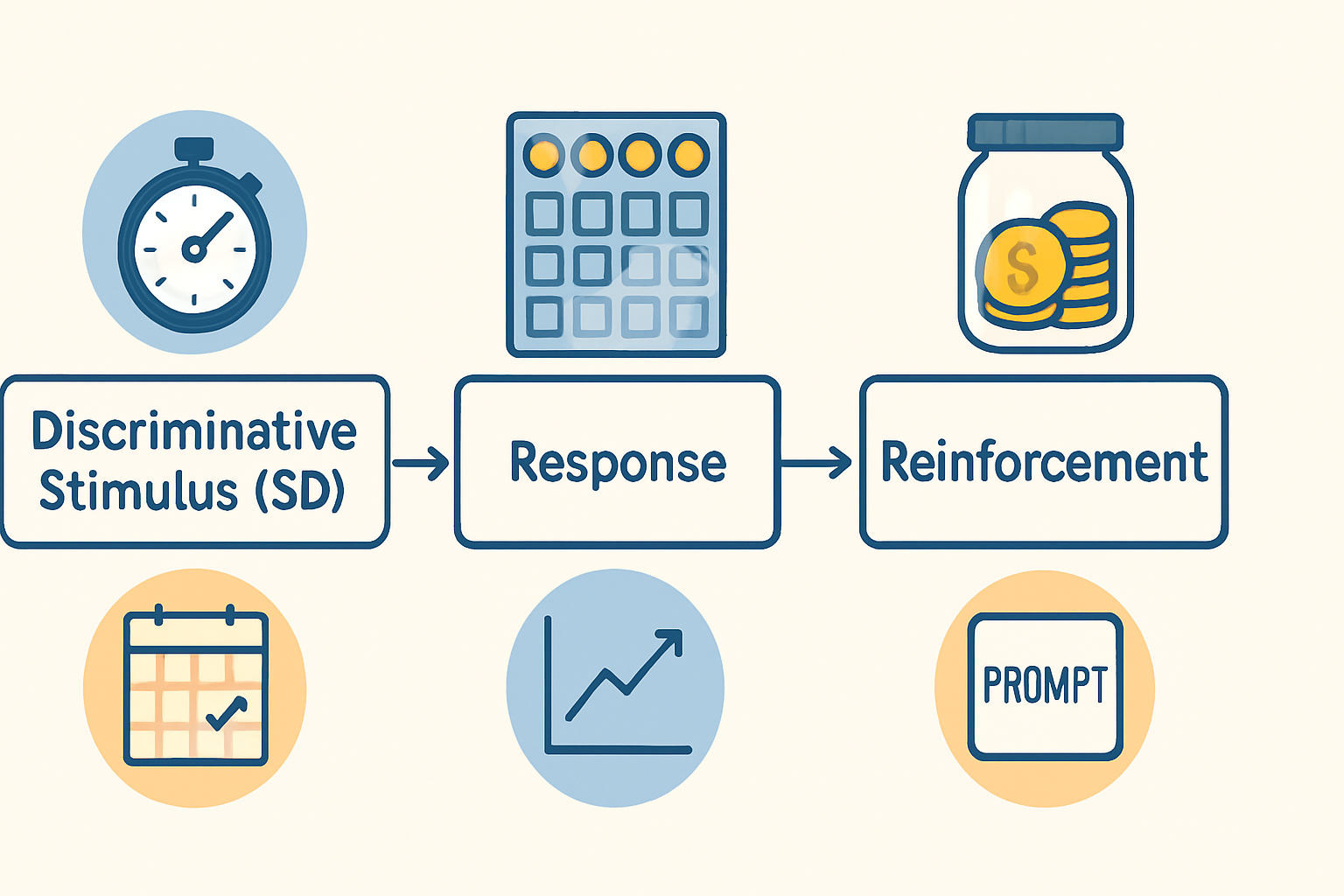
SD in the Three-Term Contingency (ABC)
The discriminative stimulus fits into the three-term contingency as the antecedent component. This ABC framework helps analyze how environmental events influence behavior. The SD specifically occupies the ‘A’ position, preceding the behavior and signaling what consequence will follow.
Consider this sequence: When the phone rings (SD), you answer it (behavior) because this has led to conversation (reinforcement) in the past. The ringing phone doesn’t force you to answer, but it sets the occasion for that response based on your learning history.
SD in Action: Worked Examples from Practice
Real-world examples clarify how discriminative stimuli operate in various contexts. These scenarios demonstrate the practical application of SD concepts in ABA therapy and everyday situations.
Example 1: The SD for Manding (Requesting)
A child sees their favorite cookie on the kitchen counter (SD). In the past, pointing at the cookie (behavior) led to receiving it (reinforcement). The cookie’s presence signals that requesting will likely be successful. This establishes stimulus control where the cookie reliably evokes requesting behavior.
Example 2: The SD for Compliance in a Classroom
A teacher presents a flashcard with the word ‘CAT’ (SD). The student has learned that saying ‘cat’ (behavior) when shown this card results in praise (reinforcement). The flashcard gains discriminative properties through this consistent reinforcement history. Different flashcards become different SDs for different verbal responses.
Example 3: The SD for Greeting a Friend
Seeing a familiar person wave (SD) sets the occasion for waving back (behavior) because this social exchange has been reinforced in the past. The wave functions as an SD because it predicts social reinforcement. This example shows how social stimuli can acquire discriminative functions through natural reinforcement.
SD on the BCBA® Exam: Relevance and Common Traps
Discriminative stimulus questions appear frequently on the BCBA exam, often testing your ability to identify SDs within scenarios or distinguish them from related concepts. Understanding these exam patterns helps you approach questions strategically.
How SD Questions Are Typically Framed
Exam questions typically present brief scenarios and ask you to identify the discriminative stimulus. They may also ask you to distinguish SDs from motivating operations (MOs) or S-Deltas. Some questions test your understanding of how SDs establish stimulus control or fade during prompt fading procedures.
Frequent Exam Pitfalls to Avoid
Several common mistakes trip up candidates on SD-related questions. Being aware of these exam traps improves your accuracy.
- Confusing SD with MO: Remember that SDs signal reinforcement availability, while MOs alter the value of reinforcement
- Overlooking learning history: An SD is defined by past reinforcement, not just current stimulus properties
- Missing S-Delta distinctions: Failing to recognize when a stimulus signals non-reinforcement
- Ignoring stimulus control: Not recognizing when behavior is under discriminative control
For more on distinguishing SDs from other antecedents, see our guide on SD vs MO differences.
Quick Checklist: Is It an SD?
Use this practical checklist to quickly determine if a stimulus functions as a discriminative stimulus in any given scenario. This tool helps with self-assessment and rapid review.
- Does the stimulus signal that reinforcement is available for a specific response?
- Has the behavior been reinforced in the presence of this stimulus in the past?
- Does the behavior occur more frequently in the presence of this stimulus?
- Is the stimulus an antecedent that precedes the behavior?
- Does removing the stimulus decrease the likelihood of the behavior?
- Can you identify the specific reinforcement history for this stimulus-behavior relationship?
Summary and Key Takeaways
The discriminative stimulus is a cornerstone concept in ABA that every BCBA candidate must master. Understanding SDs helps you analyze behavior-environment relationships and implement effective interventions.
Key points to remember include: SDs signal reinforcement availability based on learning history, they establish stimulus control over behavior, and they differ fundamentally from motivating operations. On the exam, carefully analyze scenarios to identify true discriminative stimuli and avoid common confusion points.
For comprehensive exam preparation, explore our BCBA exam prep guide and practice with mock exam questions. The BACB’s Task List provides official guidance on required SD knowledge.


