
Understanding Schedules of Reinforcement
A schedule of reinforcement specifies exactly when reinforcement will be delivered following a target behavior. These schedules are fundamental to behavior analysis because they determine how quickly behaviors are acquired and how resistant they are to extinction. Understanding these patterns is essential for both clinical practice and exam success.
Table of Contents
- Understanding Schedules of Reinforcement
- Applying Schedules: Worked ABA Examples
- Schedules of Reinforcement on the BCBA Exam
- Quick-Reference Checklist and Summary
The Basic Dichotomy: Continuous vs. Intermittent
Continuous reinforcement (CRF) delivers reinforcement after every occurrence of the target behavior. This schedule is most effective during the initial acquisition phase of learning. In contrast, intermittent reinforcement (INT) delivers reinforcement only after some occurrences of the behavior, making behaviors more resistant to extinction during maintenance phases.
- CRF: Best for teaching new skills; produces rapid learning but quick extinction
- INT: Best for maintaining established behaviors; produces slower learning but greater resistance to extinction
- Transition from CRF to INT is a key strategy for promoting response maintenance
The Four Classic Intermittent Schedules
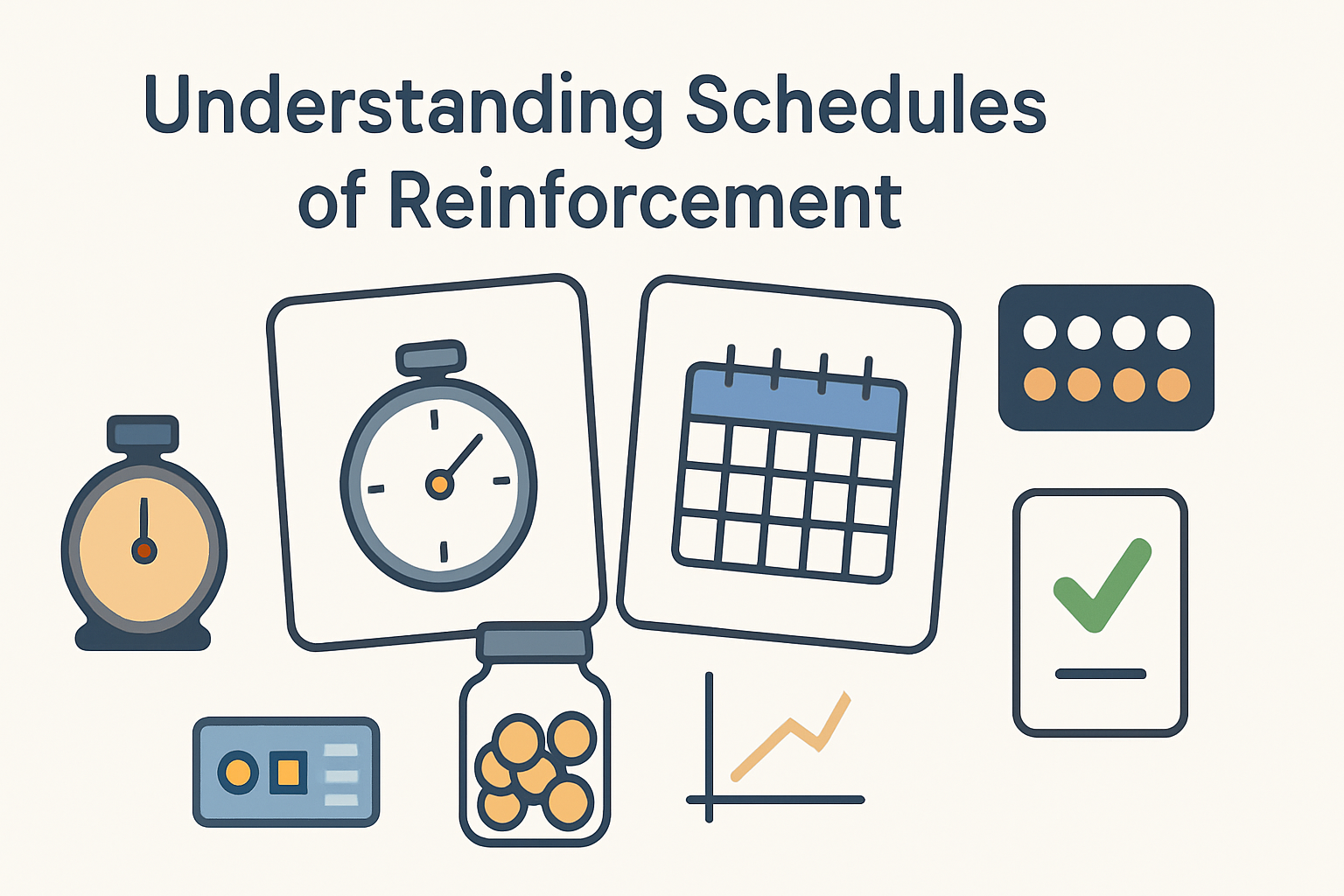
The four basic intermittent schedules are defined by whether they are ratio-based or interval-based, and whether they are fixed or variable. Ratio schedules depend on the number of responses, while interval schedules depend on the passage of time.
- Fixed Ratio (FR): Reinforcement after a set number of responses (e.g., FR-5)
- Variable Ratio (VR): Reinforcement after an average number of responses (e.g., VR-3)
- Fixed Interval (FI): Reinforcement after the first response following a set time period (e.g., FI-2min)
- Variable Interval (VI): Reinforcement after the first response following variable time periods (e.g., VI-30sec)
Applying Schedules: Worked ABA Examples
Let’s examine how different schedules of reinforcement function in real clinical scenarios. Each example includes the antecedent, behavior, and consequence to illustrate the reinforcement contingency clearly.
Example 1: Building Academic Engagement with a VR Schedule
A student in a classroom setting raises their hand to answer teacher questions. The teacher implements a VR-3 schedule, meaning reinforcement (praise and attention) is delivered after an average of three hand raises.
- Antecedent: Teacher asks a question to the class
- Behavior: Student raises hand
- Consequence: Teacher calls on student (VR-3 schedule)
- Pattern: Steady, high-rate responding typical of VR schedules
- Function: Access to adult attention and academic reinforcement
Example 2: Reducing Stereotypy Using a DRO FI Schedule
A client engages in hand-flapping behavior maintained by automatic reinforcement. The BCBA implements a Differential Reinforcement of Other Behavior (DRO) procedure using an FI-2min schedule.
- Antecedent: No hand-flapping for 2 minutes
- Behavior: Absence of target behavior
- Consequence: Access to preferred item (FI-2min DRO)
- Pattern: Post-reinforcement pause followed by responding as interval ends
- Key feature: Time-based rather than response-based reinforcement
Example 3: Staff Training with a FR Schedule
A behavior technician is learning to collect trial-by-trial data during discrete trial training. The supervisor provides corrective feedback using an FR-5 schedule.
- Antecedent: BT completes 5 consecutive correct data entries
- Behavior: Accurate data collection
- Consequence: Supervisor provides specific praise and feedback (FR-5)
- Pattern: Characteristic ‘break-and-run’ pattern with pauses after reinforcement
- Utility: Effective for skill acquisition while gradually thinning reinforcement
Schedules of Reinforcement on the BCBA Exam
Exam questions about schedules of reinforcement typically present clinical vignettes requiring you to identify the schedule in use. Understanding the defining characteristics of each schedule is more important than memorizing definitions.
Common Exam Traps and How to Avoid Them
Several patterns consistently trip up exam candidates. Being aware of these common pitfalls can help you avoid costly mistakes.
- Confusing ratio vs. interval: Remember ratio = responses, interval = time
- Misidentifying variable vs. fixed: Look for patterns across multiple instances, not single examples
- Over-applying to respondent conditioning: Schedules apply only to operant behavior
- Forgetting real-world approximations: Natural contingencies often create ‘VR-like’ or ‘VI-like’ patterns
- Ignoring compound schedules: Some scenarios involve compound schedules of reinforcement that combine elements
Practice Identifying Schedules from Vignettes
Test your understanding with these exam-style scenarios. Try to identify the schedule before reading the explanations.
Scenario 1: A child receives a sticker after completing every third math problem correctly during independent work time. The teacher counts completed problems and delivers reinforcement predictably.
Scenario 2: A client working on vocational skills receives supervisor praise at unpredictable times throughout the work session, averaging about every 5 minutes of on-task behavior.
Scenario 3: During toilet training, a child receives immediate praise and a small treat every time they successfully use the toilet.
Answers: Scenario 1 is FR-3 (fixed ratio). Scenario 2 is VI-5min (variable interval). Scenario 3 is CRF (continuous reinforcement). Notice how each scenario’s pattern matches the schedule’s defining characteristics.
Quick-Reference Checklist and Summary
Use this checklist to review key concepts about schedules of reinforcement before your exam or when designing interventions.
- CRF: Every response reinforced; use for acquisition
- FR: Fixed number of responses; produces break-and-run pattern
- VR: Variable number of responses; produces steady, high-rate responding
- FI: Fixed time interval; produces scalloped pattern with post-reinforcement pause
- VI: Variable time interval; produces steady, moderate-rate responding
- Always consider thinning schedules from dense to lean during maintenance
- Match schedule selection to behavioral function and clinical goals
- Remember that natural environments often create intermittent reinforcement patterns
Schedules of reinforcement represent one of the most practical applications of behavior analysis principles. Mastery requires understanding both the theoretical patterns and their clinical implementation. For related concepts, explore our guide on differential reinforcement procedures and positive reinforcement strategies. The BACB Task List includes multiple items related to reinforcement schedules, making this a high-yield topic for exam preparation.


