
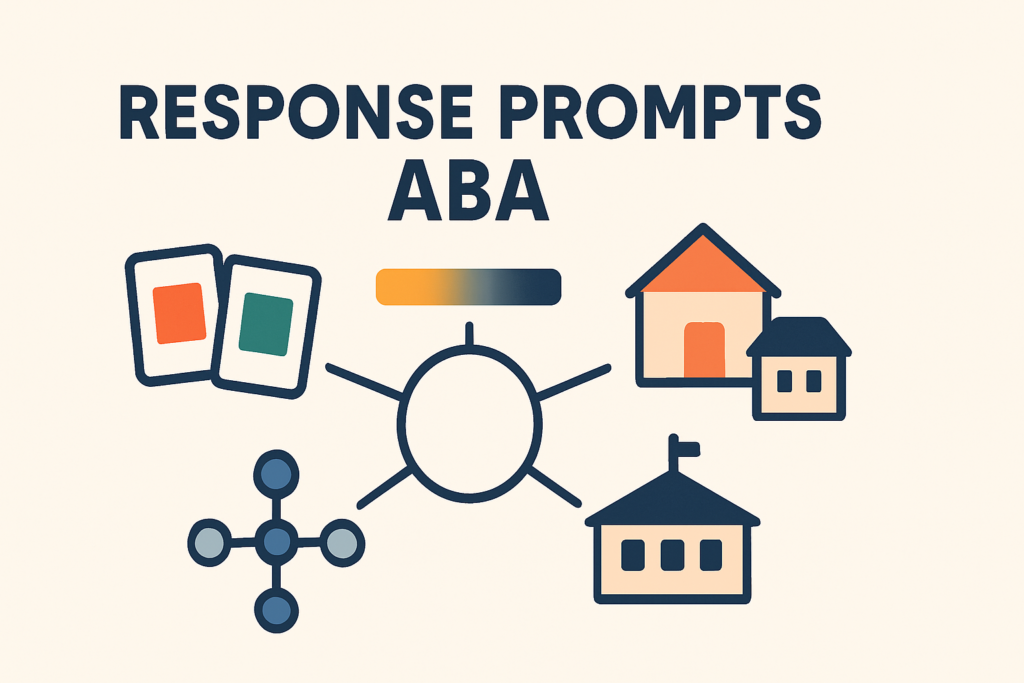
response prompts ABA: Defining Response Prompts in ABA
Response prompts are antecedent stimuli added after the discriminative stimulus to increase the likelihood of a correct response. These prompts help learners acquire new skills by providing additional support during the learning process.
Table of Contents
- response prompts ABA: Defining Response Prompts in ABA
- Applying Response Prompts: Worked Examples and Fading
- Response Prompts on the BCBA Exam: Common Traps and Ethical Links
- Quick Checklist for Using Response Prompts
- Final Summary and Next Steps
Understanding response prompts is essential for effective teaching and appears frequently on the BCBA exam. They differ from stimulus prompts, which alter the SD itself rather than providing additional cues after it.
Response Prompts vs. Stimulus Prompts: A Key Distinction
The critical difference lies in when and how the prompt is delivered. Response prompts occur after the SD, while stimulus prompts modify the SD or antecedent itself.
- Response prompts: Verbal instruction, model, physical guidance delivered after “Touch blue”
- Stimulus prompts: Making the blue card larger or brighter before saying “Touch blue”
- Response prompts target the learner’s behavior directly
- Stimulus prompts alter the environmental stimuli
- This distinction affects data collection and fading procedures
The Hierarchy of Response Prompts
Response prompts follow a systematic hierarchy from least to most intrusive. This structure guides prompt fading procedures and helps maintain learner independence.
- Verbal prompts: Spoken instructions or hints (“Put your hands under the water”)
- Gestural prompts: Pointing, nodding, or other non-verbal cues
- Model prompts: Demonstrating the correct response
- Partial physical prompts: Light touch or guidance (hand on elbow)
- Full physical prompts: Complete hand-over-hand assistance
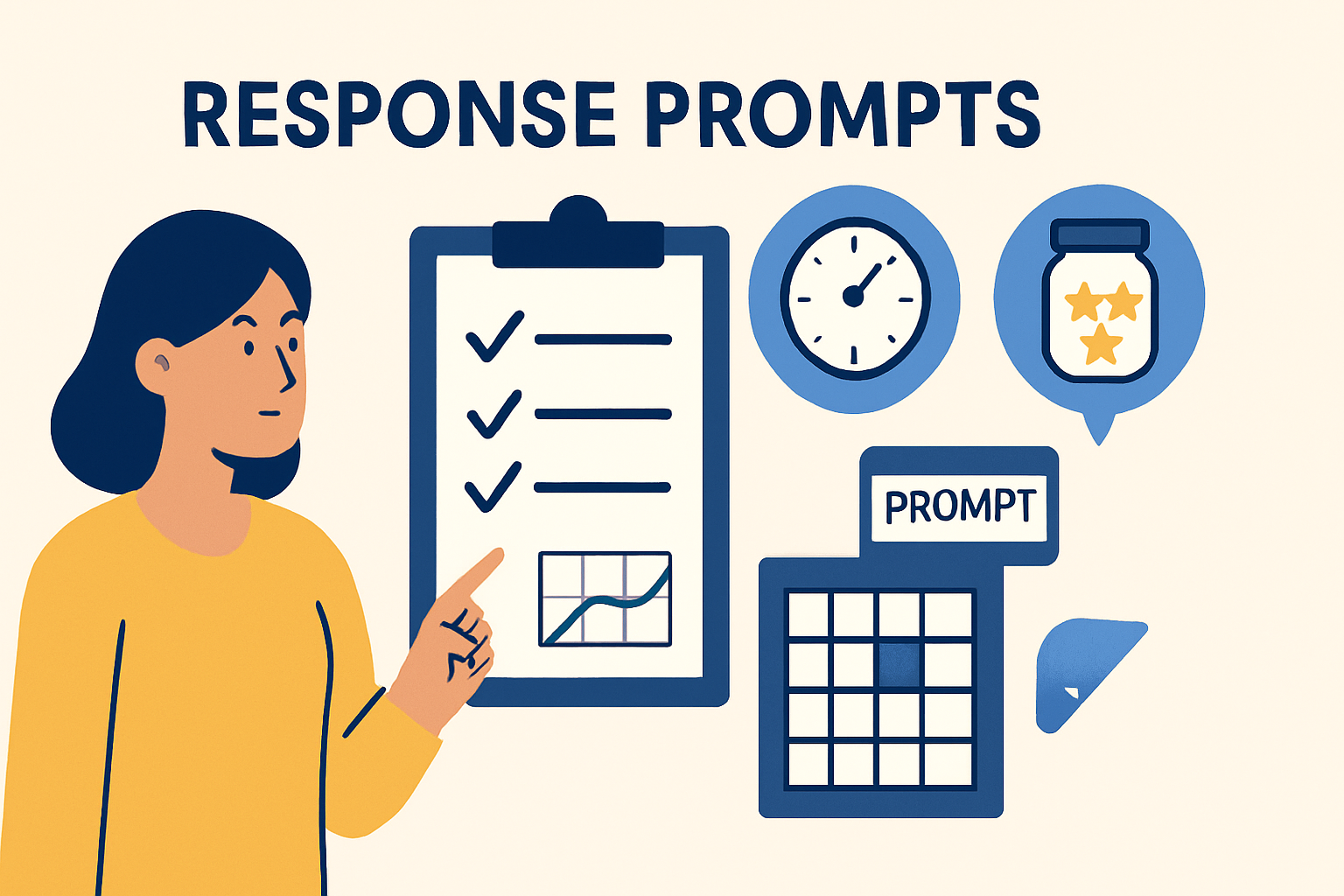
Applying Response Prompts: Worked Examples and Fading
Effective prompting requires careful planning and systematic fading. Let’s examine two common teaching scenarios to understand practical application.
Example 1: Teaching Handwashing (Chained Task)
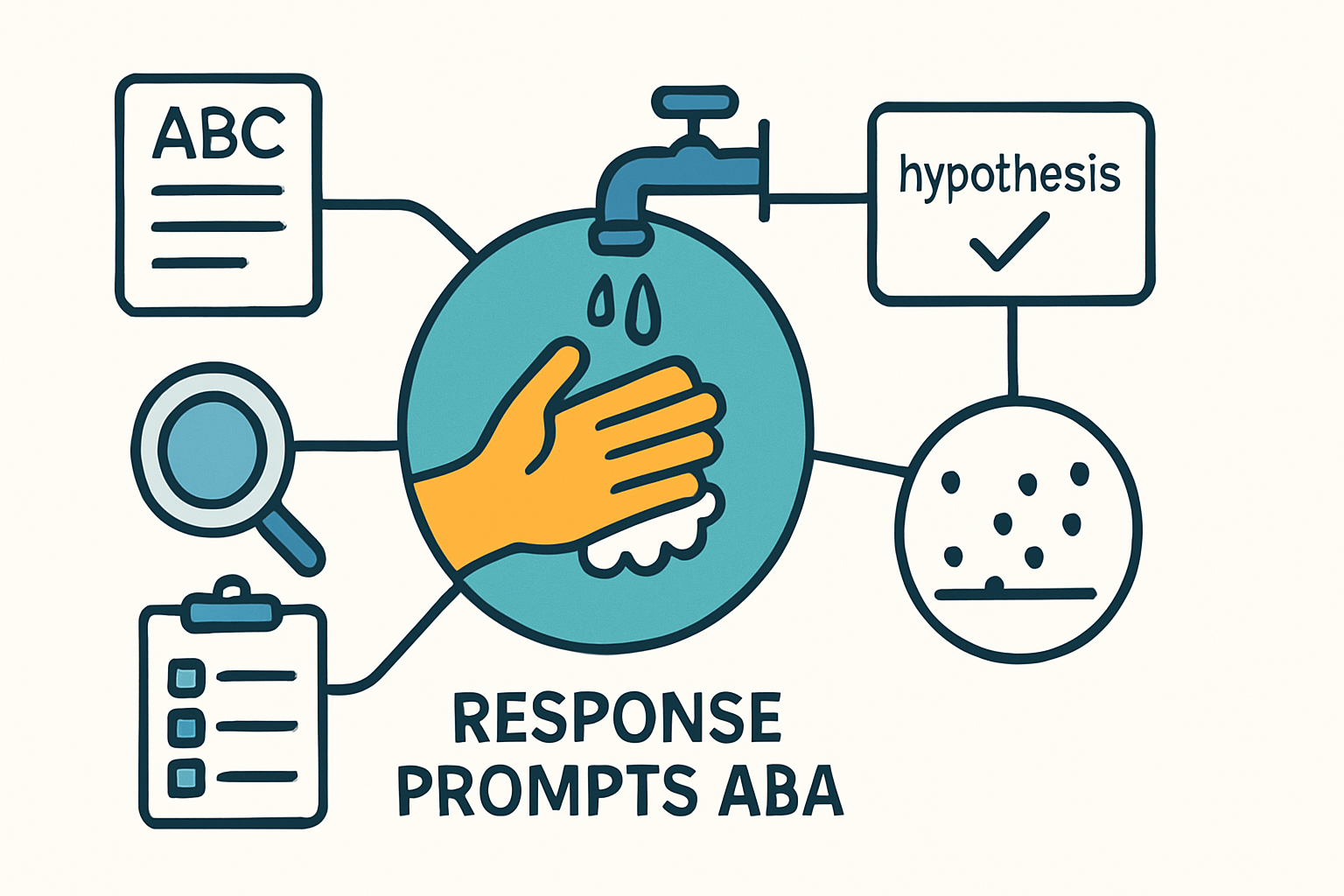
Teaching multi-step skills like handwashing often involves chaining procedures with carefully planned prompts. Consider the step “Apply soap to hands.”
ABC data might show: Antecedent = “Now put soap on your hands,” Behavior = No response within 5 seconds, Consequence = Therapist models rubbing hands together with soap.
The hypothesized function is escape or avoidance of task demands. A least-to-most fading plan would start with verbal prompts, then gestural, then model if needed.
Example 2: Teaching Color Identification (Discrete Trial)
In discrete trial training, prompts must be faded systematically to avoid prompt dependency. Consider teaching “Touch blue” with three colored cards.
ABC data shows: Antecedent = “Touch blue,” Behavior = Looks at cards but doesn’t respond, Consequence = Therapist points to blue card.
The function is likely access to reinforcement (praise or tangible) for correct responding. The choice between most-to-least and least-to-most depends on learner history and skill acquisition rate.
Response Prompts on the BCBA Exam: Common Traps and Ethical Links
Prompting questions test both technical knowledge and clinical judgment. Understanding common pitfalls can improve exam performance and clinical practice.
Top 3 Exam Traps Related to Prompting
These common mistakes separate prepared candidates from those who struggle with application questions.
- Confusing prompt delay with inter-trial interval (ITI is between trials, prompt delay is within a trial)
- Misidentifying stimulus prompts as response prompts (or vice versa) on scenario questions
- Selecting inappropriate fading procedures (using most-to-least for learners who find physical guidance aversive)
- Forgetting to consider prompt dependency risks when designing interventions
- Overlooking the importance of treatment integrity data for prompting procedures
The Ethical Imperative of Effective Prompting
Proper prompting practices directly support ethical standards in the BACB Ethics Code. Ineffective prompting can violate multiple ethical principles.
Prompt dependency undermines client autonomy and dignity. When learners cannot perform skills without prompts, they remain dependent rather than independent.
Unnecessarily intrusive prompts, especially physical guidance, can violate personal boundaries and comfort. Ethical practitioners use the least intrusive prompt necessary.
Systematic prompt fading promotes skill independence, aligning with the ethical principle of benefiting clients. This connects to broader concepts like compassionate care and client dignity in ABA practice.
Quick Checklist for Using Response Prompts
This actionable summary helps both exam preparation and clinical application. Refer to it when designing or evaluating prompting procedures.
- Define the target behavior clearly and operationally before selecting prompts
- Choose prompt type based on learner needs and skill complexity
- Plan fading procedure from the beginning (most-to-least vs. least-to-most)
- Collect prompt level data to track progress and make data-based decisions
- Monitor for prompt dependency and adjust procedures if needed
- Consider learner preferences and history with different prompt types
- Document procedures clearly for treatment integrity and replication
Final Summary and Next Steps
Mastering response prompts requires understanding both the technical procedures and their clinical implications. Effective prompting balances skill acquisition with independence.
For exam preparation, focus on distinguishing prompt types, selecting appropriate fading procedures, and recognizing ethical considerations. Practice with scenario-based questions that test application skills.
In clinical practice, remember that prompts are temporary supports. The ultimate goal is always independent performance without prompts. Regular data collection and analysis ensure prompt fading occurs at an appropriate pace.
To deepen your understanding of related concepts, explore our guide on errorless learning procedures and chaining techniques. For authoritative information on ethical standards, refer to the BACB Ethics Codes and research on effective prompting strategies in peer-reviewed literature.


