
Response Generalization in ABA: How It Works and Why It Matters
Response generalization in ABA is a concept that many BCBA® candidates recognize but struggle to explain clearly.
On the exam, questions rarely use the phrase “response generalization” directly. Instead, they describe situations where a learner begins to use new but functionally equivalent responses without being directly taught each one. This definition aligns with how generalization is described in the BACB Task List, which outlines core concepts tested on the BCBA® exam. If you do not understand how response generalization works, these questions can feel confusing.
This article explains response generalization in ABA using clear language, simple examples, and BCBA-style exam guidance. The goal is to help you recognize response generalization quickly, explain why it matters, and apply it correctly in both exam questions and real teaching programs.
What Does This Concept Mean?
Definition (task-list style)
Response generalization occurs when a learner demonstrates new responses that serve the same function as the taught response, even though those new responses were not directly reinforced during teaching.
Key points to remember:
-
The stimulus stays the same
-
The response changes
-
The responses are functionally equivalent
-
The behavior change occurs without direct teaching of each variation
If the learner only performs the exact response that was taught, response generalization has not occurred.
Response Generalization vs Stimulus Generalization
BCBA® exam questions often test the difference between these two concepts.
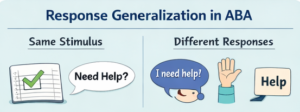
Response generalization
-
Same stimulus
-
Different responses
-
Responses serve the same function
Example:
You teach a child to request help by saying “help please.” Later, the child also says “I need help” or raises a hand when stuck, without being directly taught those responses.
Stimulus generalization
-
Different stimuli
-
Same response
Example:
You teach a child to say “dog” when shown a picture of a dog. Later, the child says “dog” when seeing a real dog, a stuffed dog, or a cartoon dog.
If the response changes, think response generalization.
If the stimulus changes, think stimulus generalization.
Why Response Generalization Matters in ABA

Response generalization is critical because real-life environments do not reinforce only one “perfect” response.
Functional communication improves
In ABA, we often teach one clear communication response first. Over time, response generalization allows the learner to communicate the same need in multiple appropriate ways.
For example:
-
Saying “break please”
-
Handing over a break card
-
Signing “break”
All of these responses can serve the same function: accessing a break.
When response generalization occurs, communication becomes more flexible and more likely to succeed across settings.
Skills become more natural
If a learner can only respond using one rigid form, the skill may look artificial or fail outside of teaching sessions.
Response generalization helps skills:
-
Sound more natural
-
Fit different social situations
-
Maintain over time
This is especially important for social skills, conversation, and functional language.
Programs rely less on prompting
When learners generate new responses independently, they rely less on prompts and direct instruction.
This shows that learning has moved beyond rote memorization and toward functional use.
Everyday Examples of Response Generalization
Teaching requests
Taught response:
Child says “water” to request a drink.
New responses observed:
“Drink,” “I’m thirsty,” pointing to the cup.
The stimulus (wanting a drink) stays the same.
The responses change but serve the same function.
Social greetings
Taught response:
Learner says “hi” when a peer enters the room.
New responses observed:
“Hello,” waving, smiling and saying the peer’s name.
These variations show response generalization, not errors.
Academic responding
Taught response:
Student answers “4” when asked “What is 2 + 2?”
New responses observed:
“Four,” holding up four fingers, writing the number.
All responses demonstrate the same skill under the same stimulus condition.
How to Promote This Skill in Practice
BCBA® exam questions often ask how to increase generalization.
Reinforce response variability
Instead of reinforcing only one form, reinforce multiple appropriate responses that meet the same goal.
For example, reinforce different polite ways to request help rather than requiring one exact phrase.
Avoid overprompting exact responses
Excessive echoic or model prompts can limit generalization. Fade prompts early so learners have opportunities to generate their own responses.
Teach function, not form
Focus on the function of the behavior rather than its exact topography.
If the goal is requesting, reinforce all appropriate requests that access the same outcome.
Use natural consequences
Natural reinforcement supports generalization better than highly artificial rewards. When appropriate, allow real-world outcomes to reinforce flexible responding.
Common Misunderstandings About Response Generalization

“Response generalization means sloppy behavior”
Incorrect.
Response generalization does not mean accepting inappropriate or ineffective responses. All generalized responses must still:
-
Be socially appropriate
-
Contact reinforcement
-
Meet the instructional goal
“Response generalization happens automatically”
Not always.
Poorly designed programs that reinforce only one exact response may limit generalization. Intentional programming increases the likelihood that response generalization will occur.
How Response Generalization Appears on the BCBA® Exam
Look for these clues in exam questions:
-
The learner uses new responses that were not directly taught
-
The same stimulus condition is described
-
The new responses still contact reinforcement
-
The question asks whether learning has generalized
Common exam prompts include:
-
“Which outcome best demonstrates response generalization?”
-
“Which data pattern suggests response generalization has occurred?”
-
“Which programming change would most likely promote response generalization?”
If the scenario shows flexible responding under the same conditions, response generalization is likely the correct answer.
Quick Study Checklist
Before the exam, make sure you can:
-
Define response generalization in your own words
-
Distinguish response generalization from stimulus generalization
-
Identify response generalization in real-life examples
-
Explain why response generalization matters for functional skills
-
Choose interventions that promote response generalization
Mastering these points will make generalization questions much easier to answer.
Final Thoughts
Response generalization in ABA shows that learning is meaningful, flexible, and functional.
When learners can respond in multiple appropriate ways to the same situation, skills are more likely to last and transfer beyond structured teaching. For BCBA® candidates, understanding response generalization helps clarify exam questions and improves real-world program design.
When you focus on function, reinforcement, and flexibility, response generalization becomes a natural outcome of effective ABA teaching.


