

Understanding respondent behavior is essential for any behavior analyst preparing for certification. This fundamental concept appears throughout the BCBA exam and forms the basis for understanding how certain behaviors develop through stimulus pairing rather than consequence manipulation.
Table of Contents
- What is Respondent Behavior? A Foundational Definition
- Respondent Behavior in Practice: ABA Examples and Analysis
- Respondent vs Operant: The Critical Distinction for the Exam
- Study Checklist and Summary
What is Respondent Behavior? A Foundational Definition
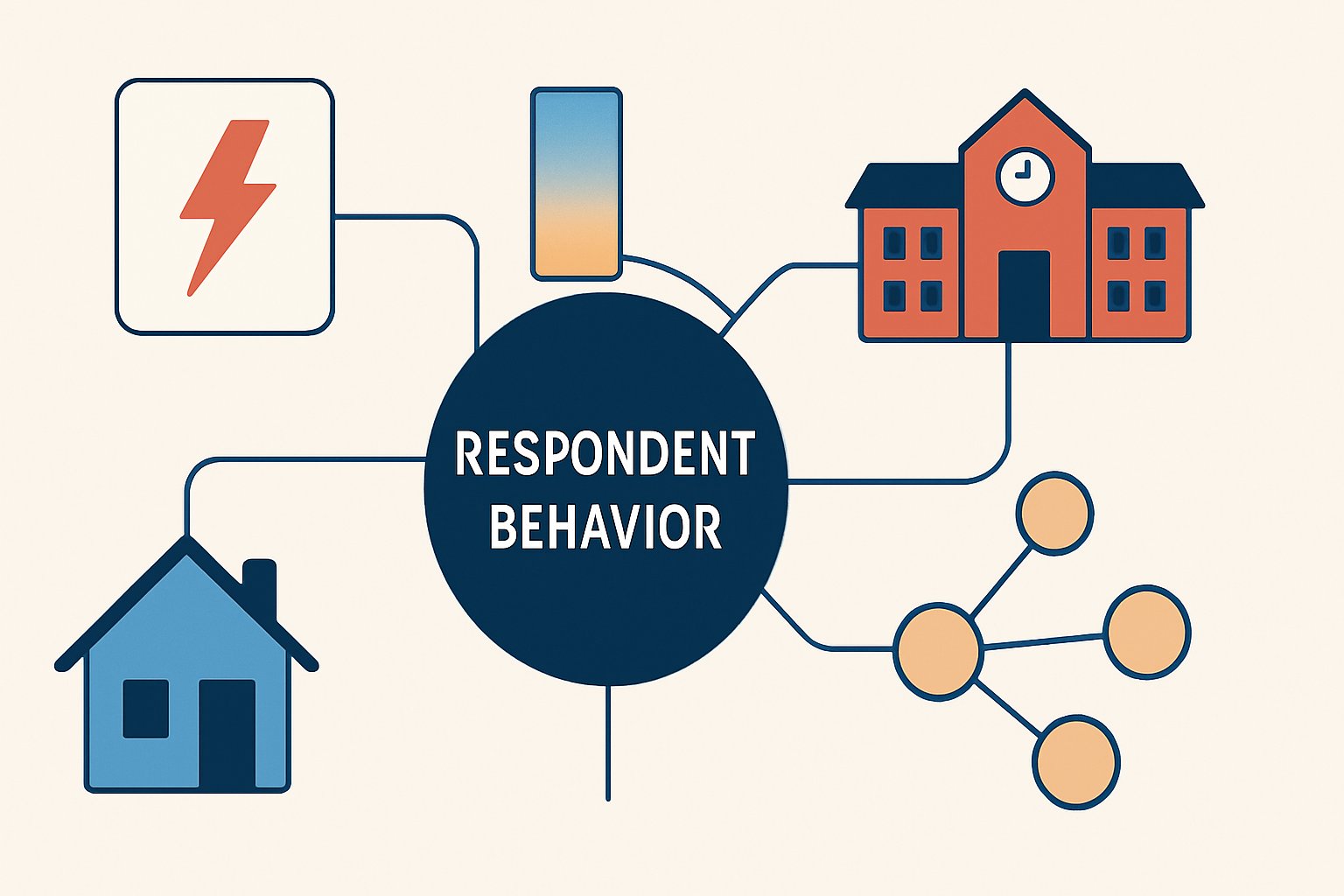
Respondent behavior refers to reflexive responses that are elicited by specific antecedent stimuli. Unlike operant behaviors that are emitted and shaped by consequences, respondent behaviors occur automatically when the appropriate stimulus is present.
The Core Principle: Elicited, Not Emitted
The defining characteristic of respondent behavior is its stimulus-response relationship. When a specific stimulus occurs, a particular response follows automatically. This relationship was first systematically studied by Ivan Pavlov, whose work with dogs established the basic model of classical conditioning.
In Pavlov’s famous experiment, dogs naturally salivated (response) when presented with food (stimulus). Through repeated pairing, a neutral stimulus (bell) became associated with food, eventually eliciting salivation on its own.
Key Terms You Must Know
Master these four essential terms to analyze any respondent conditioning scenario:
- Unconditioned Stimulus (US): A stimulus that naturally and automatically triggers a response without prior learning
- Unconditioned Response (UR): The natural, unlearned reaction to an unconditioned stimulus
- Conditioned Stimulus (CS): A previously neutral stimulus that, after association with an unconditioned stimulus, comes to trigger a conditioned response
- Conditioned Response (CR): The learned response to a previously neutral conditioned stimulus
These terms form the foundation for understanding how respondent conditioning works in both laboratory and applied settings.
Respondent Behavior in Practice: ABA Examples and Analysis
Moving from theory to application, let’s examine how respondent conditioning manifests in real-world scenarios relevant to behavior analysts.
Example 1: Medical Anxiety and Needle Phobia
Consider a child who develops distress at the sight of medical personnel. The original unconditioned stimulus was the pain from an injection, which naturally elicited crying and withdrawal (unconditioned response). Through repeated pairings, the sight of a nurse’s uniform (previously neutral) becomes a conditioned stimulus that now elicits anxiety and avoidance behaviors (conditioned response).
This example demonstrates how conditioned emotional responses can develop through respondent conditioning and significantly impact client behavior in clinical settings.
Example 2: Salivation at the Sound of a Lunch Bell
This classic example illustrates the basic respondent conditioning process:
- Before conditioning: Food (US) → Salivation (UR)
- During conditioning: Bell (neutral) + Food (US) → Salivation (UR)
- After conditioning: Bell (CS) → Salivation (CR)
The conditioned response (salivation to bell) is typically similar but not identical to the unconditioned response (salivation to food). This distinction is important for exam questions about response characteristics.
Example 3: Emotional Response to a Specific Location
A client becomes anxious when entering a specific therapy room where previous difficult sessions occurred. The room’s features (lights, furniture arrangement) serve as conditioned stimuli that elicit anxiety (conditioned response) due to their previous pairing with challenging demands (unconditioned stimuli).
This scenario shows how contextual stimuli can become conditioned through respondent processes, affecting client engagement and treatment outcomes.
Respondent vs Operant: The Critical Distinction for the Exam
This distinction represents one of the most common exam traps. Understanding the fundamental differences is crucial for accurate behavior analysis.
Side-by-Side Comparison
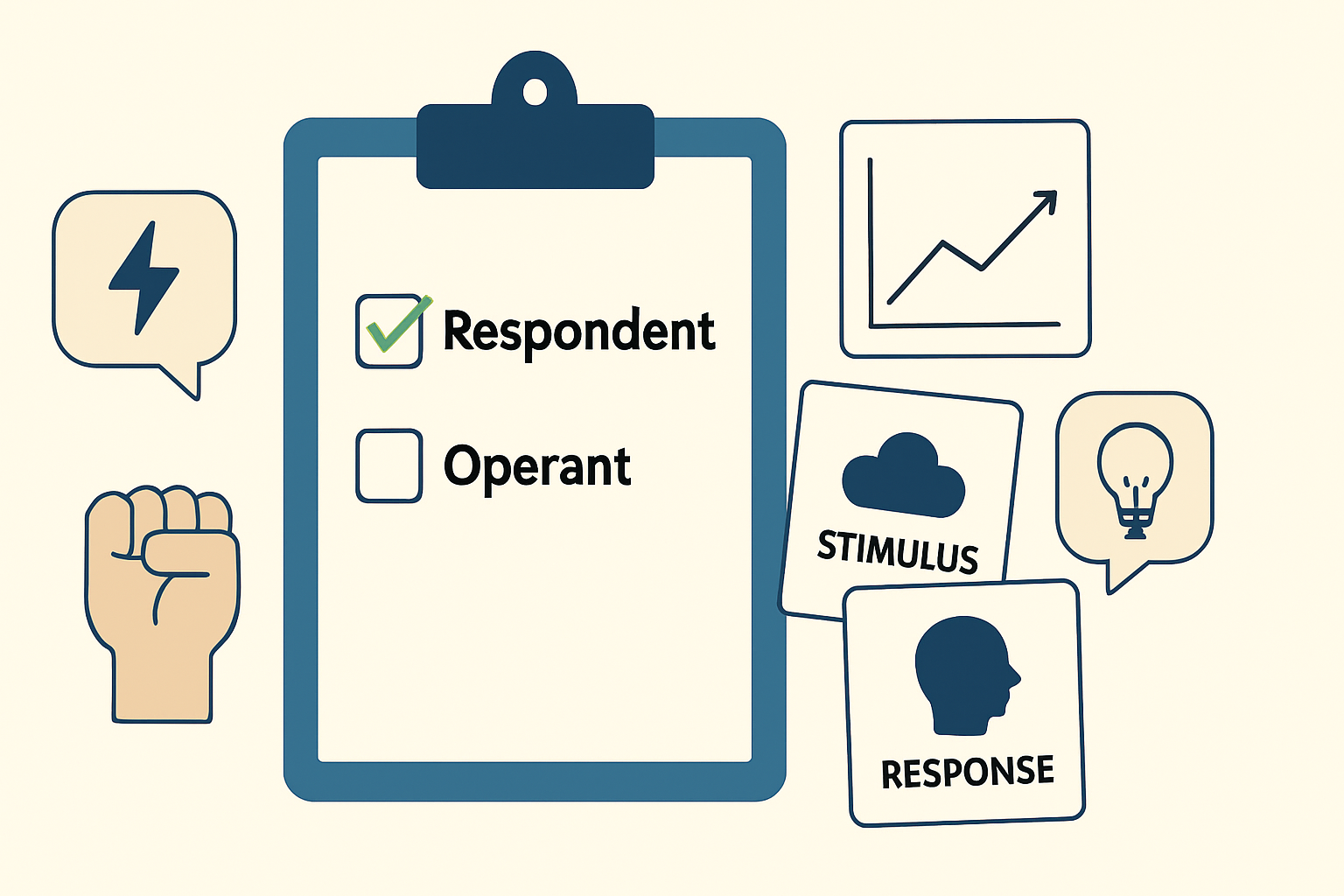
The key differences between respondent and operant behavior center on what controls the behavior:
- Control mechanism: Respondent – antecedent stimuli; Operant – consequences
- Behavior nature: Respondent – elicited; Operant – emitted
- Learning type: Respondent – classical conditioning; Operant – operant conditioning
- Key pioneers: Respondent – Pavlov; Operant – Skinner
- Response type: Respondent – reflexive; Operant – voluntary
For more on how consequences affect behavior, see our guide on how consequence affects behavior in ABA.
Common Exam Traps and How to Avoid Them
Watch for these frequent mistakes on BCBA exam questions:
- Misidentifying operant behaviors with clear antecedents as respondent (just because a behavior has an antecedent doesn’t make it respondent)
- Confusing conditioned motivating operations with respondent conditioning (CMOs involve value-altering effects, not stimulus-response pairings)
- Over-applying respondent explanations to behaviors clearly maintained by reinforcement or punishment
- Failing to recognize that many behaviors involve both respondent and operant components
Red flag clues include behaviors that are clearly goal-directed, vary based on consequences, or show evidence of shaping through reinforcement history.
Study Checklist and Summary
Use this checklist to ensure you’ve mastered respondent behavior concepts for your exam preparation.
Quick-Reference Study Checklist
- Can I define respondent behavior in my own words?
- Can I correctly label US, UR, CS, and CR in any given example?
- Can I explain the critical difference between respondent and operant behavior?
- Do I recognize common exam traps related to this distinction?
- Can I identify real-world examples of respondent conditioning in clinical practice?
- Do I understand how respondent processes can affect treatment implementation?
For additional study resources, explore our BCBA exam prep guide and free BCBA mock exam practice questions.
Key Takeaways for Your Exam
Respondent behavior is reflexive and elicited by specific antecedent stimuli. It develops through stimulus-stimulus pairing in classical conditioning. The critical distinction from operant behavior lies in what controls the behavior: antecedents versus consequences.
Remember that many complex behaviors involve interactions between respondent and operant processes. For comprehensive behavior analysis, understanding both systems is essential. The BACB Task List includes respondent conditioning concepts, so thorough preparation in this area is necessary for exam success.


