

What is Reinforcement Discrimination?
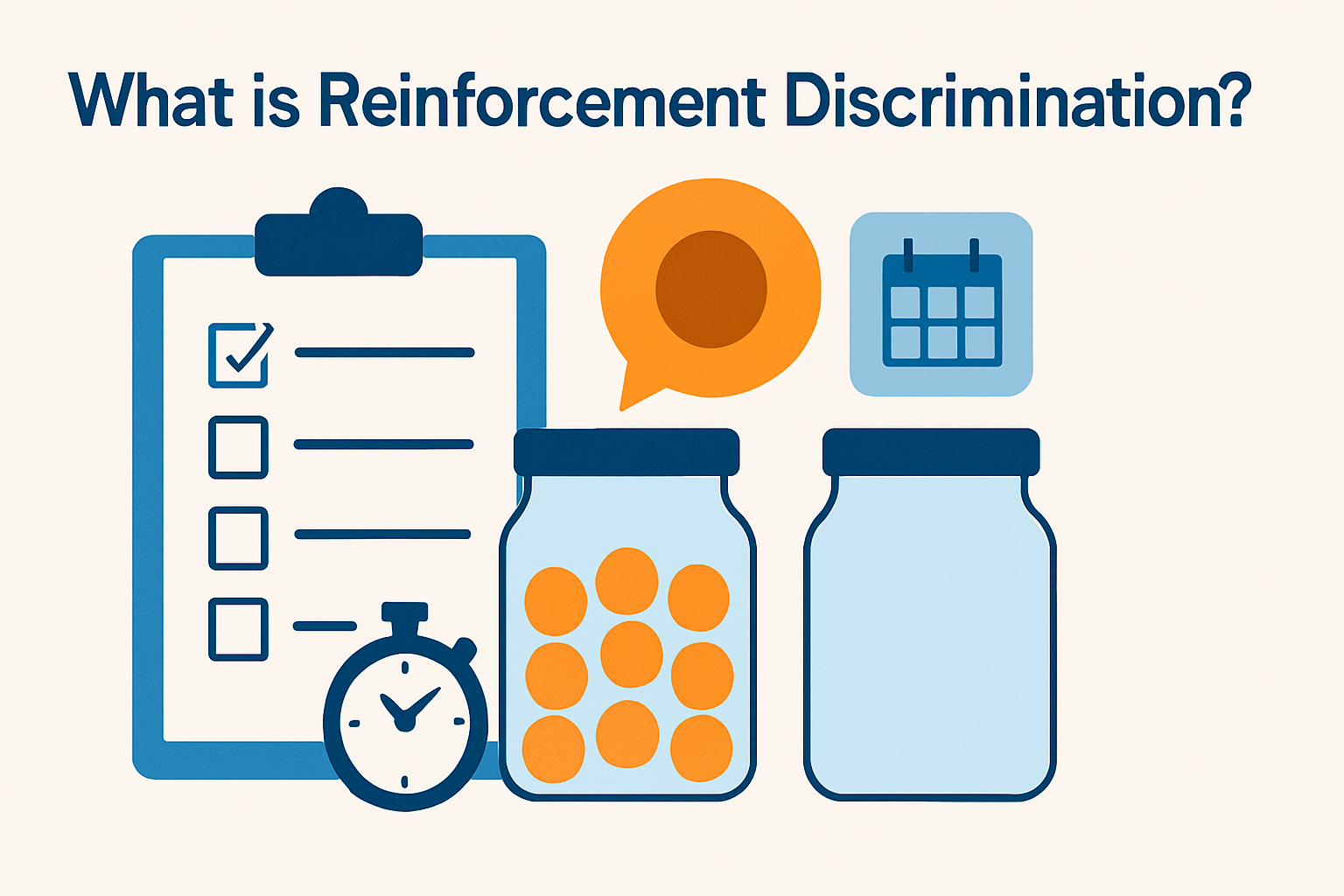
Reinforcement discrimination occurs when a behavior is reinforced only in the presence of a specific stimulus and not in its absence. This fundamental concept in applied behavior analysis explains how organisms learn to respond differently to different environmental cues.
Table of Contents
- What is Reinforcement Discrimination?
- Reinforcement Discrimination in Action: ABA Examples
- Reinforcement Discrimination on the BCBA Exam
- Quick Checklist for Mastery
The process involves two critical components working together: the discriminative stimulus (SD) and the S-delta (SΔ). Understanding their relationship is essential for mastering this concept.
The Core Components: SD vs. S-Delta
The discriminative stimulus signals that reinforcement is available for a particular behavior. When the SD is present, engaging in the target behavior will likely produce reinforcement.
Conversely, the S-delta indicates that reinforcement is NOT available for that same behavior. The SΔ signals that the behavior will not be reinforced, even if it occurs.
Key characteristics of reinforcement discrimination:
- Differential reinforcement occurs based on stimulus presence
- Behavior increases in the presence of the SD
- Behavior decreases or extinguishes in the presence of the SΔ
- Both stimuli must be clearly distinguishable to the learner
- The process establishes stimulus control over behavior
Reinforcement Discrimination in Action: ABA Examples
Let’s examine practical scenarios that demonstrate reinforcement discrimination in everyday ABA practice. Each example follows the ABC framework and identifies the hypothesized function.
Example 1: Classroom Instruction
In a discrete trial training session, the therapist presents two colored cards. The SD is the instruction ‘Touch blue.’ The SΔ is the instruction ‘Touch red.’
When the client touches the blue card following the SD, they receive praise and a token. This positive reinforcement strengthens the correct response. However, touching blue after the SΔ instruction produces no reinforcement.
The behavior demonstrates discrimination training where the client learns to respond only to specific instructional stimuli. The function is access to social reinforcement and tokens.
Example 2: Manding for a Break
A client has two visual cards on their desk: a red break card and a green work card. The red card serves as the SD for requesting a break, while the green card functions as the SΔ.
When the red card is present, handing it to the therapist produces a 2-minute break. This negative reinforcement strengthens the manding behavior. Handing the red card when the green card is present yields no break.
This example illustrates discrimination between stimuli that signal different reinforcement contingencies. The function is escape from task demands.
Example 3: Greeting a Familiar Person
A child learns to greet familiar people appropriately. The sight of their caregiver serves as the SD for saying ‘Hi, Mom!’ The sight of a stranger functions as the SΔ.
Greeting the caregiver produces a hug and smile (social reinforcement). Greeting a stranger does not produce the same reinforcing consequence, teaching appropriate social discrimination.
This scenario highlights discrimination based on social stimuli and demonstrates how reinforcement shapes socially appropriate behavior. For more on social behavior, see our guide on socially significant behaviors.
Reinforcement Discrimination on the BCBA Exam
Understanding reinforcement discrimination is crucial for BCBA exam success. This concept frequently appears in questions about stimulus control, discrimination training, and behavioral procedures.

Common Exam Traps and How to Avoid Them
Several pitfalls can trip up exam candidates. Recognizing these common errors will help you select the correct answers.
- Confusing with stimulus generalization: Remember that discrimination involves responding differently to different stimuli, while generalization involves responding similarly to similar stimuli
- Missing the SΔ component: Reinforcement discrimination requires BOTH an SD and an SΔ – don’t focus only on the reinforced stimulus
- Overlooking withholding of reinforcement: The absence of reinforcement in SΔ presence is as important as reinforcement in SD presence
- Mistaking for simple reinforcement: Discrimination involves differential reinforcement based on stimulus conditions, not just reinforcement delivery
Practice Applying the Concept
Consider this scenario: A therapist teaches a child to request ‘cookie’ when a cookie is visible (SD) but not when an apple is visible (SΔ). When the child says ‘cookie’ with the cookie present, they receive a small piece. When they say ‘cookie’ with the apple present, they receive no cookie.
Identify: What is the SD? What is the SΔ? What behavior is being reinforced? This scenario demonstrates mand discrimination where the child learns to request based on available items.
For additional practice with related concepts, explore our resource on verbal operants.
Quick Checklist for Mastery
Use this checklist to ensure you’ve mastered reinforcement discrimination concepts for your studies and practice.
- Can you define discriminative stimulus (SD) and S-delta (SΔ)?
- Do you understand that reinforcement is available in SD presence but withheld in SΔ presence?
- Can you identify SD and SΔ in practical ABA scenarios?
- Do you recognize the difference between discrimination and stimulus generalization?
- Can you explain how discrimination establishes stimulus control?
- Are you familiar with common exam traps related to this concept?
- Can you apply the concept to novel scenarios and case examples?
Mastering reinforcement discrimination provides a solid foundation for understanding more complex behavioral concepts. This knowledge is essential for effective applied behavior analysis practice and BCBA exam success. For further study on related topics, the BACB Task List outlines all required content areas.
Remember that discrimination training is a fundamental procedure in ABA that helps clients learn to respond appropriately to different environmental cues. This skill is crucial for developing functional communication, social skills, and academic competencies. For more information on behavioral procedures, see our guide on differential reinforcement.


