

Understanding reinforcement and extinction is fundamental to mastering applied behavior analysis. These core principles represent opposite sides of behavior change—one strengthens behavior while the other weakens it. For BCBA candidates, distinguishing between these procedures and recognizing their applications is essential for both clinical practice and exam success.
Table of Contents
- Defining the Core Procedures: Reinforcement and Extinction
- Applied Analysis: Reinforcement and Extinction in Practice
- Exam Focus: Critical Distinctions and Common Traps
- Quick-Review Checklist for Reinforcement and Extinction
- References
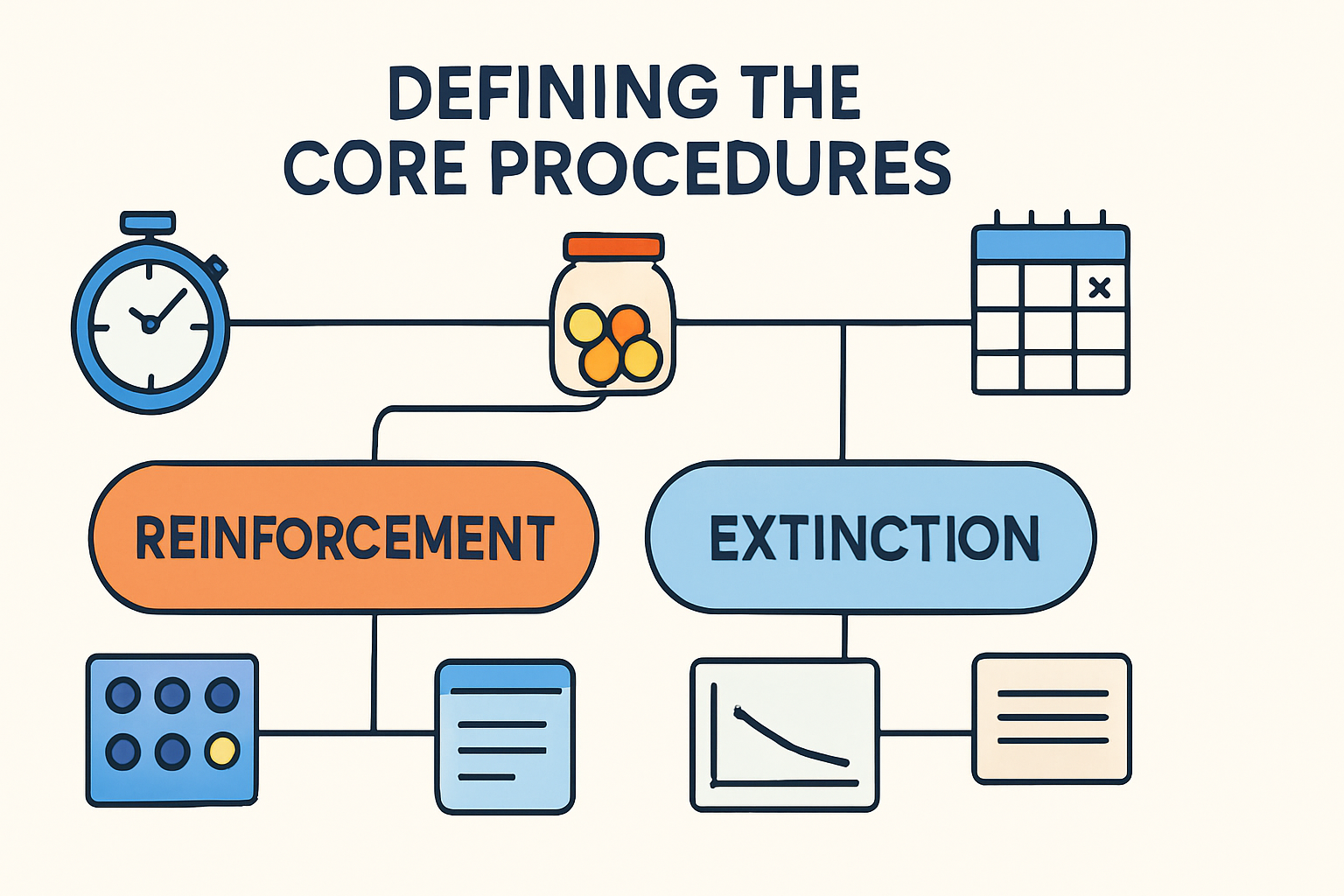
Defining the Core Procedures: Reinforcement and Extinction
Before applying these principles, you need precise definitions. Both concepts are defined by their procedures and effects on future behavior.
What is Reinforcement?
Reinforcement is a procedure where a consequence follows a behavior, making that behavior more likely to occur in the future. The key distinction is between positive reinforcement and negative reinforcement. Positive reinforcement involves adding a stimulus after behavior, while negative reinforcement involves removing an aversive stimulus. Both procedures increase behavior frequency.
Remember that a reinforcer is defined functionally—it’s only a reinforcer if it actually increases behavior. This differs from a reward, which is given without necessarily affecting future behavior. For exam purposes, always look for the effect on behavior frequency.
What is Extinction?
Extinction is a procedure where reinforcement that previously maintained a behavior is withheld. This leads to a decrease in behavior over time. Crucially, extinction is not forgetting—it’s an active procedure requiring consistent implementation.
Two critical phenomena accompany extinction procedures. The extinction burst describes an initial increase in behavior magnitude or frequency when reinforcement is first withheld. Spontaneous recovery refers to the temporary return of extinguished behavior after a period of time. Understanding these patterns helps you identify when extinction is working correctly.
Applied Analysis: Reinforcement and Extinction in Practice
Moving from definitions to application requires analyzing behavior through the ABC framework. Each example below demonstrates how consequences maintain behavior and how extinction procedures are implemented.
Example 1: Attention-Maintained Behavior
Consider a child who whines when a parent is on the phone. The antecedent is the parent’s phone conversation, the behavior is whining, and the consequence is parental attention. This represents positive reinforcement—attention is added, increasing future whining.
To implement extinction, the parent would use planned ignoring—systematically withholding attention for whining. Expect an extinction burst where whining initially increases in intensity or frequency before decreasing. This procedure requires consistency across caregivers to be effective.
Example 2: Escape-Maintained Behavior
A student rips worksheets during difficult math problems. The antecedent is the challenging task, the behavior is worksheet destruction, and the consequence is task removal. This demonstrates negative reinforcement—removing the aversive task increases future destructive behavior.
Extinction for escape-maintained behavior involves escape extinction. Instead of removing the task, the teacher implements guided compliance or task continuation. The student must complete the work without escape opportunities. This approach requires careful consideration of ethical implementation and alternative teaching strategies.
Example 3: Automatic Reinforcement Scenarios
Some behaviors are maintained by automatic reinforcement—the sensory consequences they produce. For stereotypy like hand-flapping, the reinforcement comes from proprioceptive feedback. Extinction here isn’t about ignoring but about altering sensory consequences through response interruption or providing alternative sensory input.
This distinction is crucial for exam questions. When behavior is automatically reinforced, traditional social extinction procedures won’t work. You need to identify the maintaining variable through functional analysis before selecting an intervention.
Exam Focus: Critical Distinctions and Common Traps
The BCBA exam tests your ability to distinguish between similar concepts and apply principles correctly. These common traps frequently appear in exam questions.

Trap 1: Confusing Procedure with Outcome
Reinforcement and extinction are defined by the procedures implemented, not guaranteed outcomes. A planned ignoring procedure is still extinction even if behavior doesn’t immediately decrease. Similarly, presenting a preferred item after behavior is positive reinforcement regardless of whether behavior increases in that specific instance.
Exam questions often describe procedures without showing data. Your task is to identify the procedure being implemented, not predict outcomes. Focus on what the practitioner is doing, not what might happen.
Trap 2: Misidentifying Negative Reinforcement
Negative reinforcement is frequently confused with punishment. Remember: negative reinforcement increases behavior by removing an aversive stimulus. Punishment decreases behavior. A classic exam scenario involves a student completing homework to avoid detention—this is negative reinforcement (avoidance).
Contrast this with negative punishment, which decreases behavior by removing a preferred stimulus. The key difference is the effect on behavior frequency. For more on this distinction, see our guide on negative reinforcement examples.
Trap 3: Overlooking the Extinction Burst
When behavior initially increases during extinction, inexperienced practitioners might abandon the procedure. The exam tests whether you recognize this as an extinction burst and would recommend continuing with extinction. Questions may describe increased aggression after implementing planned ignoring and ask what to do next.
Remember that extinction bursts are expected and temporary. The correct response is typically to persist with the extinction procedure while ensuring safety and considering reinforcement of alternative behaviors.
Quick-Review Checklist for Reinforcement and Extinction
Use this checklist for last-minute review before your exam. Each item represents a critical distinction or application point.
- Define reinforcement functionally: It increases future behavior, regardless of whether the consequence seems pleasant
- Distinguish positive vs. negative reinforcement: Positive adds a stimulus; negative removes an aversive stimulus
- Identify extinction procedures: Withholding the maintaining reinforcer, not just ignoring
- Expect extinction bursts: Initial behavior increase is normal; persist with the procedure
- Match extinction to function: Different procedures for attention, escape, tangible, and automatic reinforcement
- Recognize spontaneous recovery: Temporary return of extinguished behavior doesn’t mean procedure failed
- Apply ethical considerations: Especially for escape extinction and behaviors with potential harm
- Combine with reinforcement: Always reinforce alternative appropriate behaviors during extinction
For comprehensive exam preparation, explore our BCBA exam study framework that integrates these principles with other key concepts.
Mastering reinforcement and extinction requires both conceptual understanding and practical application. These principles form the foundation of behavior change procedures in ABA. By recognizing the distinctions, anticipating common exam traps, and applying these concepts systematically, you’ll be well-prepared for both the BCBA exam and ethical clinical practice. Remember that effective intervention often involves combining extinction with reinforcement of appropriate alternatives, as outlined in the BACB Task List requirements.


