

Prompting in ABA is a fundamental teaching strategy that helps learners acquire new skills by providing assistance before or during a response. This antecedent intervention bridges the gap between what a learner can do independently and what they need to learn. Understanding different prompt types and how to systematically fade them is essential for both effective therapy and BCBA exam success.
Table of Contents
- prompting in ABA: What is Prompting in Applied Behavior Analysis?
- Applying and Fading Prompts: Worked Examples
- Prompting for the BCBA Exam: Key Terms and Common Traps
- Quick-Reference Checklist for Effective Prompting
- References
prompting in ABA: What is Prompting in Applied Behavior Analysis?
In behavior analysis, a prompt is any supplemental stimulus that increases the likelihood of a correct response. Prompts are temporary supports that help establish stimulus control over target behaviors. They work by making the correct response more probable, which allows for immediate reinforcement and skill acquisition.
Response Prompts vs. Stimulus Prompts: Knowing the Difference
Response prompts involve the behavior of the therapist or instructor. These include physical guidance, verbal instructions, gestures, and modeling. In contrast, stimulus prompts involve changes to the task materials or environment itself.
Common stimulus prompts include changing the position of correct items, adding color cues, or altering size differences. This distinction is crucial for exam questions that ask you to identify prompt types in scenarios.
The Prompt Hierarchy: From Most to Least Intrusive
The standard prompt hierarchy organizes prompts by their level of intrusiveness. Clinicians typically start with the least intrusive prompt that will be effective, though sometimes begin with more intrusive prompts for safety or initial skill acquisition.
- Physical prompts: Full or partial physical guidance of the learner’s body
- Verbal prompts: Spoken instructions, questions, or hints
- Gestural prompts: Pointing, nodding, or other nonverbal cues
- Model prompts: Demonstrating the target behavior
- Visual/Positional prompts: Environmental arrangements or pictures

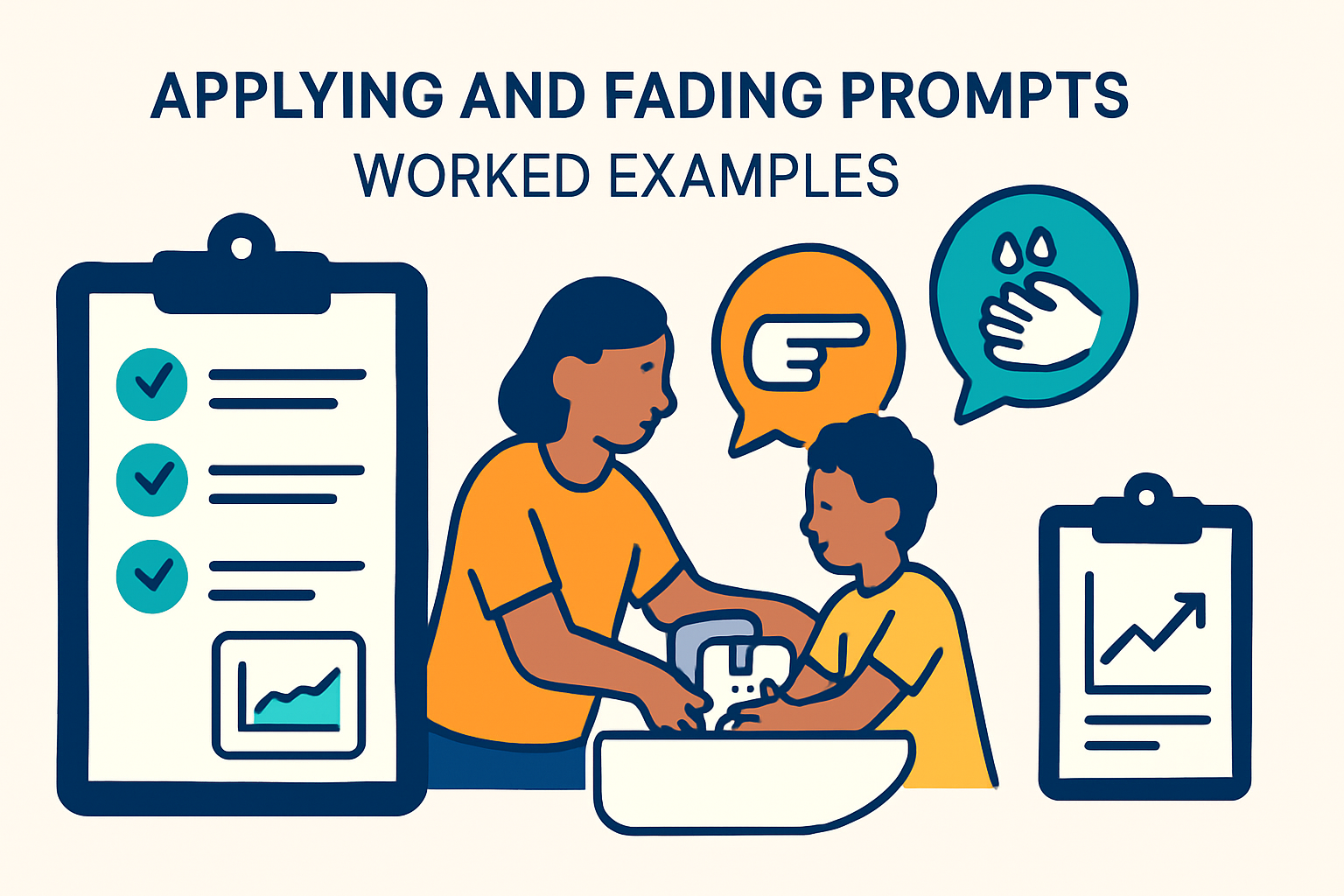
Applying and Fading Prompts: Worked Examples
Effective prompting requires both proper application and systematic fading. The goal is always to transfer stimulus control from the prompt to the natural discriminative stimulus. Let’s examine two practical scenarios.
Example 1: Teaching Handwashing with Physical-to-Visual Fading
Teaching handwashing to a child with limited fine motor skills requires careful prompting. The task analysis includes turning on water, applying soap, rubbing hands, rinsing, and drying.
Initial ABC data shows: Antecedent (“Time to wash hands”), Behavior (no response), Consequence (no reinforcement). The hypothesized function is escape from task demands due to skill deficit.
The intervention begins with full physical guidance through all steps, immediately reinforced with praise. As the child shows success, prompts fade systematically:
- Week 1: Full physical guidance
- Week 2: Partial physical guidance (hand-over-hand)
- Week 3: Gestural prompts (pointing to next step)
- Week 4: Visual checklist (stimulus prompt) on the wall
- Week 5: Natural cue only (dirty hands or before meals)
Example 2: Using a Gestural Prompt for Social Initiation
A child learning to ask peers to play presents with ABC data: Antecedent (peer present with toys), Behavior (no initiation), Consequence (no social interaction). The intervention uses a gestural prompt – the therapist points toward the peer while saying “Ask to play.”
As the child begins to initiate, the prompt fades from a full point to a subtle head nod, then to just the verbal cue, and finally to the natural social cue alone. This approach helps establish social initiation as a reinforced behavior.
Prompting for the BCBA Exam: Key Terms and Common Traps
Exam questions often test your ability to identify prompt types, select appropriate fading procedures, and recognize ethical considerations. Understanding these concepts is essential for both clinical practice and exam success.
Ethical Fading and Avoiding Prompt Dependency
The BACB Ethics Code requires behavior analysts to minimize the risk of prompt dependency. Prompt dependency occurs when a learner becomes reliant on prompts and fails to respond to natural cues. This violates the principle of client dignity and autonomy.
A data-based fading plan should include:
- Clear criteria for prompt reduction
- Systematic data collection on prompt levels
- Regular assessment of independence
- Adjustments based on learner progress
For more on ethical considerations, see our guide on ethics in ABA practice.
Exam Focus: Errorless Learning vs. Trial-and-Error
Errorless learning uses prompt hierarchies (typically most-to-least) to prevent incorrect responses during skill acquisition. This approach minimizes frustration and establishes correct responding from the beginning. In contrast, trial-and-error learning allows errors to occur naturally.
Errorless learning is particularly effective for:
- Learners with limited frustration tolerance
- Complex or potentially dangerous tasks
- Establishing initial stimulus control
For more on teaching procedures, explore our article on errorless learning in ABA.
Quick-Reference Checklist for Effective Prompting
Use this checklist to ensure you’re implementing prompting procedures correctly in both clinical practice and exam scenarios.
- Select appropriate prompt type based on learner needs and task demands
- Establish clear fading criteria before intervention begins
- Collect systematic data on prompt levels and independence
- Reinforce prompted responses initially, then fade to natural reinforcement
- Monitor for prompt dependency and adjust procedures as needed
- Transfer stimulus control from prompt to natural discriminative stimulus
- Document procedures clearly in behavior plans and progress notes
Mastering prompting procedures requires understanding both the technical aspects and the ethical considerations. Effective prompting balances immediate assistance with long-term independence, always keeping the learner’s autonomy and dignity at the forefront. For comprehensive exam preparation, consider using our BCBA mock exam resources to practice applying these concepts in test scenarios.


