

prompt levels ABA: What Are Prompt Levels in ABA?
In applied behavior analysis, prompts are supplementary stimuli that help learners perform target behaviors. Understanding prompt levels is essential for effective teaching and appears frequently on the BCBA exam.
Table of Contents
- prompt levels ABA: What Are Prompt Levels in ABA?
- Applying Prompt Levels: Worked Examples for BCBAs
- Prompt Fading and Ethical Considerations
- Prompt Levels on the BCBA Exam: What to Know
- References
The Two Main Categories: Response vs. Stimulus Prompts
Response prompts involve actions by the instructor that directly guide the learner’s response. These include:
- Physical prompts: Hand-over-hand guidance through the entire movement
- Verbal prompts: Spoken instructions, hints, or questions
- Gestural prompts: Pointing, nodding, or other non-verbal cues
- Model prompts: Demonstrating the correct response for imitation
Stimulus prompts involve altering the instructional materials or environment to make correct responses more likely. Common types include:
- Positional prompts: Placing the correct item closer to the learner
- Movement prompts: Moving materials to draw attention
- Redundancy prompts: Adding extra cues like color coding
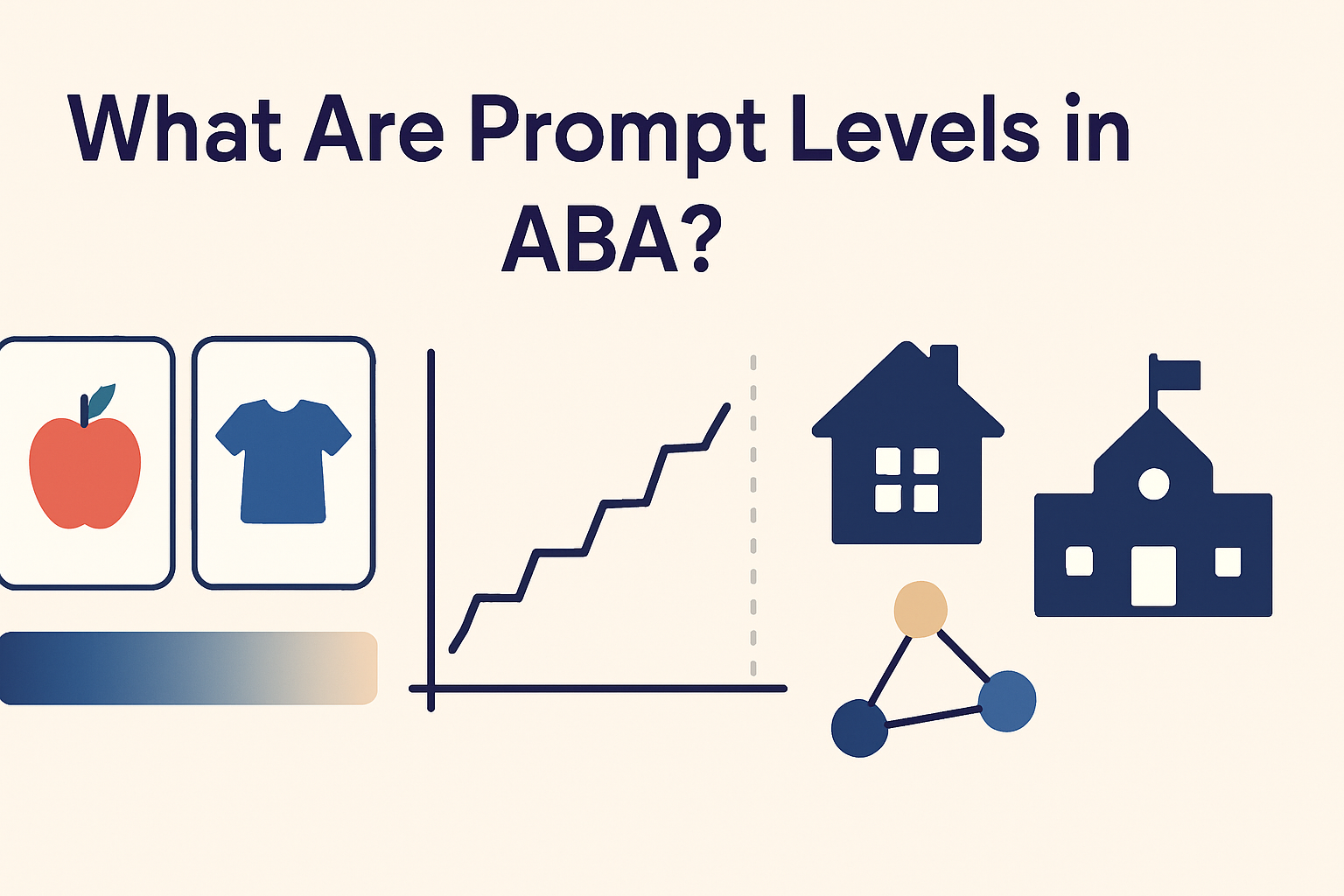
The Prompt Hierarchy: From Most-to-Least to Least-to-Most
Two primary procedural approaches organize prompt levels systematically. Most-to-least prompting begins with the most intrusive support and gradually reduces assistance. This approach minimizes errors and builds initial success, making it ideal for new or complex skills.
Least-to-most prompting starts with minimal assistance and increases support only as needed. This approach encourages independence and problem-solving, suitable for learners with some existing skill components.
Applying Prompt Levels: Worked Examples for BCBAs
Practical application of prompt levels requires careful planning within an ABC framework. Let’s examine two common teaching scenarios.
Example 1: Teaching Handwashing with Most-to-Least Prompting
When teaching a multi-step skill like handwashing to a learner who avoids task demands, a most-to-least approach ensures success while minimizing escape opportunities.
- Antecedent: “Time to wash hands” instruction
- Behavior: Complete 6-step handwashing task analysis
- Consequence: Praise and access to preferred activity
The fading sequence progresses systematically:
- Week 1: Full physical prompts for all steps
- Week 2: Partial physical prompts (gentle touch guidance)
- Week 3: Gestural prompts (pointing to next step)
- Week 4: Independent performance with praise only
Example 2: Teaching Color Identification with Stimulus Prompts
For teaching color matching to a learner motivated by tangible rewards, stimulus prompts provide effective support.
- Antecedent: “Match red” instruction with red, blue, and green cards
- Behavior: Selecting the red card from array
- Consequence: Token and access to preferred item
The positional prompt fading plan:
- Initial: Red card placed directly in front of learner
- Fade 1: Red card placed slightly closer than others
- Fade 2: All cards equally spaced but red highlighted
- Final: Standard array with no positional cues
Prompt Fading and Ethical Considerations
Effective prompt fading is both a technical skill and an ethical imperative. Without systematic reduction, learners may develop prompt dependency, undermining their autonomy and dignity.
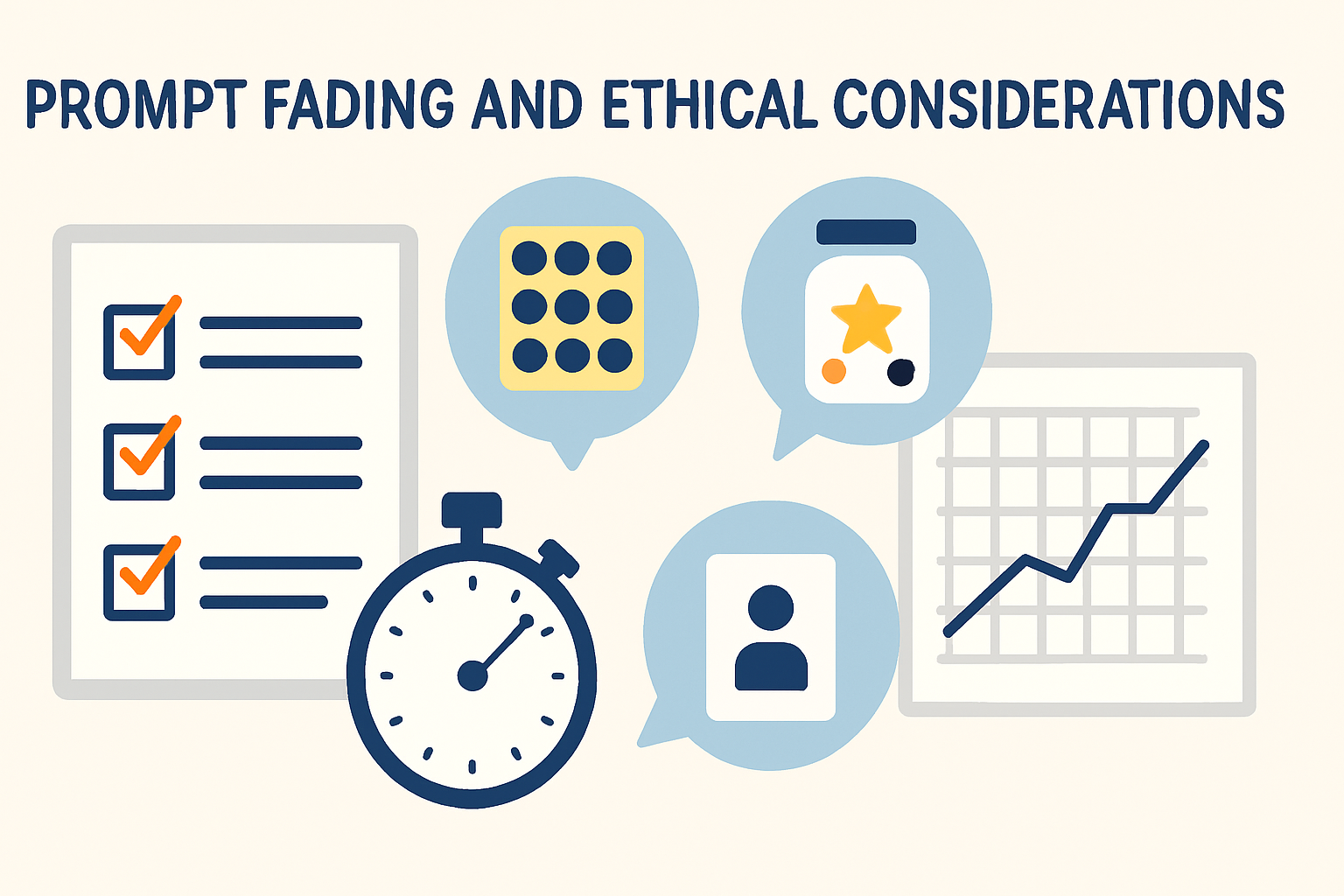
Systematic Fading Plans: A Key Exam Topic
Three primary fading techniques appear regularly on the BCBA exam:
- Time delay: Gradually increasing the interval between instruction and prompt
- Increasing latency: Allowing more time for independent response before prompting
- Prompt intensity reduction: Moving from physical to gestural to independent
Each technique requires data collection to monitor progress and adjust the plan as needed. For more on ethical practice, see our guide on ethics in ABA practice.
Avoiding Prompt Dependency: An Ethical Imperative
Prompt dependency occurs when learners cannot perform skills without assistance. This violates multiple BACB ethics code principles, particularly those related to client welfare and treatment effectiveness.
To prevent dependency, fading should begin from the first teaching session. Regular probe trials without prompts assess true independence. For comprehensive assessment strategies, explore our assessment in ABA guide.
Prompt Levels on the BCBA Exam: What to Know
Exam questions about prompt levels test both definitional knowledge and application skills. Understanding common traps improves your test performance.
Common Exam Traps and Misconceptions
Several recurring patterns trip up candidates:
- Confusing model prompts (demonstration) with gestural prompts (pointing)
- Selecting the wrong hierarchy for the learner’s skill level
- Misidentifying a prompt as a reinforcer rather than an antecedent
- Overlooking the need for systematic fading in treatment plans
- Failing to distinguish between response and stimulus prompts
Quick-Reference Prompting Checklist
Use this action-oriented list for rapid review:
- 1. Identify target skill and prerequisite abilities
- 2. Select prompt type based on learner characteristics
- 3. Choose hierarchy (most-to-least or least-to-most)
- 4. Plan fade from Day 1 with specific criteria
- 5. Collect data on prompt level needed for each trial
- 6. Conduct regular probes to assess independence
- 7. Adjust plan based on performance data
For additional exam preparation resources, including practice questions on related topics like stimulus control, explore our comprehensive study materials.
Mastering prompt levels requires understanding both the technical hierarchy and the ethical responsibility to fade support systematically. By applying these principles with careful data collection, you can promote genuine independence while avoiding common exam pitfalls.


