

Prompt fading is a systematic procedure used in applied behavior analysis to gradually reduce and eventually eliminate prompts while maintaining correct responding. This technique is essential for promoting independence and ensuring that learners can perform skills without ongoing assistance.
Table of Contents
- What is Prompt Fading? Definition and Core Concept
- Implementing Prompt Fading: Step-by-Step Procedures
- Prompt Fading in Practice: Worked ABA Examples
- Prompt Fading on the BCBA® Exam: Relevance and Common Traps
- Quick-Reference Implementation Checklist
- Summary and Key Takeaways
What is Prompt Fading? Definition and Core Concept
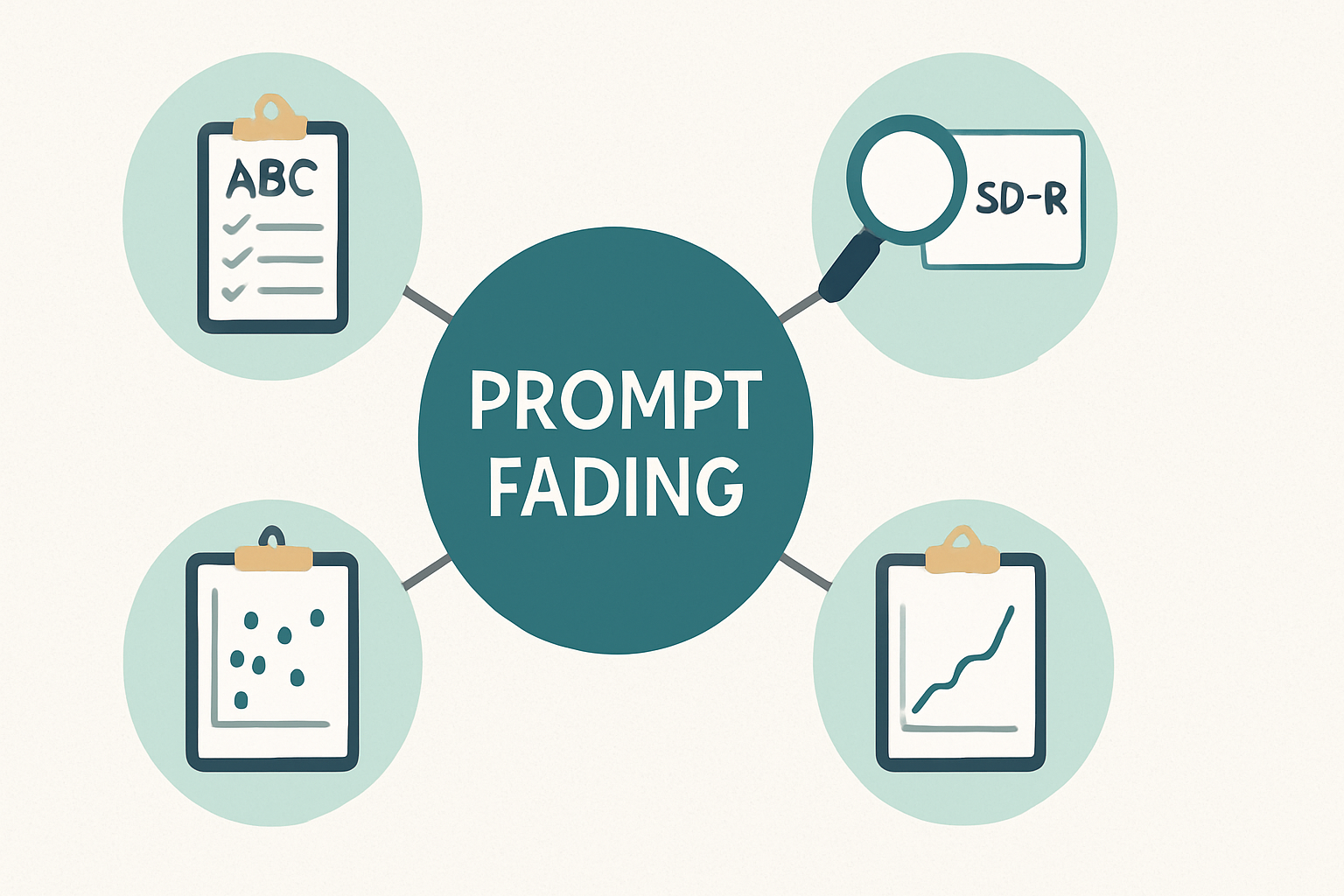
Prompt fading refers to the systematic reduction of prompts while maintaining correct responding. The fundamental goal is to transfer stimulus control from the prompt to the natural discriminative stimulus.
The Goal: Transfer of Stimulus Control
Transfer of stimulus control occurs when a response comes under the control of a new stimulus. In prompt fading, we gradually remove artificial prompts so the natural SD (discriminative stimulus) evokes the correct response independently.
Think of it like training wheels on a bicycle. Initially, the training wheels provide maximum support. As the rider gains balance, we gradually raise them until they’re no longer needed. Similarly, prompts provide temporary support that we systematically reduce.
Implementing Prompt Fading: Step-by-Step Procedures
Two primary methods exist for implementing prompt fading, each with specific applications and advantages.
Most-to-Least Prompt Fading (Errorless Learning)
This approach begins with the most intrusive prompt and systematically reduces intensity. It’s ideal for teaching new, difficult, or low-frequency skills where preventing errors is crucial.
- Start with full physical guidance or verbal modeling
- Systematically reduce to partial physical guidance
- Fade to gestural prompts or positional cues
- Finally, eliminate all prompts when independent responding is consistent
- This method minimizes error patterns and builds initial success
Least-to-Most Prompt Fading (Time Delay)
This procedure allows time for an independent response before providing prompts, increasing prompt intrusiveness only as needed.
- Present the natural SD and wait for a response
- If no response occurs within a specified time delay, provide a minimal prompt
- Gradually increase prompt intensity if needed
- This approach promotes independence from the start
- It’s particularly effective for maintaining previously learned skills

Prompt Fading in Practice: Worked ABA Examples
Concrete examples demonstrate how prompt fading works in real clinical scenarios.
Example 1: Teaching Shoe Tying to a Child (Motor Skill)
ABC data for physical prompt fading sequence:
- Antecedent: Shoes presented with laces untied
- Behavior: Child attempts to tie shoes
- Consequence: Reinforcement for attempts
Hypothesized function: Escape from adult assistance and access to independence. The fading steps would progress from hand-over-hand guidance to verbal cues only.
Example 2: Teaching a Client to Order Lunch (Verbal Skill)
ABC data for verbal prompt fading using time delay:
- Antecedent: Cashier asks “What would you like?”
- Behavior: Client responds verbally
- Consequence: Receives ordered food
Hypothesized function: Access to preferred food and social interaction. The time delay would start at 0 seconds and gradually increase to 5 seconds.
Prompt Fading on the BCBA® Exam: Relevance and Common Traps
Understanding prompt fading is crucial for exam success and clinical practice.
Key Terminology and Concepts to Know
- Stimulus control – When a response occurs in the presence of specific stimuli
- Prompt hierarchy – Systematic arrangement of prompt types by intrusiveness
- Most-to-least vs. least-to-most fading procedures
- Time delay – Waiting period before providing prompts
- Errorless learning – Minimizing errors during skill acquisition
- Transfer of stimulus control – The ultimate goal of fading
Frequent Exam Pitfalls and How to Avoid Them
Common mistakes include confusing fading with other procedures and selecting inappropriate methods.
- Confusing prompt fading with shaping or chaining procedures
- Selecting the wrong fading method based on learner characteristics
- Fading too quickly, resulting in error patterns
- Fading too slowly, creating prompt dependency
- Not planning for generalization across settings and people
- Forgetting to collect data on prompt levels and independence
Quick-Reference Implementation Checklist
- Define the target skill and natural discriminative stimulus
- Select appropriate prompt type and hierarchy
- Choose fading method based on learner needs and skill complexity
- Establish clear criteria for prompt reduction
- Collect ongoing data on prompt levels and independent responses
- Program for generalization and maintenance from the beginning
- Monitor for prompt dependency and adjust as needed
- Ensure treatment integrity through staff training and monitoring
Summary and Key Takeaways
Prompt fading is essential for promoting independence in skill acquisition. The systematic reduction of prompts transfers stimulus control from artificial supports to natural environmental cues.
Remember that most-to-least fading prevents errors for new skills, while least-to-most promotes independence for maintained skills. Always collect data, monitor progress, and plan for generalization. For more on related concepts, see our guide on errorless learning and chaining procedures.
For authoritative information on behavior analytic procedures, consult the Behavior Analyst Certification Board resources and peer-reviewed journals like the Journal of Applied Behavior Analysis.


