What Is Prompt Dependency in ABA? Causes, Examples, and How to Reduce It
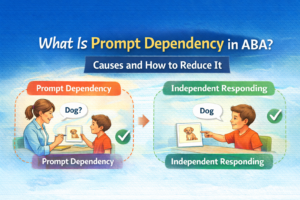
In Applied Behavior Analysis (ABA), prompt dependency refers to a situation in which a learner performs a target skill only when specific prompts are present and fails to do so independently when those prompts are removed. Prompt dependency is one of the most common challenges faced in behavior‑analytic instruction because it can mask true learning and hinder the development of independent skills.
Prompt dependency is not the goal of effective intervention; rather, it is something practitioners need to identify, prevent, and remediate through careful teaching procedures and prompt‑fading strategies. Understanding what prompt dependency looks like, why it occurs, and how to address it is essential for clinicians, educators, and anyone preparing for the BCBA® exam.
https://pmc.ncbi.nlm.nih.gov/articles/PMC11428823/
What Is Prompting?
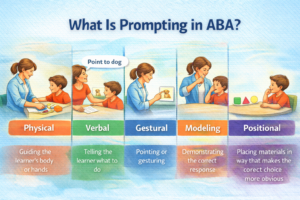
Before defining prompt dependency, it’s important to understand what prompting is in ABA. A prompt is an additional stimulus or cue used to increase the likelihood that a learner will emit a correct response. Prompts can be:
-
Physical — guiding the learner’s body or hands
-
Verbal — telling the learner what to do
-
Gestural — pointing or gesturing
-
Modeling — demonstrating the correct response
-
Positional — placing materials in a way that makes the correct choice more obvious
Prompts are useful and necessary when teaching new skills, but they must be systematically faded so the learner does not become dependent on them.
What Is Prompt Dependency?
Prompt dependency occurs when a learner requires the presence of prompts to produce a behavior and does not perform the skill independently. For example, a learner might only label objects when the instructor points at the object (gesture prompt), but cannot do so when the object is presented without the gesture.
In such cases, the learner’s performance is controlled by the prompts rather than by natural antecedents in the environment. Prompt dependency is especially problematic when learners cannot generalize the skill outside the structured instructional situation.
A clear explanation and examples of prompt dependency are provided by this educational resource:
Why Prompt Dependency Happens
Prompt dependency develops when prompts are too intrusive, used too frequently, or not faded systematically. There are several common reasons:
-
Prompting Without Prompt Fading:
If the instructor fails to fade prompts, the learner may come to expect the prompt and withholds responding without it. -
Prompt Hierarchies Not Followed:
Using the most intrusive prompt first (e.g., full physical) without a planned progression can create reliance on that prompt level. -
Reinforcement of Prompted Responses:
If every prompted response is reinforced without encouraging independent responding, the learner learns to wait for the prompt before responding. -
Lack of Transfer Across Stimuli:
If teaching is limited to one setting, one instructor, or one context, the learner may not learn the skill in varied conditions, appearing dependent on the specific context or prompt.
Preventing prompt dependency requires deliberate planning from the outset of instruction. Effective ABA programming anticipates prompts and includes systematic fading procedures with data collection.
How Prompt Dependency Shows Up in Practice
Here are real‑world examples of prompt dependency:
Example 1: Teaching a Tact
A learner is taught to label pictures of animals. The instructor always points to the picture and immediately says, “What is it?” The learner replies only when the instructor points but cannot name the animal when the picture is shown without a prompt. The learner has become dependent on the gesture.
Example 2: Toilet Training
An instructor always stands behind the learner and tells them “Sit here” while guiding their hand. The learner never goes to the toilet independently and waits for the instructor’s instruction and physical assistance.
Example 3: Hand‑raising in Class
A teacher says, “Raise your hand before speaking” and always gestures to the learner to raise it. The learner raises their hand only when the teacher gestures, not when asked verbally alone.
In all these cases, the behavior occurs reliably only in the presence of a prompt, which indicates a lack of stimulus control by natural antecedents.
Data and Assessment for Prompt Dependency
To detect prompt dependency, behavior analysts collect frequency, latency, and prompt level data. If the data shows that correct responding occurs predominantly with prompts and drops significantly when prompts are removed or faded, this is a clear sign of prompt dependency.
A simple way to document prompt levels is to use a prompting hierarchy chart where each prompt type and level of assistance is coded. This aids in both detecting patterns of dependency and guiding prompt‑fading decisions.
For a practical example of prompt hierarchies and data collection, see:
Prompt Fading: How to Reduce Prompt Dependency
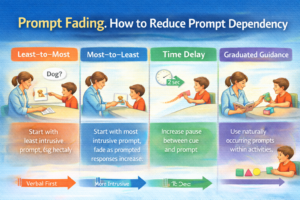
Prompt fading is a planned, systematic reduction of prompts to transfer stimulus control from the prompt to the naturally occurring stimulus. Common fading strategies include:
Least‑to‑Most Prompting
Start with the least intrusive prompt (e.g., verbal) and only escalate if necessary, then fade back down.
Most‑to‑Least Prompting
Start with the most intrusive prompt (e.g., physical) to establish the response, then systematically reduce prompt intensity as mastery increases.
Time Delay
Introduce a brief delay between the natural cue and the prompt. Gradually increase the delay so the learner has an opportunity to respond independently before the prompt is given.
Graduated Guidance
Begin with more physical assistance and gradually reduce touch until the learner performs the skill with minimal or no physical guidance.
Prompt Interspersal
Deliver natural prompts within play or instruction to encourage independent responding without establishing prompt reliance.
The right of these strategies depends on learner needs and the skill being taught, but all require data tracking to ensure progress and fading effectiveness. For a complete tutorial on prompt‑fading techniques, check:
https://pcdi.org/wp‑content/uploads/2023/12/Prompts‑prompt‑fading‑strategies.pdf
Errorless Teaching and Prompt Dependency
Some ABA teaching methods, like errorless learning, use prompts to prevent errors during early acquisition. If not faded carefully, this can inadvertently create prompt dependency. In errorless learning, prompts are initially strong to minimize incorrect responses, but must be faded quickly enough so the learner does not come to rely on them.
Balancing error prevention with prompt fading is critical; clinicians should always plan fade steps and mastery criteria before instruction begins.
More on managing prompt levels in errorless learning:
https://www.peakit.org/resources/peak‑errorless‑learning/ (peakit.org)
Generalization and Maintenance
Prompt dependency not only affects independent responding but also generalization and maintenance of skills. A skill that only occurs in the presence of a prompt in a specific setting is unlikely to generalize to new contexts or people.
To promote generalization, practitioners should:
-
Teach the skill across multiple settings
-
Use multiple instructors
-
Fade prompts in varied contexts
-
Reinforce independent responses across different stimuli
The generalization of skills is a core requirement for socially significant behavior change in ABA. A professional overview of generalization strategies can be found here:
https://www.bacb.com/bcba/generalization‑and‑maintenance/ (bacb.com)
Prompt Dependency and Ethical Practice
The BACB® Code of Ethics requires that behavior analysts design interventions that empower learners and prioritize independence and meaningful skill acquisition. Allowing prompt dependency to persist without remediation can violate ethical standards because it limits learner autonomy and may result in instructional control that replaces natural contingency control.
Behavior analysts should always evaluate whether a prompt is necessary, how it can be faded, and whether the skill will transfer to real‑world settings.
The BACB Ethics Code sections relevant to prompt dependency include commitments to meaningful outcomes and avoiding harm:
https://www.bacb.com/ethics/code/ (bacb.com)
Common BCBA Exam Questions on Prompt Dependency
When studying for the BCBA exam, you may encounter scenarios like:
-
“A learner only completes math tasks when the instructor uses a gestural prompt. What does this suggest?”
→ The learner may be prompt dependent. -
“Which prompt‑fading strategy systematically delays the prompt until the learner responds?”
→ Time delay. -
“Why must prompt levels be faded?”
→ To transfer stimulus control from the prompt to natural antecedents and promote independent responding.
Understanding prompt dependency requires knowing both what it is and how to prevent and remediate it through systematic prompt fading and data‑based decision‑making.
Conclusion: Independent Skills Matter
Prompt dependency is a critical concept in ABA because it helps clinicians recognize when learners are not responding to natural cues, but to artificial supports. While prompts are an essential part of teaching new skills, independence is the ultimate goal.
By planning prompt hierarchies, fading strategies, and multiple exemplar training from the start, practitioners can prevent prompt dependency, promote generalization, and ensure skills truly transfer to everyday life.
Prompt dependency is not a failure—it’s a teaching signal that tells us to adjust our methods so learners gain independence, confidence, and true mastery.