
Understanding prompt delay is essential for both effective clinical practice and success on the BCBA exam. This procedure represents a critical component of stimulus control transfer strategies in applied behavior analysis.
Table of Contents
- prompt delay ABA: What is Prompt Delay in ABA?
- Applying Prompt Delay: Worked ABA Examples
- Prompt Delay on the BCBA Exam
- Quick Clinical Implementation Checklist
- Summary and Key Takeaways
prompt delay ABA: What is Prompt Delay in ABA?
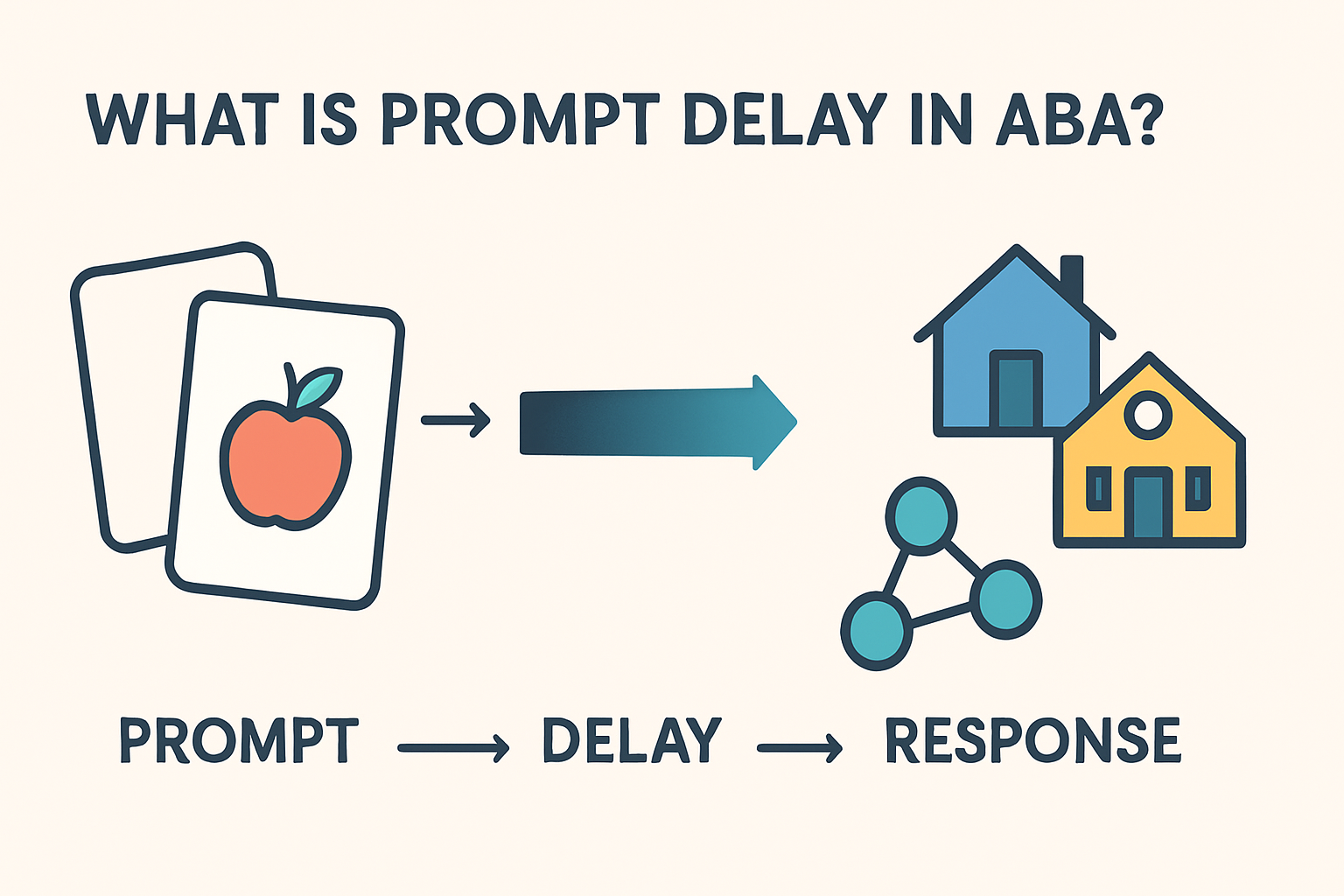
Prompt delay refers to a teaching procedure where a brief, predetermined pause is inserted between the instructional stimulus (SD) and the delivery of a controlling prompt. This intentional waiting period creates an opportunity for the learner to respond independently before receiving assistance.
Core Definition and Purpose
The primary goal of prompt delay is to facilitate stimulus control transfer from the artificial prompt to the natural discriminative stimulus. By providing a brief window for independent responding, practitioners encourage learners to attend to the relevant environmental cues rather than waiting for prompts.
This procedure is particularly effective for reducing prompt dependency and promoting skill acquisition. The delay interval is typically very short—often just 1-3 seconds—making it distinct from more formal time delay procedures.
Prompt Delay vs. Time Delay: A Critical Distinction
Many exam candidates confuse these related but distinct procedures. Prompt delay usually involves a constant, brief pause (e.g., 2 seconds) inserted systematically. In contrast, time delay procedures typically use increasing intervals (progressive time delay) or constant longer intervals.
The key difference lies in the systematic nature and interval progression. Prompt delay is often embedded within other teaching procedures like graduated guidance or errorless learning approaches.
Applying Prompt Delay: Worked ABA Examples
These practical examples demonstrate how prompt delay functions in real clinical scenarios. Each includes ABC data format and hypothesized behavioral function.
Example 1: Teaching a Child to Hang a Backpack
This example illustrates prompt delay in a daily living skill context:
- Antecedent: SD “Hang up your backpack” + 2-second delay before gestural prompt toward hook
- Behavior: Child hangs backpack independently after 1 second of the delay period
- Consequence: Specific praise (“Great job hanging your backpack!”)
- Hypothesized function: Negative reinforcement (avoids gestural prompt) and access to social praise
The brief delay allowed the child to respond to the natural SD rather than waiting for the gesture. This promotes independent responding while maintaining error rates low.
Example 2: Promoting Vocal Manding with an Adult
This example shows prompt delay in communication training:
- Antecedent: Presence of empty cup (establishing operation) + 3-second delay before model prompt “water”
- Behavior: Client says “wa” independently before prompt delivery
- Consequence: Immediate delivery of water
- Hypothesized function: Positive reinforcement (access to water)
The delay interval created an opportunity for spontaneous manding while the establishing operation was strong. This approach helps transfer stimulus control from the modeled prompt to the natural motivating operation.
Prompt Delay on the BCBA Exam
Understanding how prompt delay appears on the exam is crucial for test success. Questions often test your ability to distinguish this procedure from similar interventions and apply it appropriately in clinical scenarios.
Key Terms and Concepts You Must Know
- Stimulus control transfer: The process of shifting control from prompts to natural stimuli
- Errorless learning: Teaching approach that minimizes errors through prompt fading
- Controlling prompt: A prompt that ensures correct responding
- Progressive prompt delay: Increasing delay intervals over trials
- Constant time delay: Fixed delay interval used consistently
These concepts frequently appear together in exam questions about prompting procedures and skill acquisition strategies.
Common Exam Traps and How to Avoid Them
Several predictable traps await unprepared candidates:
- Confusing prompt delay with response delay: Response delay refers to waiting for a response after instruction, not before prompt delivery
- Selecting time delay when scenario describes fixed brief pause: Exam questions often describe prompt delay but list time delay as a distractor
- Forgetting embedded nature: Prompt delay is frequently used within other procedures like errorless learning or graduated guidance
- Overlooking interval specificity: Prompt delay intervals are typically shorter than time delay intervals
Sample Practice Questions
Consider these question formats you might encounter:
“A behavior technician presents the SD ‘Touch blue,’ waits 2 seconds, then provides a physical prompt if no response occurs. Which procedure is being used?”
“When teaching a child to request ‘more’ during snack time, the practitioner waits 3 seconds after the child finishes before modeling the word. This primarily aims to…”
These questions test your understanding of procedure identification and clinical application of prompt delay strategies.
Quick Clinical Implementation Checklist
Use this actionable checklist for implementing prompt delay effectively:
- Determine appropriate delay interval based on learner characteristics and skill complexity
- Select controlling prompt that ensures correct responding when needed
- Systematically insert delay between SD and prompt delivery
- Monitor independent responses during delay periods
- Reinforce independent responding immediately and specifically
- Adjust delay intervals based on learner progress and error patterns
- Document procedure fidelity and response patterns for data-based decisions
This checklist ensures you implement prompt delay with procedural integrity while monitoring for prompt dependency reduction.
Summary and Key Takeaways
Prompt delay represents a powerful tool for promoting independent responding and facilitating stimulus control transfer. Key points to remember include:
- Prompt delay involves a brief, constant pause between SD and prompt delivery
- The procedure aims to transfer control from prompts to natural stimuli
- Distinguish prompt delay from formal time delay procedures on the exam
- Implementation requires careful interval selection and progress monitoring
- Common exam traps include confusing related procedures and overlooking embedded applications
For more information on related procedures, explore our guide to stimulus control and prompt dependency reduction. Additional authoritative information can be found in the BACB resources and peer-reviewed literature on prompt fading procedures.
Mastering prompt delay enhances both your clinical effectiveness and exam performance by deepening your understanding of skill acquisition principles and behavior change procedures.


