
equity in BCBA supervision: Defining Equity in the Context of BCBA Supervision
Understanding equity in BCBA supervision requires moving beyond simple fairness to recognize how historical, social, and individual factors create different starting points for supervisees. This concept is central to Domain I of the BCBA exam, which focuses on supervision and management responsibilities.
Table of Contents
- equity in BCBA supervision: Defining Equity in the Context of BCBA Supervision
- Applied Examples: Identifying and Addressing Inequity in Supervision
- Exam Relevance and Common Traps
- A Supervisor’s Quick-Check for Equitable Practices
- Summary and Key Takeaways for Domain I
The BACB Ethics Code establishes clear expectations for supervisors to promote equitable practices throughout all supervisory relationships.
Equity vs. Equality: A Critical Distinction for Behavior Analysts
Imagine three people of different heights trying to watch a baseball game over a fence. Giving everyone the same size box (equality) doesn’t solve the problem—the shortest person still can’t see. Providing boxes of different heights based on individual needs (equity) ensures everyone can watch the game.
This visual metaphor directly applies to BCBA supervision. The ethical principle of justice (BACB Code 1.01) requires supervisors to provide individualized support that accounts for different backgrounds, experiences, and learning needs.
Core Ethical Foundations in Domain I
Several key BACB Ethics Code items establish the foundation for equitable supervision practices:
- Code 1.07 Cultural Responsiveness: Requires behavior analysts to actively acquire knowledge about cultural differences and adapt their practices accordingly
- Code 4.0 Responsibilities to Supervisees: Mandates that supervisors provide appropriate training, feedback, and professional development opportunities
- Code 5.0 Public Statements: Prohibits discrimination and requires behavior analysts to promote diversity and inclusion
The supervisor’s role extends beyond following rules—they must actively model equitable practices and teach these principles to their supervisees.

Applied Examples: Identifying and Addressing Inequity in Supervision
Real-world scenarios help translate ethical principles into practical applications. These ABC examples demonstrate how inequity can manifest in supervision and what ethical responses should look like.
Example 1: Differential Access to Training Opportunities
Antecedent: A supervisor consistently assigns complex, high-profile cases only to supervisees who share their cultural background and communication style.
Behavior: Other supervisees from different backgrounds report feeling undervalued, disengage from supervision meetings, and show decreased motivation.
Consequence/Function: The supervisor’s behavior may be maintained by social positive reinforcement from working with familiar individuals, creating perceived in-group favoritism.
Equitable strategies would include implementing a rotating case assignment system, providing additional support for supervisees working with unfamiliar populations, and ensuring all supervisees have access to diverse clinical experiences.
Example 2: Feedback Style and Cultural Communication Norms
Antecedent: A supervisor provides direct, public corrective feedback during team meetings, following their preferred communication style.
Behavior: A supervisee from a culture that values indirect communication and saving face becomes silent, avoids eye contact, and stops asking questions.
Consequence/Function: The supervisee’s behavior serves an escape/avoidance function from aversive social interactions that conflict with their cultural norms.
Culturally responsive supervisors would adapt their feedback methods, offer private feedback options, and learn about different communication preferences to create a more inclusive environment.
Exam Relevance and Common Traps
BCBA exam questions about equity in supervision often test your ability to distinguish between procedural fairness and equitable outcomes. Understanding these common traps can significantly improve your exam performance.
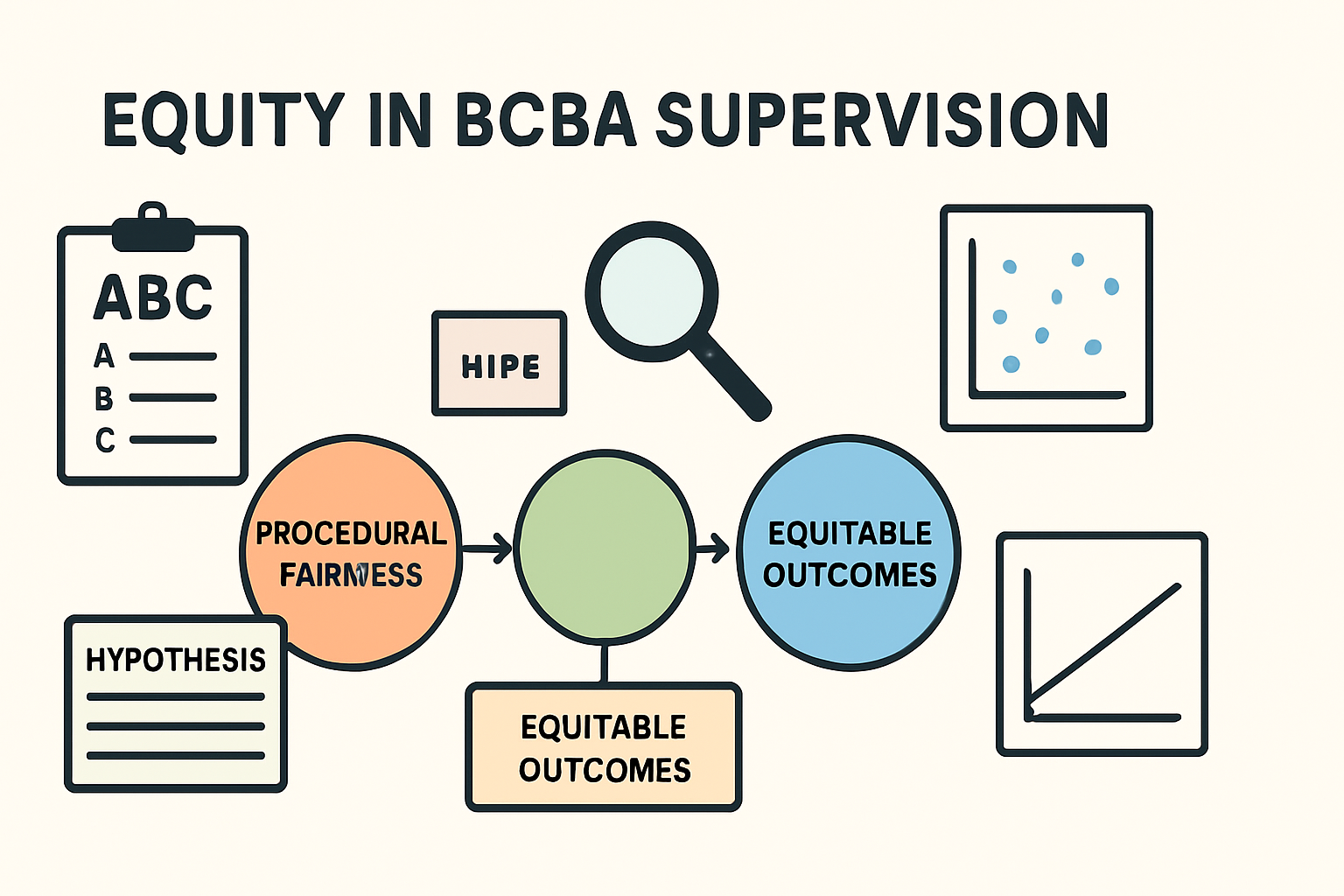
Trap 1: Confusing Procedural Fairness with Equitable Outcomes
Exam questions may present a scenario where a supervisor uses the same feedback form for all supervisees, which seems procedurally fair. However, if this approach disadvantages supervisees with different learning styles or cultural backgrounds, it creates inequitable outcomes.
The ethical answer typically requires adapting procedures based on individual needs rather than maintaining uniform processes that perpetuate disparities. This aligns with the BACB Ethics Code requirement for cultural responsiveness.
Trap 2: Overlooking the Supervisor’s Active Role
Candidates often select passive responses like ‘respect differences’ or ‘acknowledge diversity.’ While these are important, they don’t fulfill the supervisor’s ethical obligation to actively promote equity.
Correct answers usually involve the supervisor taking active steps such as assessing individual needs, modifying supervisory practices, providing additional resources, or implementing systemic changes to address inequities.
A Supervisor’s Quick-Check for Equitable Practices
Use this actionable checklist to evaluate and improve your supervisory practices. These steps align with Domain I requirements and ethical standards.
- Assess individual needs through regular check-ins and needs assessments
- Review case assignments to ensure equitable distribution of learning opportunities
- Adapt communication styles based on supervisee preferences and cultural norms
- Provide multiple feedback formats (written, verbal, private, public) to accommodate different learning styles
- Monitor progress data disaggregated by relevant demographic factors
- Address microaggressions promptly and provide education when needed
- Seek ongoing training in cultural competence and equitable practices
This checklist serves both as an exam preparation tool and a practical guide for future supervisory practice.
Summary and Key Takeaways for Domain I
Promoting equity in BCBA supervision is not a passive state but an active, ongoing ethical obligation. Key takeaways for Domain I include:
- Equity requires individualized approaches that account for different starting points and needs
- The BACB Ethics Code provides specific requirements for cultural responsiveness and equitable treatment
- Supervisors must take active steps to identify and address inequities in their practices
- Exam questions often test your ability to distinguish between procedural fairness and equitable outcomes
- Developing culturally responsive practices is essential for ethical supervision
For more comprehensive exam preparation, explore our guide on ethics in ABA practice and the BCBA exam study framework. Additional resources on cultural variables in assessment can be found in our article on integrating cultural variables.
For authoritative guidance, consult the BACB Ethics Code and research on culturally responsive behavior analysis to deepen your understanding of equitable practices.


