
What Are Preference Assessments and Why Are They Critical in ABA Practice?
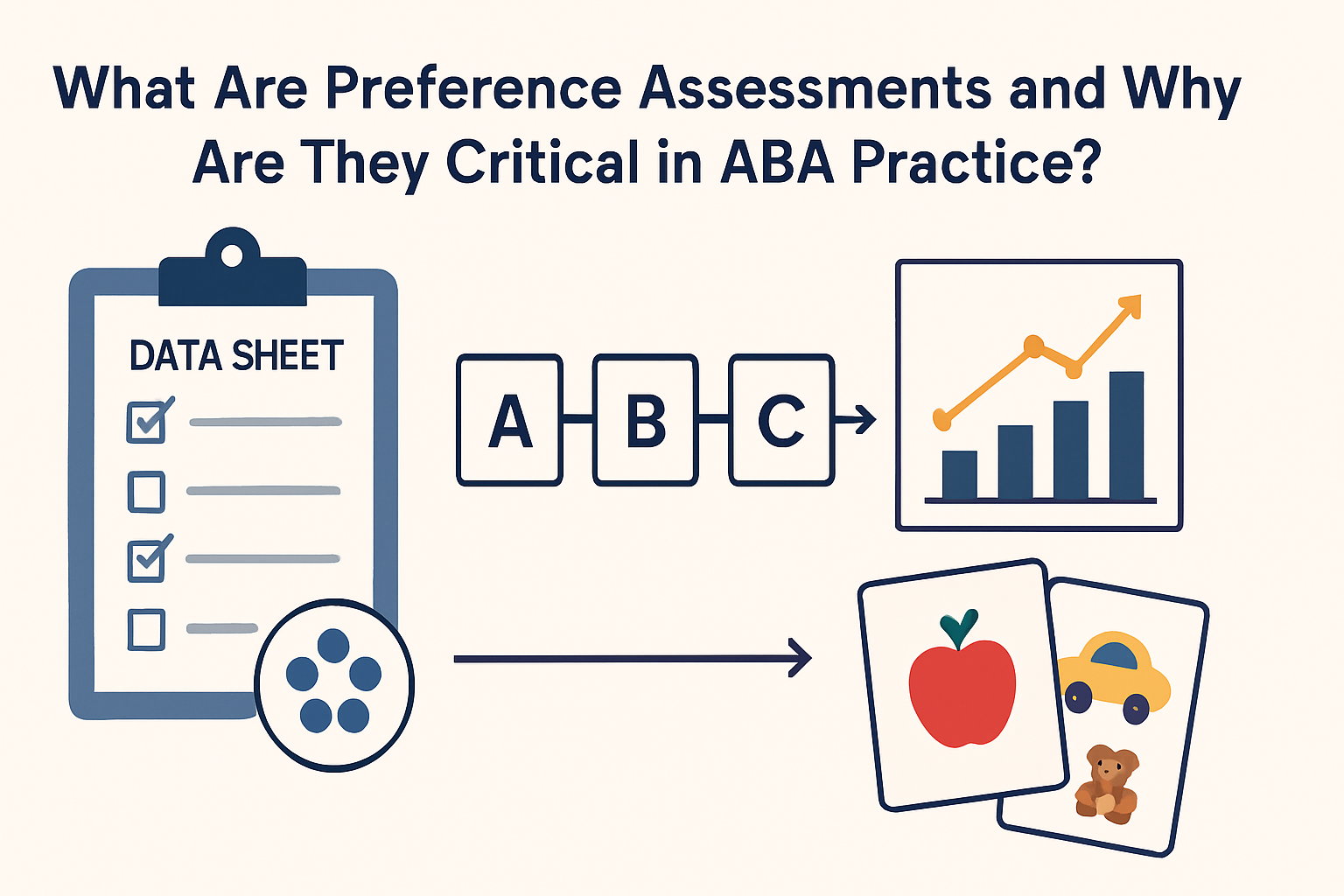
Preference assessments are systematic procedures used to identify stimuli that an individual prefers over other available options. These assessments form the foundation of effective intervention in applied behavior analysis by helping practitioners identify potential reinforcers. The BACB Task List specifically addresses this competency in Section F-2, requiring BCBAs to conduct preference assessments as part of ethical practice.
Ethically, conducting preference assessments respects client dignity and autonomy by involving them in treatment planning. Practically, they increase intervention effectiveness by ensuring reinforcement procedures use stimuli that are actually motivating to the individual. Without proper preference assessments, interventions may rely on assumed reinforcers that fail to produce meaningful behavior change.
Preference vs. Reinforcer Assessment: The Crucial Distinction
A critical distinction for BCBA candidates is understanding that preference assessments identify likely reinforcers, while only a reinforcer assessment confirms they actually increase behavior. This means a preferred item identified through assessment may not function as a true reinforcer in all contexts. The BACB emphasizes this distinction because assuming preference equals reinforcement can lead to ineffective interventions.
Preference assessments measure relative value among stimuli, while reinforcer assessments measure behavioral effect. This fundamental concept appears frequently on the BCBA exam, often in scenarios where candidates must choose the appropriate assessment type based on the practitioner’s goal. Understanding this difference prevents the common mistake of assuming all preferred items will automatically function as reinforcers.
A Guide to Common Preference Assessment Procedures
Several standardized procedures exist for conducting preference assessments, each with specific applications and advantages. Selecting the appropriate method depends on factors like the client’s communication abilities, assessment goals, and practical constraints. BCBAs must be proficient in multiple assessment types to match procedure to context effectively.
Free Operant Observation: Capturing Natural Choices
Free operant observation involves presenting multiple stimuli simultaneously and recording which items the individual engages with without prompts or restrictions. This method can be conducted in natural environments or contrived settings, with data typically recorded as duration or frequency of engagement. It’s particularly useful for initial assessments or with non-verbal clients who may not respond well to more structured procedures.
The key advantage of free operant observation is its ecological validity, as it captures choices in contexts similar to natural environments. However, it may not establish clear preference hierarchies when engagement is similar across items. Practitioners should use this method when seeking to understand natural preferences without the influence of structured testing procedures.
Stimulus Choice Assessments: Structured Testing
Structured stimulus choice assessments provide more controlled methods for establishing preference hierarchies. The single stimulus procedure presents items one at a time, recording approach or engagement. While simple to implement, this method doesn’t establish relative preferences between items.
The paired-choice assessment (also called forced-choice) presents items in pairs, requiring selection between two options. This method establishes clear preference hierarchies through systematic pairing of all items. The multiple stimulus without replacement (MSWO) procedure presents all items simultaneously, removing chosen items after selection to establish a clear hierarchy. In contrast, multiple stimulus with replacement (MSW) returns chosen items to the array, which can be useful when item quantity is limited.
Each structured assessment has specific applications: MSWO efficiently establishes hierarchies, paired-choice provides robust data on relative preferences, and single stimulus works well with clients who become overwhelmed by multiple choices. Understanding these differences is essential for selecting appropriate assessment procedures in practice.
Applying Preference Assessments: Worked Examples from Practice
Translating assessment procedures to real-world applications demonstrates their practical value in behavior intervention planning. These examples show how preference assessment results directly inform treatment strategies and highlight the connection between assessment findings and functional behavior analysis.
Example 1: MSWO for Tangible Reinforcement
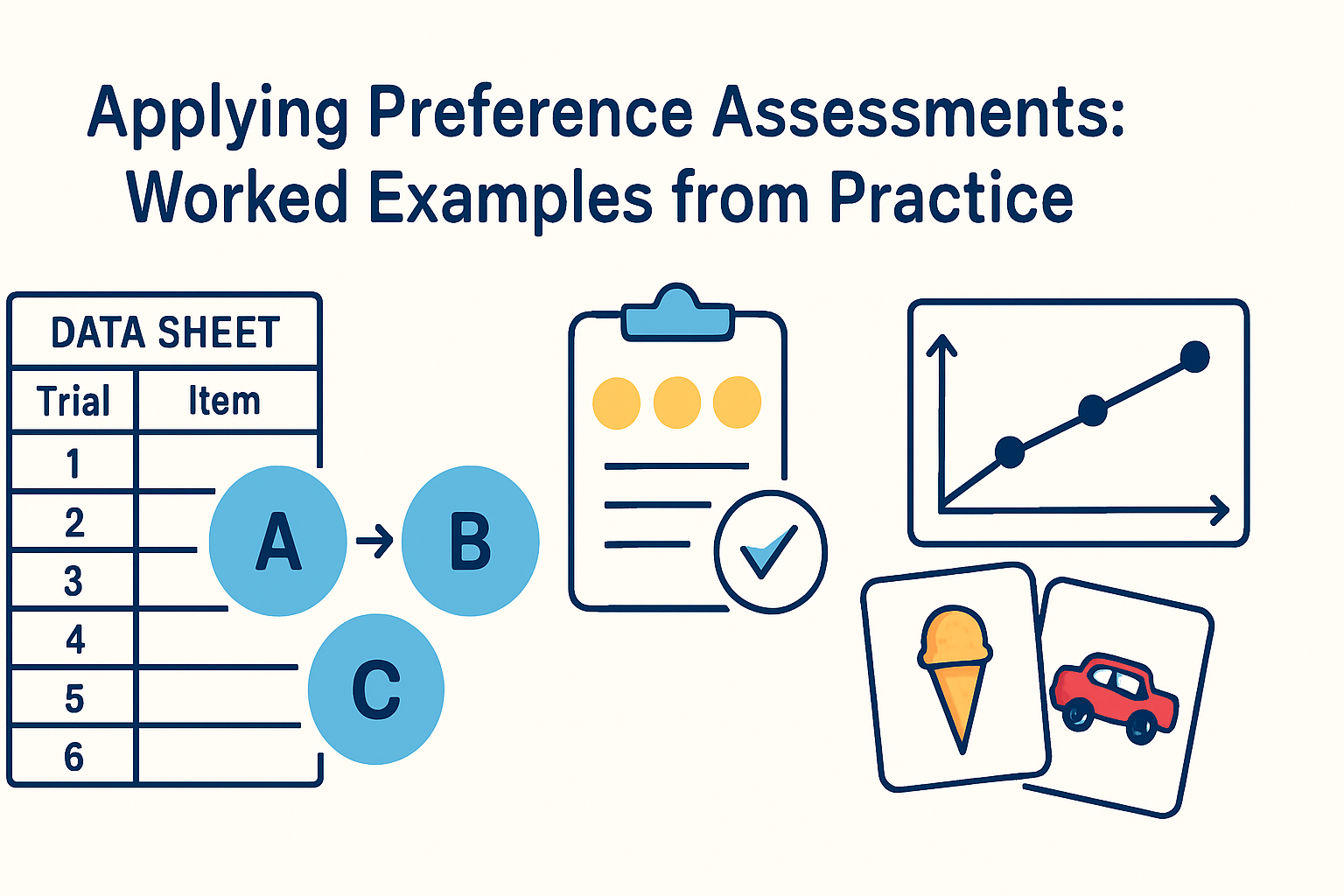
Scenario: A 7-year-old child engages in property destruction (behavior) when their tablet is removed (antecedent). The BCBA hypothesizes the function is access to tangibles. To develop an effective intervention, they conduct an MSWO assessment with five potential alternative items: puzzle, coloring book, building blocks, storybook, and sensory toy.
The assessment reveals the following hierarchy: 1) building blocks, 2) sensory toy, 3) puzzle, 4) coloring book, 5) storybook. This information allows the BCBA to design an intervention where access to blocks serves as reinforcement for appropriate tablet transition behaviors. The assessment data directly informs which alternative items will most likely function as effective reinforcers, increasing intervention success probability.
Example 2: Paired-Choice for Escape-Maintained Behavior
Scenario: A student elopes from the classroom (behavior) during difficult math work (antecedent). The function is hypothesized to be escape from demands. The BCBA conducts a paired-choice assessment with four potential break activities: drawing, listening to music, walking break, and quiet reading.
The assessment establishes that drawing is most preferred, followed by walking breaks, then music, with quiet reading least preferred. This hierarchy informs a differential reinforcement procedure where completing math problems earns access to preferred break activities. The assessment ensures the reinforcement system uses activities the student actually values, making escape less reinforcing than the available break options. This approach aligns with functional behavior assessment principles by addressing the maintaining variable through reinforcement-based strategies.
Navigating Common BCBA Exam Traps on Preference Assessments
The BCBA exam frequently tests nuanced understanding of preference assessment concepts through carefully constructed scenarios. Recognizing common examination pitfalls helps candidates avoid errors and demonstrate comprehensive knowledge of assessment applications and limitations.
Misinterpreting ‘Most’ and ‘Least’ Preferred
A frequent exam trap involves misunderstanding that least preferred items are not necessarily aversive—they simply rank lower on the preference hierarchy. These items may still function as effective reinforcers under appropriate conditions, such as when more preferred items are unavailable or when combined with other reinforcement strategies. The exam may present scenarios where candidates must recognize that even low-preference items can reinforce behavior when properly implemented.
Overlooking the Context and Deprivation
Preferences are not static characteristics but vary based on context, satiation, and deprivation states. Exam questions often test whether candidates recognize when to re-assess preferences given changes in environment or motivational variables. For example, a child’s preference for food items may change immediately after lunch, requiring assessment at different times of day to capture accurate preference patterns.
Candidates should be prepared to identify when contextual factors necessitate preference reassessment, such as changes in setting, time of day, or recent access to preferred items. This understanding reflects the dynamic nature of reinforcement value in real-world applications.
Confusing Assessment Type by Description
Exam questions often describe assessment procedures without naming them, requiring candidates to identify the assessment type from procedural details. Key phrases to recognize include: ‘all items available simultaneously’ (free operant or MSWO), ‘presented in pairs’ (paired-choice), and ‘removed once chosen’ (MSWO versus MSW).
Practice identifying assessment types from brief descriptions by focusing on procedural elements rather than assessment names. This skill is particularly valuable for scenario-based questions that test application knowledge rather than rote memorization. For additional practice with assessment identification, consider BCBA mock exam questions that specifically target this competency.
Quick-Reference Checklist and Key Takeaways
This summary provides essential information for BCBA exam preparation and clinical practice reference. Memorizing these key points ensures readiness for assessment-related questions and ethical practice implementation.
Procedural Steps for Major Assessments
- MSWO Procedure: Present all items simultaneously, record first choice, remove chosen item, re-present remaining items, continue until all items chosen or no selection occurs
- Paired-Choice Assessment: Systematically pair all items, present pairs in randomized order, record selection for each pair, calculate percentage of selections for each item
- Free Operant Observation: Arrange environment with multiple items available, record duration/frequency of engagement with each item, avoid prompting or restricting access
- Single Stimulus: Present items one at a time in randomized order, record approach/engagement behaviors, repeat presentations to establish consistency
Core Concepts to Memorize
- Preference assessments identify likely reinforcers; only reinforcer assessments confirm behavioral effect
- Preferences are context-dependent and influenced by satiation/deprivation states
- Least preferred items can still function as reinforcers under appropriate conditions
- Assessment selection should consider client characteristics, assessment goals, and practical constraints
- Regular re-assessment is necessary as preferences change over time and across contexts
Mastering preference assessments requires understanding both procedural details and conceptual foundations. These assessments represent more than technical skills—they embody the ethical commitment to client-centered practice in applied behavior analysis. By systematically identifying what individuals value, BCBAs can design interventions that respect autonomy while effectively addressing behavioral concerns. For authoritative guidance on assessment standards, refer to the Behavior Analyst Certification Board resources and peer-reviewed literature on preference assessment methodologies.


