


Precision Teaching in ABA: What is Precision Teaching in Applied Behavior Analysis?
Precision Teaching in ABA represents a systematic measurement approach focused on achieving behavioral fluency through precise data collection and analysis. Unlike traditional teaching methods that emphasize mere accuracy, this methodology prioritizes the rate of correct responses as the primary indicator of true learning mastery. Developed by Ogden Lindsley, the approach centers on the principle that learning should be measured in terms of celeration – the acceleration or deceleration of response rates over time.
The foundation of this methodology rests on three core components: pinpoint measurement, continuous data collection, and data-based decision making. Practitioners begin by identifying a specific, observable behavior – what Lindsley called a ‘pinpoint’ – that can be counted and timed. This precision allows for the creation of learning pictures that reveal patterns invisible to casual observation.
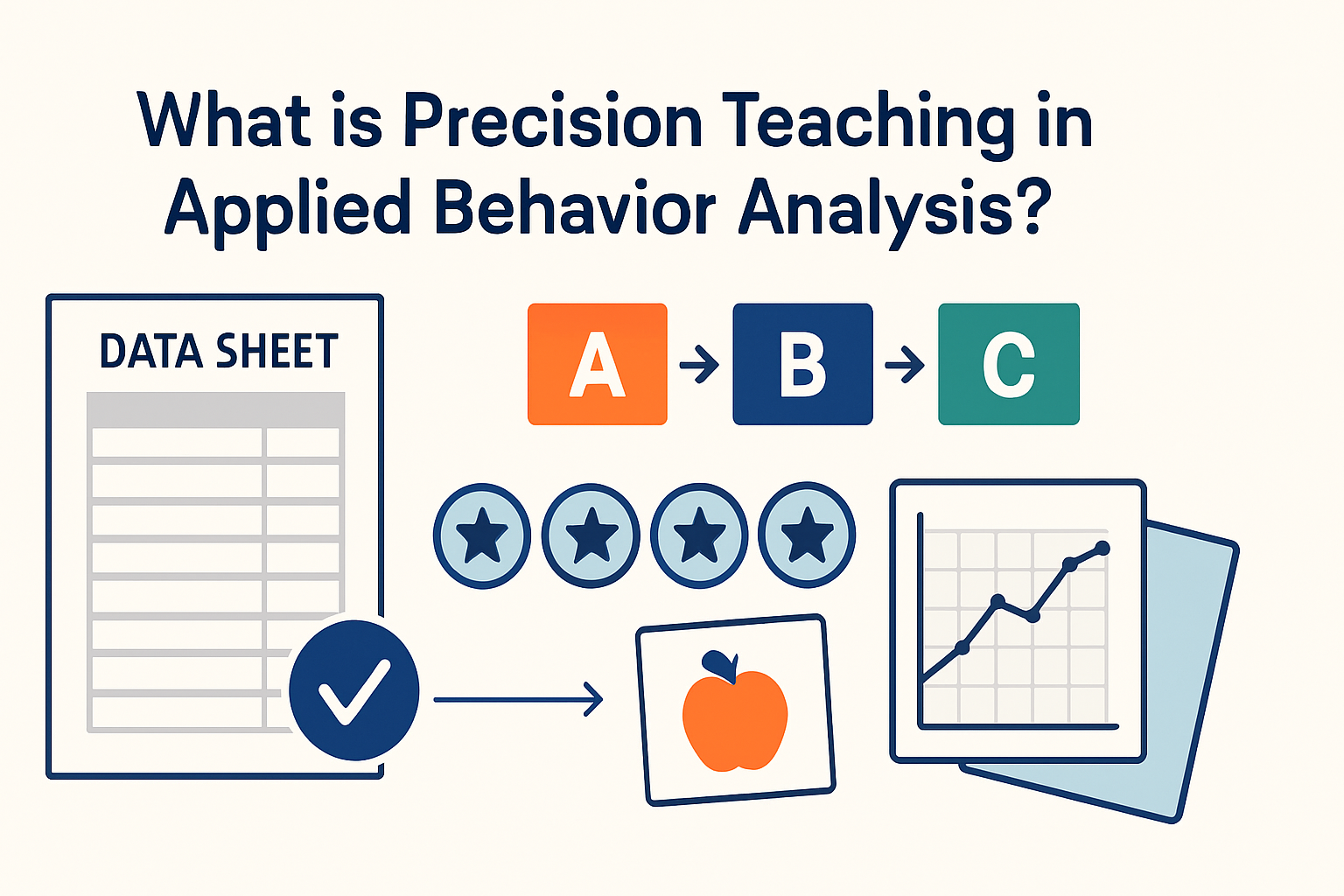
Core Principle: Fluency as the Goal
Fluency represents the ultimate objective in this measurement system, defined as accuracy plus speed with the addition of endurance and application. A fluent skill is not merely correct but performed automatically and efficiently, requiring minimal cognitive effort. This level of mastery enables learners to apply skills across various contexts without hesitation or error.
Consider the difference between a student who can correctly solve math problems versus one who solves them quickly and confidently. The latter demonstrates true fluency, which translates to better retention and generalization. This distinction is crucial for BCBA candidates to understand, as it separates basic acquisition from true mastery in behavioral programming.
The Engine: Measurement and the Standard Celeration Chart
The Standard Celeration Chart serves as the primary measurement tool, providing a visual representation of learning progress over time. This specialized chart uses a ratio scale that allows for the tracking of response rates across multiple orders of magnitude. The chart’s unique design enables practitioners to see not just whether learning is occurring, but how quickly it’s accelerating or decelerating.
Each data point on the chart represents the count per minute of correct responses, plotted on a logarithmic scale. This scaling method allows for the visualization of both small and large changes in performance, making it particularly effective for tracking rapid skill acquisition. The chart’s calendar days format provides a clear timeline of progress, helping practitioners make data-driven decisions about intervention effectiveness.
Precision Teaching in Action: Worked Examples for BCBAs
Understanding theoretical concepts is essential, but BCBA candidates must also grasp practical applications. These worked examples demonstrate how Precision Teaching principles translate into real-world interventions, complete with pinpoint definitions, measurement strategies, and functional considerations.
Example 1: Building Fluency in Letter-Sound Identification
Consider a learner struggling with early literacy skills. The practitioner defines a precise behavioral pinpoint: ‘Correctly saying the sound of a presented letter within 2 seconds of presentation.’ This definition includes clear measurement criteria for both accuracy and speed, essential for fluency building.
The antecedent condition involves presenting individual letter flashcards in random order. The target behavior is the verbal production of the correct sound. The consequence includes recording the response time and correctness on the Standard Celeration Chart. The hypothesized behavioral function might involve access to tangible reinforcement through chart progress or automatic reinforcement from achieving fluency itself.
Data collection occurs during daily 1-minute timings, with the practitioner counting correct responses per minute. The Standard Celeration Chart reveals whether the intervention produces accelerated learning or requires adjustment. This approach differs significantly from traditional methods that might only measure accuracy without considering response speed.
Example 2: Increasing Rate of Manding Using a Speech-Generating Device
For a non-verbal learner using augmentative communication, the practitioner targets manding fluency. The pinpoint becomes: ‘Independently activating the ‘I want’ + item icon sequence within 5 seconds of preferred item presentation.’ This definition emphasizes both the behavioral chain and the temporal requirement.
The antecedent involves placing preferred items within view but out of reach. The behavior requires the learner to navigate the device interface to produce the complete mand sequence. The consequence includes immediate item delivery plus data recording on the Standard Celeration Chart. The primary behavioral function is clearly access to tangibles, with rate serving as the critical measurement dimension.
This example demonstrates how Precision Teaching can enhance functional communication training by focusing on response fluency rather than mere occurrence. Faster manding rates lead to more efficient communication and reduced frustration, addressing the core purpose of applied behavior analysis – improving socially significant behaviors.
Precision Teaching and the BCBA Exam: Key Links and Common Traps
BCBA candidates must understand how this measurement system connects to exam content areas, particularly those related to measurement procedures, data display, and intervention planning. Several common traps await unprepared test-takers, making focused preparation essential.
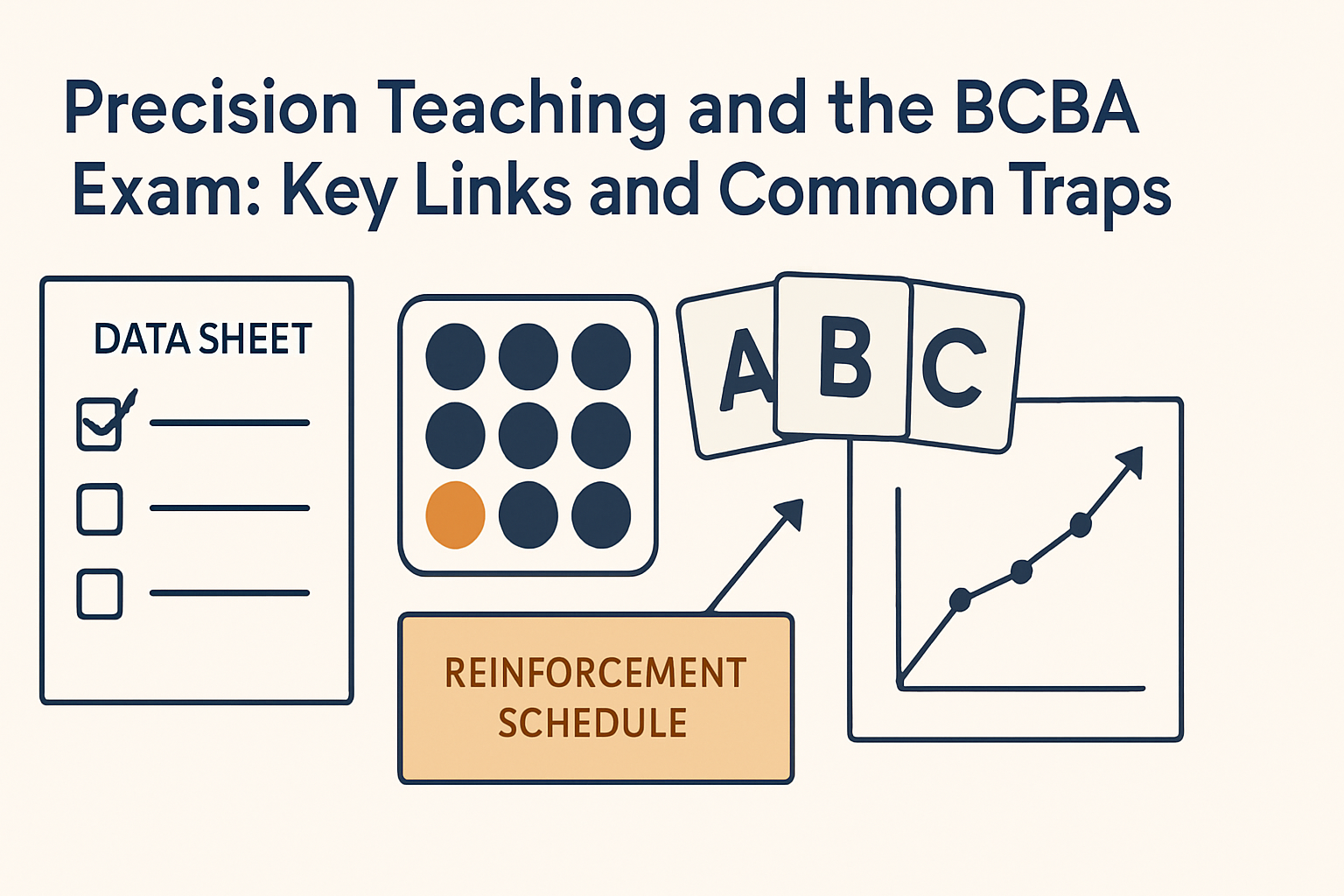
Critical Distinction: Measurement System vs. Teaching Procedure
One of the most frequent exam errors involves confusing Precision Teaching with specific teaching methodologies. Candidates must remember that this approach represents a measurement and decision-making system, not a teaching procedure itself. The Standard Celeration Chart informs intervention decisions but doesn’t prescribe specific teaching tactics.
For example, data from the chart might indicate that a learner needs more discrete trial training sessions or different prompting strategies, but Precision Teaching itself doesn’t specify these interventions. This distinction is crucial for answering questions about intervention selection and data-based decision making. Understanding this separation helps candidates avoid selecting incorrect answers that conflate measurement with instruction.
Navigating Exam Questions on Data Display
BCBA exam questions often test candidates’ ability to select appropriate data visualization methods for different measurement purposes. The Standard Celeration Chart is specifically designed for tracking rate changes over time, making it ideal for fluency-building interventions. Candidates should recognize when this specialized chart is appropriate versus when simpler line graphs or cumulative records would suffice.
Key indicators for selecting the Standard Celeration Chart include: measuring response rates, tracking learning acceleration, needing to visualize data across multiple orders of magnitude, and making celeration decisions about intervention effectiveness. Understanding these criteria helps candidates navigate complex exam scenarios involving data interpretation and graph selection.
Quick Checklist: Is This Precision Teaching?
Use this practical checklist to analyze exam vignettes and determine whether they describe Precision Teaching applications:
- Fluency measurement – Does the intervention target both accuracy AND speed of responding?
- Rate-based data – Is performance measured in counts per unit of time (e.g., responses per minute)?
- Standard Celeration Chart – Is this specialized chart used for data display and decision-making?
- Pinpoint definition – Is there a specific, observable behavior that can be counted and timed?
- Celeration focus – Does the analysis emphasize learning acceleration or deceleration patterns?
- Data-driven decisions – Are intervention changes based on charted performance trends?
- Measurement system – Is the approach primarily about measurement rather than specific teaching tactics?
If most items check positively, you’re likely dealing with a Precision Teaching scenario. For more on measurement systems, see our guide to behavior measurement in ABA.
Summary: Integrating Precision Teaching into Your Practice
Precision Teaching represents a powerful approach to achieving true behavioral fluency through systematic measurement and data analysis. The methodology’s strength lies in its focus on response rates rather than mere accuracy, using the Standard Celeration Chart to visualize learning patterns invisible to traditional measurement approaches.
For BCBA candidates, mastering this concept requires understanding several key distinctions: between measurement systems and teaching procedures, between acquisition and fluency, and between different data display methods. Practical application involves defining precise behavioral pinpoints, collecting rate-based data, and making intervention decisions based on celeration patterns.
Integrating these principles into practice enhances data collection effectiveness and intervention precision. By focusing on fluency building, practitioners can help learners achieve skills that are not just correct but automatic, efficient, and generalizable – the ultimate goal of effective behavior analysis. For authoritative information on measurement standards, consult the Behavior Analyst Certification Board resources and research from the Journal of Applied Behavior Analysis.


