
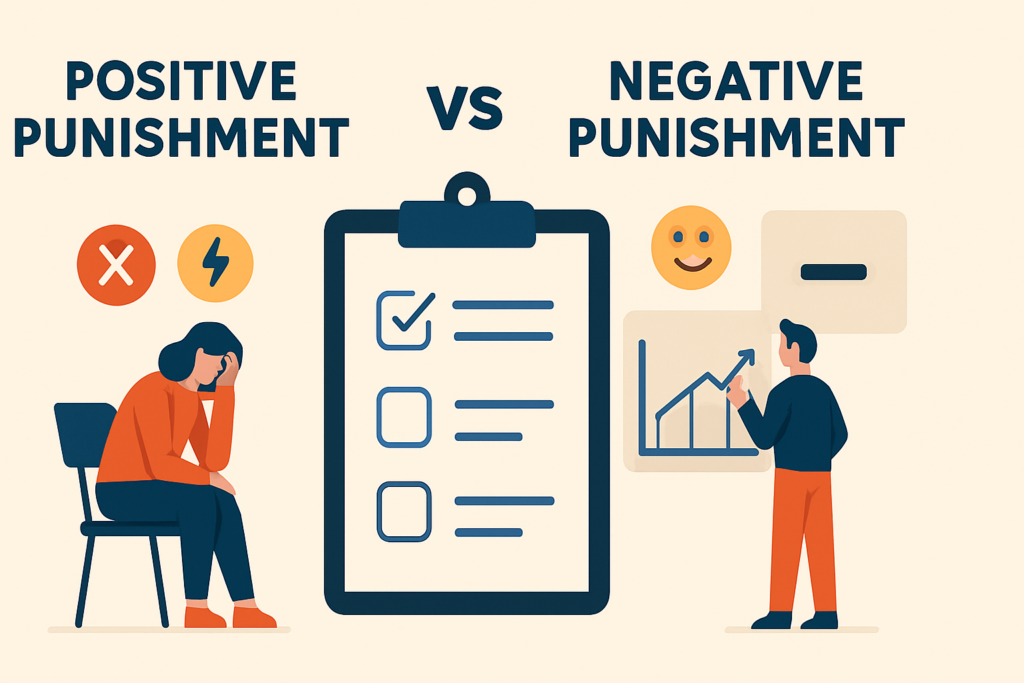
Understanding the distinction between positive punishment and negative punishment is essential for BCBA candidates. These fundamental concepts appear throughout the exam and clinical practice. This guide breaks down the definitions, provides practical examples, and highlights common exam traps to help you master this critical distinction.
Table of Contents
- Positive Punishment vs Negative Punishment: Understanding the Core Definitions
- Applied Examples in ABC Format
- Exam Relevance and Common Traps
- Quick-Study Checklist and Summary
Positive Punishment vs Negative Punishment: Understanding the Core Definitions
Before examining specific procedures, establish the foundational framework. All punishment operations share one defining feature: they decrease behavior.
What is Punishment in ABA?
In applied behavior analysis, punishment is defined by its effect on future behavior. A consequence qualifies as punishment only if it reduces the frequency of the behavior it follows. This functional definition means that what appears punishing to one person might not function as punishment for another. The key is always the behavioral effect, not the subjective experience.
Positive Punishment: Adding to Decrease
Positive punishment occurs when a stimulus is presented or added following a behavior, resulting in a decrease in that behavior’s future frequency. The term ‘positive’ refers solely to the addition of a stimulus, not to any ethical or social value. Common examples include verbal reprimands, physical effort, or aversive sounds that follow unwanted behavior.
Negative Punishment: Taking Away to Decrease
Negative punishment involves the removal or taking away of a stimulus following a behavior, leading to a decrease in that behavior’s future occurrence. The ‘negative’ denotes subtraction, not a negative evaluation. This category includes procedures like response cost and time-out from reinforcement.

Applied Examples in ABC Format
Concrete examples in Antecedent-Behavior-Consequence format solidify understanding. These scenarios demonstrate how both punishment types function in practice.
Example 1: Positive Punishment in Action
A child runs toward a busy street while playing outside. The parent immediately gives a firm verbal reprimand. The child’s street-running behavior decreases in future outdoor sessions.
- Antecedent: Child playing near street
- Behavior: Running toward street
- Consequence: Firm verbal reprimand (added stimulus)
- Effect: Decreased street-running
Ethical note: While effective, positive punishment procedures require careful consideration of side effects and should follow least restrictive principles. For more on ethical considerations, see our guide on punishment ethics and side effects.
Example 2: Negative Punishment (Response Cost)
A student frequently talks out of turn during class discussions. The teacher removes one token from the student’s token board each time this occurs. The talk-out behavior decreases over subsequent sessions.
- Antecedent: Teacher asks class question
- Behavior: Student talks without raising hand
- Consequence: Token removed from board
- Effect: Decreased talk-outs
This response cost procedure removes access to a specific reinforcer (tokens) contingent on unwanted behavior.
Example 3: Negative Punishment (Time-Out)
A child hits their sibling during a shared play activity. The parent implements a brief time-out, removing the child from the play area and toys for two minutes. Hitting behavior decreases during future play sessions.
- Antecedent: Sibling takes preferred toy
- Behavior: Child hits sibling
- Consequence: Removal from play area/toys
- Effect: Decreased hitting
Differentiation from extinction: Time-out removes access to all reinforcement, while extinction withholds only the specific reinforcer maintaining the behavior. Learn more about extinction procedures.
Exam Relevance and Common Traps
The BCBA exam frequently tests your ability to distinguish between these procedures. Understanding common pitfalls can prevent costly errors.

Trap 1: Confusing ‘Positive’ with ‘Good’
The most frequent conceptual error involves interpreting ‘positive’ as desirable or ethical. In behavioral terminology, ‘positive’ means only ‘added,’ while ‘negative’ means ‘removed.’ A positive punishment procedure adds an aversive stimulus; it doesn’t imply the procedure is beneficial.
Trap 2: Misidentifying Negative Punishment as Extinction
Students often confuse negative punishment with extinction. The critical distinction: negative punishment removes a stimulus present in the environment, while extinction withholds the specific reinforcer that was maintaining the behavior. For example, turning off a TV (removing access) is negative punishment if it decreases behavior; ignoring attention-seeking behavior is extinction.
Trap 3: Overlooking the Function (Decrease)
If a behavior doesn’t decrease following a consequence, it’s not punishment—regardless of what was added or removed. The defining feature is always the behavioral effect. Exam questions may describe procedures that appear punishing but don’t actually reduce behavior frequency.
For comprehensive exam preparation strategies, explore our BCBA exam prep guide.
Quick-Study Checklist and Summary
Use this checklist to self-assess your understanding before the exam. Each item represents a critical thinking step for identifying punishment procedures.
Your Punishment Procedure Checklist
- Check for behavioral decrease: Did the target behavior actually reduce in future occurrences?
- Identify stimulus operation: Was a stimulus added (positive) or removed (negative)?
- Verify function over form: Is this defined by effect, not by the nature of the stimulus?
- Consider ethical appropriateness: Would this be the least restrictive, justified intervention?
- Differentiate from reinforcement: Remember reinforcement increases behavior; punishment decreases it.
Key Takeaways for Your Exam
Mastering the distinction between positive punishment and negative punishment is essential for the ‘Concepts and Principles’ section of the BCBA exam. Focus on the functional definitions: both decrease behavior, but through different operations. Positive punishment adds a stimulus; negative punishment removes one. Always verify the behavioral effect before classifying a procedure.
Remember that ethical implementation requires considering side effects, social validity, and least restrictive alternatives. These concepts are tested alongside procedural knowledge on the exam.


