

Understanding positive punishment is crucial for BCBA candidates, yet the terminology often creates confusion. This guide provides clear positive punishment examples in ABA contexts, explains the underlying principles, and prepares you for exam scenarios where this concept is tested.
Table of Contents
- Defining Positive Punishment: Beyond the Confusing Name
- Positive Punishment Examples in Applied Settings
- Positive Punishment on the BCBA Exam: What to Expect
- A Quick Checklist for Identifying Positive Punishment
- Summary and Key Takeaways for Your Studies
Defining Positive Punishment: Beyond the Confusing Name
The term ‘positive punishment’ creates immediate confusion because ‘positive’ typically means good or desirable in everyday language. In behavior analysis, however, positive simply means ‘addition’ or ‘presentation’ of a stimulus.
Positive punishment occurs when a behavior is followed by the addition of an aversive stimulus, resulting in a decrease in future frequency of that behavior. The ‘punishment’ component refers specifically to the effect on behavior, not the nature of the stimulus.
The Key Elements: Addition and Decrease
Two critical elements define positive punishment. First, there must be an added stimulus following the behavior. Second, this addition must result in a measurable reduction in the behavior’s future occurrence.
Contrast this with negative punishment, which involves removing a stimulus to decrease behavior, and reinforcement procedures that increase behavior frequency. Understanding these distinctions is essential for accurate differentiation on the BCBA exam.
Why This Term Trips Up BCBA Candidates
Most exam mistakes occur because candidates interpret ‘positive’ colloquially rather than technically. The BACB exam consistently tests the functional definition, requiring you to identify whether a stimulus was added (positive) or removed (negative) and whether behavior decreased (punishment) or increased (reinforcement).
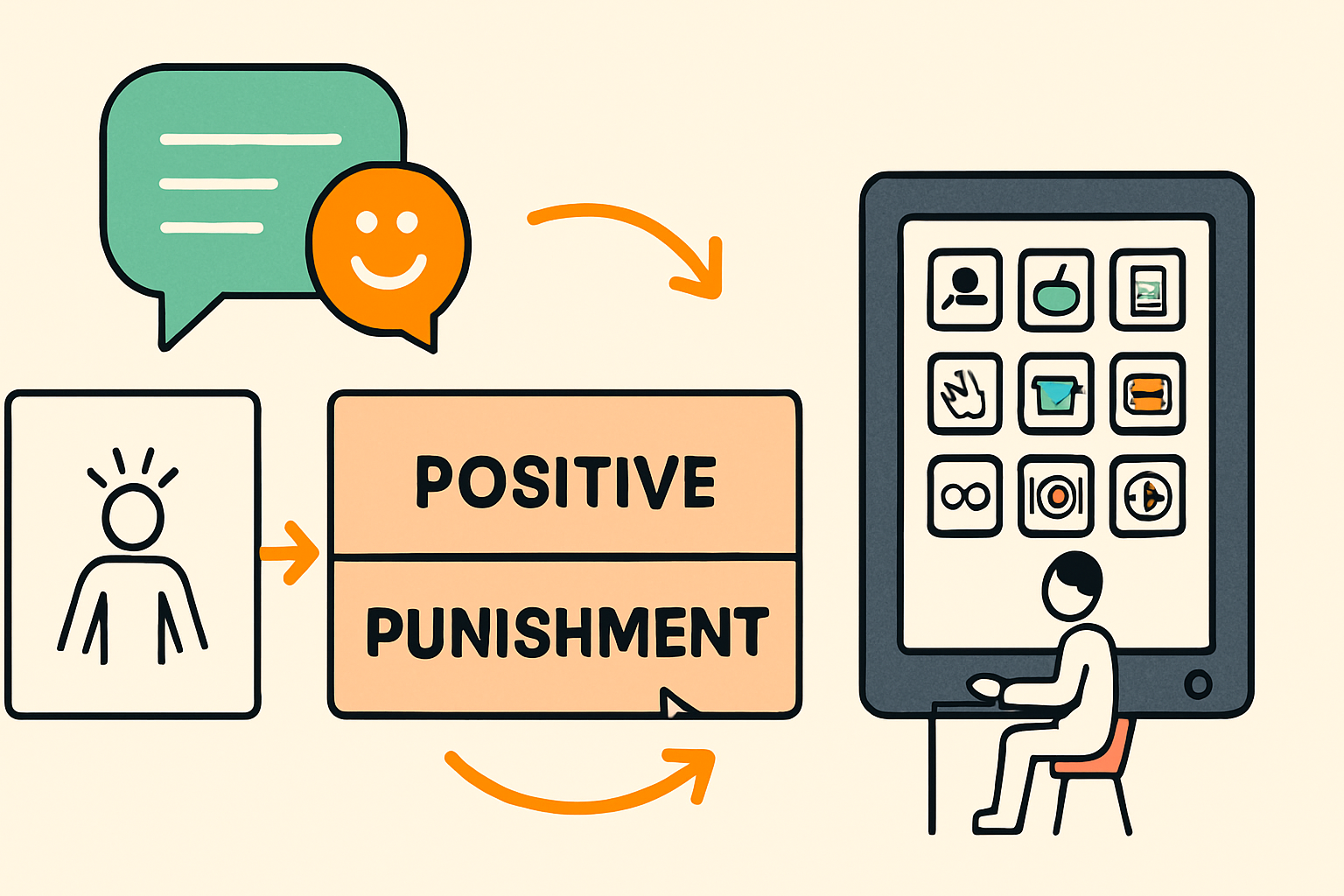
Positive Punishment Examples in Applied Settings
Real-world examples clarify how positive punishment operates in ABA practice. Each scenario follows the ABC model (Antecedent-Behavior-Consequence) and includes a hypothesized behavioral function.
Example 1: Reprimand Following Elopement
Consider a classroom scenario where a student engages in elopement behavior. The antecedent is a difficult academic demand. The behavior involves leaving the instructional area without permission. The consequence is a firm verbal reprimand from the teacher.
If the reprimand functions as an aversive stimulus and the student’s elopement decreases in future similar situations, this demonstrates positive punishment. The likely behavioral function is escape from demands, though the punishment effect operates independently of function.
Example 2: Overcorrection for Property Destruction
In a therapeutic setting, a client denied access to a preferred item throws materials. The intervention requires not only cleaning up the thrown items but also organizing the entire shelf area. This added effortful activity constitutes the positive punishment component.
When implementing such procedures, BCBAs must follow ethical guidelines including considering least restrictive alternatives first and ensuring the procedure is part of a comprehensive behavior plan. Overcorrection should only be used when reinforcement-based approaches have proven insufficient and with proper oversight.
Positive Punishment on the BCBA Exam: What to Expect
Exam questions test both identification of positive punishment and understanding of its appropriate application. You’ll encounter scenarios requiring analysis of behavioral principles in action.
Common Exam Question Formats and Traps
Typical question stems include ‘Which intervention exemplifies positive punishment?’ or ‘What behavioral principle is demonstrated in this scenario?’ Common traps include:
- Confusing positive punishment with negative punishment (removal vs. addition)
- Mistaking punishment for extinction (withholding reinforcement)
- Interpreting ‘positive’ as desirable rather than additive
- Focusing on the stimulus nature rather than its effect on behavior
Remember that punishment is defined by its effect on future behavior, not by the characteristics of the consequence itself.
Ethical Safeguards and the Exam
The BACB Ethics Code requires that punishment procedures only be implemented after reinforcement-based approaches have been considered and when justified by the behavior’s severity. Exam questions often test knowledge of these safeguards alongside principle identification.
Key ethical considerations include obtaining informed consent, using the least restrictive alternative, implementing functional assessments first, and monitoring for side effects like emotional responses or avoidance behaviors. Understanding these requirements is essential for both exam success and ethical practice.
A Quick Checklist for Identifying Positive Punishment
Use this systematic approach when analyzing exam scenarios or clinical situations:
- Identify the target behavior – What specific behavior are we examining?
- Determine what happened immediately after – Was a stimulus added or removed?
- Assess the behavioral effect – Did the behavior decrease in future occurrences?
- Rule out alternatives – Could this be negative punishment, extinction, or reinforcement?
- Consider function separately – Remember that punishment effects are independent of behavioral function
- Check ethical appropriateness – Would this procedure meet BACB standards in practice?
This checklist helps avoid common analysis errors and ensures accurate identification of behavioral principles.
Summary and Key Takeaways for Your Studies
Positive punishment involves adding an aversive stimulus following a behavior to decrease its future frequency. The terminology is counterintuitive but follows consistent behavioral principles.
Key points to remember:
- Positive means addition, not ‘good’ – This is the most common exam trap
- Punishment is defined by behavioral effect, not stimulus characteristics
- Always consider ethical guidelines when evaluating punishment procedures
- Practice distinguishing between all four contingencies of reinforcement and punishment
- Use the ABC model to systematically analyze scenarios
For further study of related concepts, explore our guide on negative reinforcement examples and the comprehensive resource on punishment ethics and side effects. The BACB Ethics Code provides essential guidance on appropriate use of behavioral procedures.
Mastering positive punishment requires both conceptual understanding and practical application skills. Regular practice with varied scenarios will build the analytical abilities needed for exam success and ethical clinical practice.


