

partial and whole interval accuracy: What Are Partial and Whole Interval Recording?
Interval recording methods are time-based measurement systems used in applied behavior analysis to quantify behavior occurrence. These approaches divide observation periods into equal intervals and record whether target behaviors happen during each segment. Understanding partial and whole interval accuracy is essential for reliable data collection and BCBA exam success.
Table of Contents
- partial and whole interval accuracy: What Are Partial and Whole Interval Recording?
- Calculating and Interpreting Accuracy
- Applied Examples from ABC to Function
- BCBA Exam Focus: Common Traps and How to Avoid Them
- Quick-Reference Checklist for Practice
- Summary and Key Takeaways
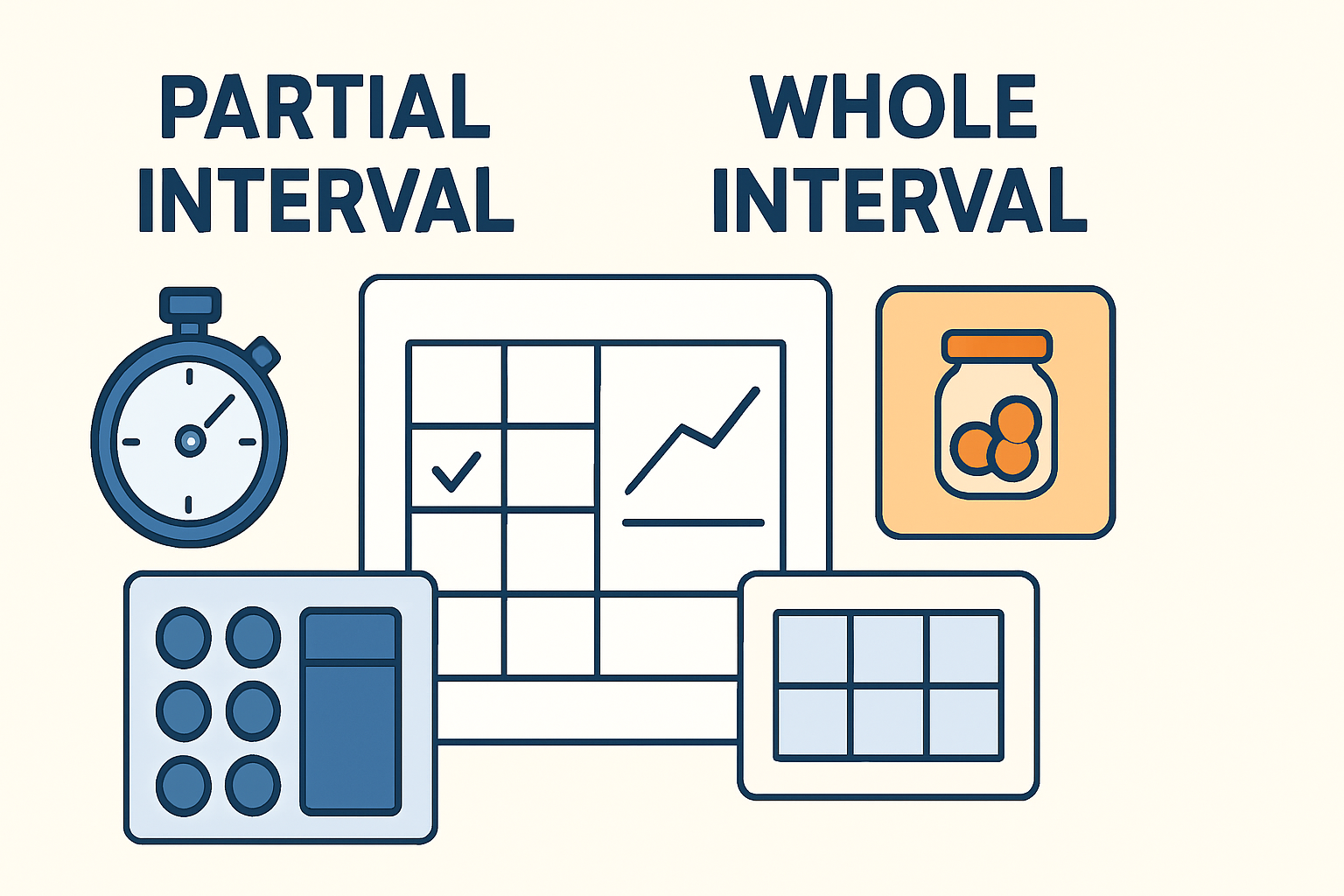
The Core Rule of Whole Interval Recording
In whole interval recording, a behavior is scored only if it occurs for the entire duration of the interval. This method provides a conservative estimate of behavior duration and is particularly useful for measuring continuous behaviors like task engagement or sustained attention.
For example, if using 10-second intervals to measure on-task behavior during academic work, the behavior would only be recorded if the client remained engaged for all 10 seconds of the interval. Brief interruptions would result in a non-scored interval.
The Core Rule of Partial Interval Recording
Partial interval recording scores a behavior if it occurs at any point during the interval, regardless of duration. This approach tends to overestimate behavior occurrence but is valuable for measuring high-frequency or low-duration behaviors that might be missed with other methods.
Consider measuring hand flapping using 5-second intervals. If the behavior happens even briefly during the interval, it’s recorded. This method captures the presence of behaviors that occur rapidly or for very short durations.
Calculating and Interpreting Accuracy
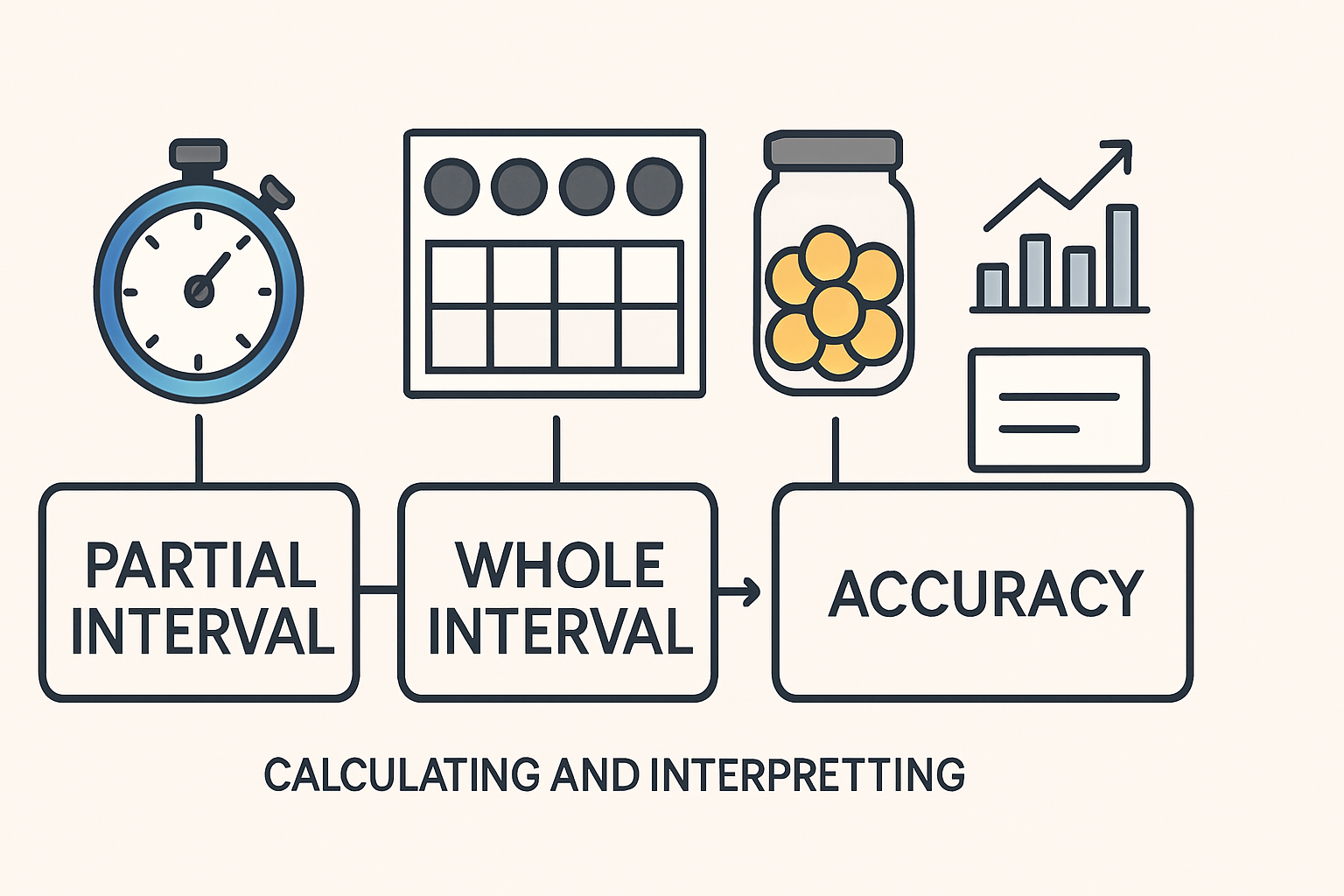
Measurement accuracy, often called interobserver agreement (IOA), determines how consistently two observers record the same behavior using the same measurement system. High accuracy percentages indicate reliable data collection procedures.
The Accuracy Formula and Worked Example
The standard formula for calculating accuracy is: (Agreements / (Agreements + Disagreements)) × 100. This calculation applies to both partial and whole interval recording methods, though the interpretation differs based on the measurement system.
Consider this data set for whole interval recording with 10 intervals:
- Observer A: +, +, -, +, -, +, +, -, +, –
- Observer B: +, +, -, +, -, +, +, -, +, –
Agreements occur in 9 intervals, disagreements in 1 interval. Accuracy = (9 / (9 + 1)) × 100 = 90%. For partial interval recording with the same data pattern, the calculation follows the same formula but represents different behavioral information.
What Does 80% Accuracy Really Tell You?
The common 80% accuracy standard serves as a clinical and research benchmark for acceptable measurement reliability. However, this percentage means different things depending on the recording method used.
For whole interval recording, 80% accuracy indicates observers agreed that the behavior lasted entire intervals most of the time. For partial interval recording, the same percentage means observers agreed about behavior occurrence at any point during intervals. The behavioral implications differ significantly between these interpretations.
Applied Examples from ABC to Function
Selecting the appropriate interval recording method depends on behavior topography, hypothesized function, and measurement goals. These practical examples demonstrate how to apply each method effectively.
Example 1: Measuring Task Engagement (Hypothesized: Escape)
A client consistently avoids math worksheets by looking away, fidgeting, or making off-task comments. The ABC data suggests escape-maintained behavior. For measuring ‘engaged with task,’ whole interval recording provides the most meaningful data about sustained engagement.
Using 15-second intervals, two observers record data:
- Observer A scores 8 intervals with engagement
- Observer B scores 7 intervals with engagement
- They agree on 12 of 15 intervals
Accuracy = (12 / (12 + 3)) × 100 = 80%. This indicates reliable measurement of sustained task engagement, crucial for evaluating escape-maintained behavior interventions.
Example 2: Measuring Vocal Stereotypy (Hypothesized: Automatic)
A client emits brief, frequent vocal sounds throughout sessions. These behaviors occur rapidly and for short durations. For this topography, partial interval recording better captures occurrence patterns than duration-based methods.
Using 10-second intervals across a 5-minute observation:
- Observer A records behavior in 18 intervals
- Observer B records behavior in 16 intervals
- They agree on 26 of 30 intervals
Accuracy = (26 / (26 + 4)) × 100 = 86.7%. This reliable measurement helps track automatic reinforcement patterns and intervention effectiveness for vocal stereotypy.
BCBA Exam Focus: Common Traps and How to Avoid Them
Exam questions about interval recording often test conceptual understanding rather than simple recall. Recognizing these common traps improves your chances of selecting correct answers.
Trap 1: Confusing the Interval Rule
Exam items may subtly switch definitions between partial and whole interval recording. Remember this mnemonic: “Whole means whole time, Partial means any part.” Always verify which scoring rule the question describes before selecting your answer.
Trap 2: Misapplying the Method to Behavior Topography
Questions often present behavior descriptions and ask which recording method is most appropriate. Use this decision logic:
- Choose whole interval recording for continuous, sustained behaviors (task engagement, social interaction)
- Choose partial interval recording for brief, frequent behaviors (vocalizations, motor movements)
- Consider behavior function and measurement purpose when uncertain
Trap 3: Interpreting Accuracy Percentages
A high accuracy percentage for partial interval recording on a low-rate behavior has different implications than the same percentage for whole interval recording on a high-duration behavior. Consider this example: 90% accuracy for partial interval recording of a behavior occurring in only 2 of 10 intervals suggests good agreement about absence, not presence.
Quick-Reference Checklist for Practice
Use this actionable checklist during study sessions or clinical work to ensure proper application of interval recording methods:
- Identify behavior topography before selecting measurement method
- Define clear onset and offset criteria for each target behavior
- Train observers using practice sessions with feedback
- Calculate accuracy regularly using the standard formula
- Interpret accuracy percentages in context of recording method
- Adjust interval length based on behavior characteristics
- Document measurement procedures in behavior plans
Summary and Key Takeaways
Mastering partial and whole interval recording requires understanding their distinct scoring rules and appropriate applications. Whole interval recording measures sustained behavior occurrence, while partial interval recording captures brief behavior presence. Both methods serve important roles in comprehensive behavior assessment.
Accuracy calculations follow the same formula but yield different behavioral interpretations. The 80% benchmark indicates acceptable reliability, though clinical judgment considers context and measurement goals. For BCBA exam preparation, focus on distinguishing between methods, selecting appropriate applications, and interpreting accuracy data correctly.
Effective behavior measurement supports ethical practice and data-driven decision making. As you prepare for the BCBA exam, practice applying these concepts to diverse scenarios and review foundational measurement principles in resources like our guide to data collection methods and assessment approaches. For authoritative guidance on measurement standards, consult the BACB Ethics Code and peer-reviewed literature on measurement reliability.


