
Partial interval recording is a discontinuous measurement procedure commonly used in applied behavior analysis to track behavior occurrence. This method provides a practical balance between accuracy and feasibility when constant observation isn’t possible. Understanding how partial interval recording works, when to use it, and its limitations is essential for both clinical practice and BCBA exam preparation.
Table of Contents
- What is Partial Interval Recording? Definition and Core Procedure
- When is Partial Interval Recording Commonly Used in Practice?
- BCBA Exam Focus: Critical Considerations and Common Traps
- Quick Implementation Checklist and Summary
What is Partial Interval Recording? Definition and Core Procedure
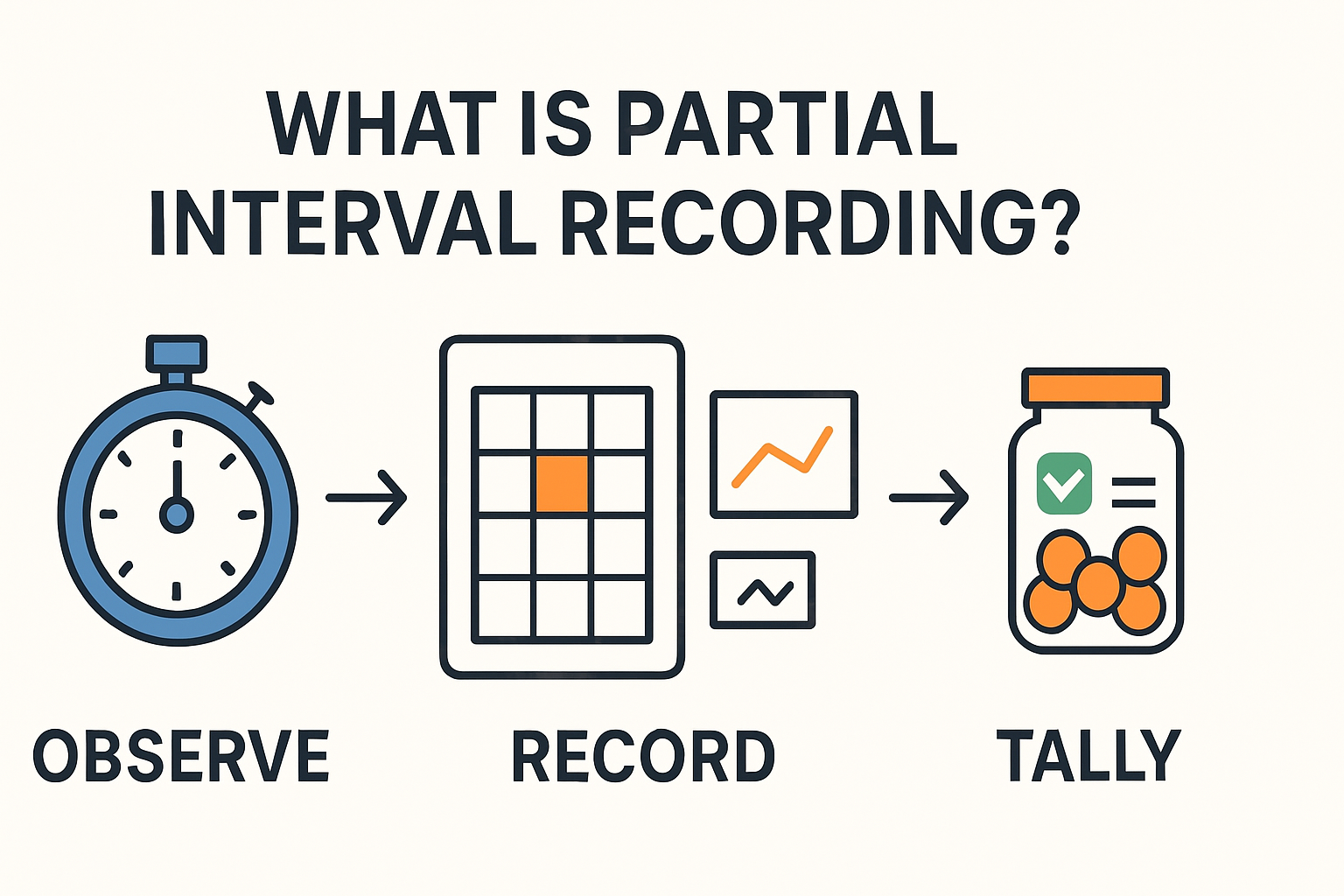
Partial interval recording involves dividing observation periods into equal intervals and recording whether a target behavior occurred at any point during each interval. Unlike continuous measurement methods, this approach provides an estimate rather than an exact count.
The Formal Definition and Key Characteristics
In partial interval recording, an observer marks a yes if the target behavior occurs at any time during the interval, regardless of duration or frequency within that interval. This method systematically overestimates occurrence compared to continuous measurement. It differs from whole interval recording, which requires the behavior to occur throughout the entire interval, and from momentary time sampling, which only checks at specific moments.
Step-by-Step: How to Implement Partial Interval Recording
Follow these steps to implement partial interval recording correctly:
- Define the target behavior operationally with clear beginning and ending criteria
- Determine interval length based on behavior characteristics and observation constraints (typically 10-30 seconds)
- Set up a data sheet with columns for each interval and rows for observation sessions
- Start the timer and observe continuously throughout each interval
- Mark yes if the behavior occurs at any point during the interval
- Record data at the end of each interval, then reset for the next interval
- Calculate percentage of intervals with behavior occurrence for analysis
When is Partial Interval Recording Commonly Used in Practice?
This measurement method is particularly useful in specific clinical scenarios where continuous observation isn’t feasible or necessary.
Ideal Scenarios: High-Rate and Continuous Behaviors
Partial interval recording works best for behaviors that are high frequency or continuous in nature. Common applications include measuring stereotypy, tantrumming, off-task behavior, or vocalizations. The method’s tendency to overestimate occurrence is acceptable when you need a conservative measure or when the behavior occurs frequently enough that slight overestimation doesn’t affect intervention decisions.
Worked Example 1: Measuring Vocal Stereotypy in a Classroom
Consider a child in a classroom setting during independent work time. The target behavior is vocal stereotypy defined as audible humming or repetitive vocalizations lasting longer than 2 seconds. The hypothesized function is automatic sensory reinforcement.
Using 15-second intervals over a 5-minute observation period:
- Interval 1: Humming occurs at 12 seconds – mark YES
- Interval 2: No humming – mark NO
- Interval 3: Brief humming at 5 seconds – mark YES
- Interval 4: Continuous humming throughout – mark YES
- Interval 5: No humming – mark NO
- Interval 6: Humming at 14 seconds – mark YES
Result: 4 out of 6 intervals (67%) contained vocal stereotypy. This data helps track intervention effectiveness over time. For more on behavior measurement techniques, see our guide to data collection in ABA.
Worked Example 2: Tracking Off-Task Behavior During Study Sessions
A teenager during homework sessions exhibits off-task behavior when encountering difficult math problems. The behavior is defined as eyes away from work for more than 3 seconds or playing with pencil instead of writing. The function appears to be escape from demanding academic tasks.
Using 30-second intervals over a 10-minute session:
- Intervals 1-3: On-task behavior – all NO
- Interval 4: Looks away at 25 seconds – mark YES
- Interval 5: Continuous pencil twirling – mark YES
- Interval 6: On-task – mark NO
- Interval 7: Multiple glances away – mark YES
- Intervals 8-10: On-task – all NO
Result: 3 out of 10 intervals (30%) contained off-task behavior. This baseline data informs intervention planning. Understanding behavior functions is crucial; learn more about the four functions of behavior.
BCBA Exam Focus: Critical Considerations and Common Traps
BCBA exam questions often test your understanding of measurement system selection and interpretation.
Choosing the Right Measurement System: A Decision Guide
Selecting appropriate measurement requires considering behavior characteristics and practical constraints:
- Use partial interval recording for high-rate behaviors when overestimation is acceptable
- Choose whole interval recording when you need to measure behavior duration or when underestimation is preferred
- Select momentary time sampling for behaviors with clear onset/offset or when you can only observe at specific moments
- Opt for continuous measurement (frequency, duration) when precise data is essential and resources allow
- Consider practical constraints like available staff, observation time, and data analysis requirements
Frequent Exam Pitfalls and How to Avoid Them
Watch for these common mistakes in exam questions and clinical practice:
- Confusing partial with whole interval: Remember partial requires any occurrence; whole requires occurrence throughout
- Forgetting the overestimation bias: Partial interval always overestimates true occurrence compared to continuous measurement
- Using it for low-rate behaviors: This can lead to significant underestimation when behaviors are brief and infrequent
- Misinterpreting percentage of intervals: This is not equivalent to rate or duration; it’s an estimate of occurrence
- Inconsistent interval timing: Intervals must be equal in length for valid comparison across sessions
- Poor operational definitions: Vague behavior definitions lead to unreliable data collection
For comprehensive exam preparation, explore our BCBA exam prep guide covering all measurement systems.
Quick Implementation Checklist and Summary
Use this checklist when implementing partial interval recording:
- ✓ Define target behavior with clear operational criteria
- ✓ Select appropriate interval length (typically 10-30 seconds)
- ✓ Train observers on consistent scoring procedures
- ✓ Use a reliable timing device and data collection sheet
- ✓ Score YES if behavior occurs at any point during interval
- ✓ Calculate percentage of intervals with occurrence
- ✓ Interpret data considering the overestimation bias
- ✓ Use for appropriate behaviors (high-rate, continuous)
- ✓ Avoid for low-rate, brief-duration behaviors
- ✓ Compare across sessions using consistent procedures
Partial interval recording remains a valuable tool in the behavior analyst’s measurement toolkit. Its practical advantages make it particularly useful in natural settings where continuous observation isn’t feasible. Remember that this method provides an estimate of behavior occurrence rather than precise measurement, and always consider its systematic overestimation when interpreting data. For authoritative guidance on measurement procedures, refer to the BACB Ethics Code.


