
What is Negative Reinforcement? The Core ABA Definition
In applied behavior analysis, negative reinforcement is a fundamental principle where a behavior increases because it results in the removal or avoidance of an aversive stimulus. The term ‘negative’ specifically refers to subtraction or removal, not to something being bad or undesirable. This distinction is crucial for BCBA exam success and proper clinical application.
The ‘Negative’ Means Removal
The negative component in negative reinforcement indicates that something is taken away from the environment. This contrasts with positive reinforcement, where something is added. Both reinforcement types increase behavior, but through different mechanisms. The basic formula is: Behavior increases because an aversive stimulus is removed or avoided immediately after the behavior occurs.
Escape vs. Avoidance: Two Types of Negative Reinforcement
Negative reinforcement operates through two primary mechanisms: escape and avoidance. Escape behavior occurs when an individual performs an action to terminate an ongoing aversive stimulus. Avoidance behavior happens when an individual acts to prevent an aversive stimulus from starting altogether. Understanding this distinction is essential for analyzing complex behavioral patterns on the BCBA exam.
Negative Reinforcement in Action: Applied ABA Examples
Real-world examples help solidify understanding of how negative reinforcement functions in everyday and clinical settings. These scenarios demonstrate the practical application of this principle in behavior analysis practice.
Example 1: The Seatbelt Buzzer (Everyday Avoidance)
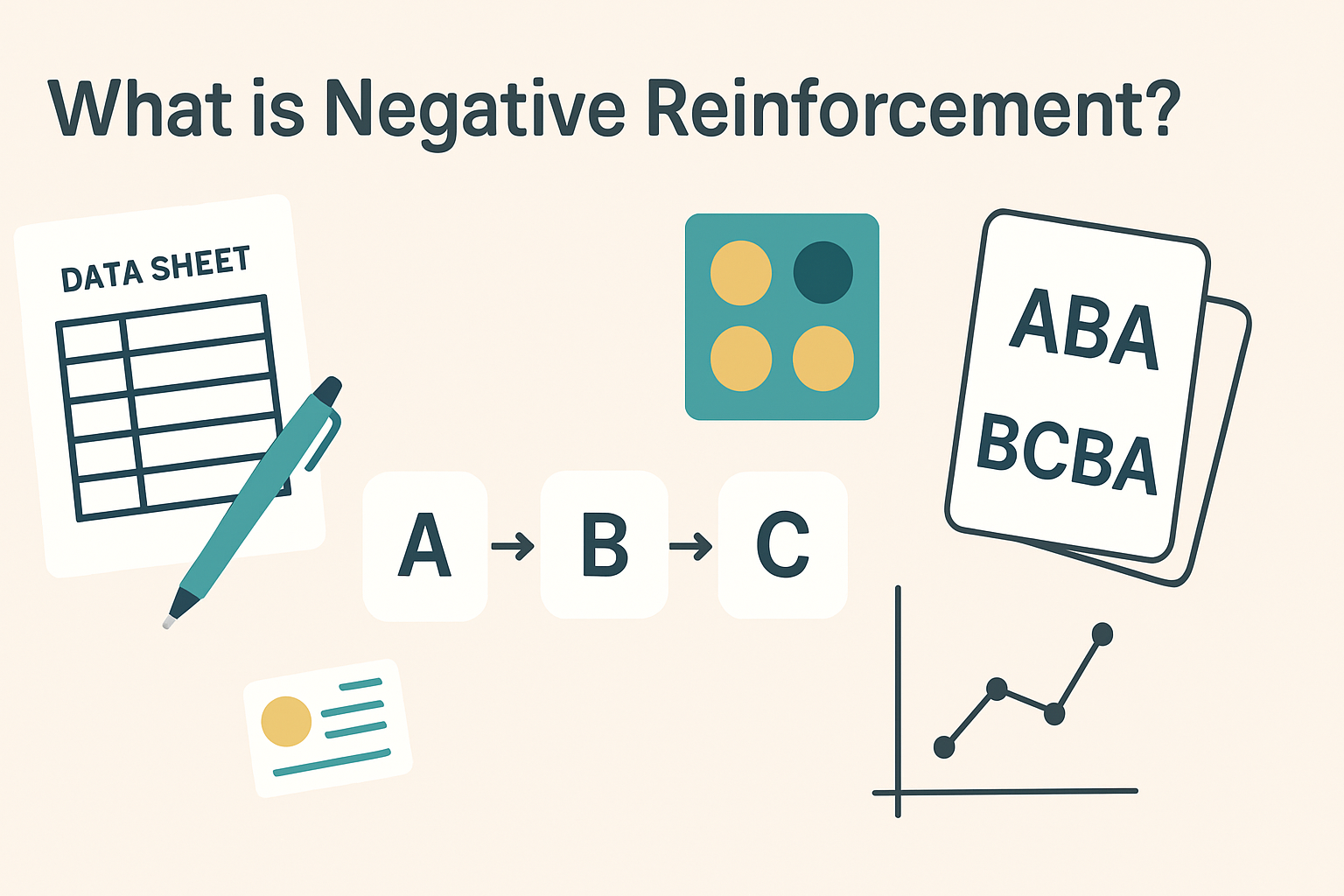
Antecedent: Car seatbelt buzzer sounds (aversive stimulus). Behavior: Driver buckles seatbelt. Consequence: Buzzer stops (removal of aversive). Future behavior: Buckling seatbelt increases to avoid the buzzer. The aversive stimulus is specifically the annoying sound, not the potential traffic ticket or safety concern.
Example 2: Task Demand and Elopement (Clinical Escape)
Antecedent: Therapist presents difficult math worksheet (aversive stimulus). Behavior: Student leaves the table (elopement). Consequence: Task demands are removed (escape). Future behavior: Elopement increases when difficult tasks are presented. This pattern represents a common behavioral function addressed in clinical practice and frequently appears on BCBA exam scenarios.
Example 3: Turning Down Volume (Automatic Negative Reinforcement)
Antecedent: Loud, uncomfortable music playing. Behavior: Person turns volume knob down. Consequence: Reduction of aversive noise level. Future behavior: Volume adjustment increases when noise becomes uncomfortable. This demonstrates automatic reinforcement, where the consequence directly alters the individual’s sensory experience without social mediation.
Why Negative Reinforcement Trips Up BCBA Candidates
Many BCBA candidates struggle with negative reinforcement concepts due to common misconceptions and tricky exam item constructions. Recognizing these common pitfalls can significantly improve exam performance.
Trap #1: Confusing It with Punishment
The most frequent error involves confusing negative reinforcement with punishment. Remember the cardinal rule: Reinforcement increases behavior, while punishment decreases behavior. The ‘negative’ or ‘positive’ label only describes whether something is removed or added. Both reinforcement types strengthen behavior, while both punishment types weaken behavior.
Trap #2: Misidentifying the Aversive Stimulus
Test-takers often incorrectly identify what’s being removed. The key is analyzing the complete ABC chain: Did the behavior make something go away? Did that consequence make the behavior more likely in the future? If both answers are yes, you’re dealing with negative reinforcement, regardless of what was removed.
Trap #3: Overlooking Avoidance Contingencies
In avoidance scenarios, the aversive stimulus never actually occurs if the behavior happens first. The behavior is maintained by preventing the aversive’s onset, which still qualifies as negative reinforcement. This subtle distinction often appears in advanced exam questions about behavioral maintenance.
Your Exam Readiness Checklist for Negative Reinforcement
Use this checklist to assess your understanding before taking the BCBA exam. Each item represents a critical concept you should master.
- Can you define negative reinforcement without using the word ‘bad’ or ‘negative’ in a value judgment sense?
- Do you understand the difference between escape and avoidance contingencies?
- Can you identify the aversive stimulus in a given scenario?
- Do you recognize that both reinforcement types increase behavior frequency?
- Can you distinguish negative reinforcement from positive punishment and negative punishment?
- Are you comfortable analyzing ABC data to determine if negative reinforcement is maintaining behavior?
- Do you understand how automatic negative reinforcement differs from socially-mediated reinforcement?
Key Takeaways and Next Steps for Mastery
Mastering negative reinforcement requires moving beyond memorization to conceptual understanding. Remember that negative reinforcement increases behavior through removal or avoidance of aversive stimuli. The ‘negative’ refers only to subtraction, not value judgment. Practice analyzing diverse scenarios to build fluency in application.
For further study, consider practicing with function-based scenarios that challenge your ability to identify behavioral functions. Review the BACB Task List sections related to fundamental principles and behavioral assessment. Additionally, explore our reinforcement vs punishment guide for comparative practice.
Research by Iwata and colleagues (1994) on functional analysis methodology provides excellent examples of negative reinforcement in clinical settings. Understanding these foundational studies will enhance your ability to apply these concepts in both exam and practice contexts.


