

What is Negative Punishment? A Core ABA Principle
In applied behavior analysis, negative punishment refers to a procedure where the removal of a stimulus following a behavior decreases the future frequency of that behavior. The term ‘negative’ indicates subtraction or removal, while ‘punishment’ denotes the effect on behavior frequency. This concept is fundamental to understanding behavior change procedures and is frequently tested on certification exams.
Table of Contents
- What is Negative Punishment? A Core ABA Principle
- Applied Negative Punishment Examples with ABC Analysis
- Exam Relevance and Common Traps for BCBA Candidates
- Quick Checklist for Identifying Negative Punishment
- Summary and Key Takeaways
The Defining Feature: Removal of a Stimulus
The critical element distinguishing negative punishment is that a valued stimulus is taken away contingent on behavior. The removed stimulus must function as a reinforcer for the individual, meaning it increases or maintains behavior when presented. The procedure is defined by its effect: a measurable decrease in the target behavior’s future occurrence.
Negative Punishment vs. Response Cost: A Critical Distinction
Response cost represents a specific type of negative punishment involving the removal of quantifiable reinforcers like tokens, points, or money. While all response cost procedures qualify as negative punishment, not all negative punishment involves response cost. For instance, time-out from positive reinforcement removes access to a reinforcing environment without quantifying specific items.

Applied Negative Punishment Examples with ABC Analysis
Understanding negative punishment requires examining real scenarios with complete ABC data. Each example below includes antecedent conditions, target behavior, and the consequence involving stimulus removal.
Example 1: Time-Out from Positive Reinforcement (Social)
This common procedure involves brief removal from a reinforcing environment contingent on inappropriate behavior.
- Antecedent: Child is playing with peers during free play time with preferred toys available
- Behavior: Child hits peer to gain access to a specific toy
- Consequence: Teacher implements 2-minute time-out in designated chair away from play area
- Hypothesized function: Tangible access to preferred item
Ethical implementation requires establishing clear parameters: time-out duration should be brief and age-appropriate, the environment must be safe and non-reinforcing, and the procedure should be consistently applied. This differs from extinction, which would involve withholding the toy without removing the child from the environment.
Example 2: Removal of a Specific Privilege
This example demonstrates negative punishment without a formal token system.
- Antecedent: Parent instructs teenager to complete homework before evening activities
- Behavior: Teen engages in verbal aggression toward parent
- Consequence: Parent removes access to video games for the remainder of the evening
- Hypothesized function: Escape from academic demands
This procedure qualifies as negative punishment because it removes a valued privilege contingent on inappropriate behavior. It’s not response cost because there’s no formal token system; rather, it involves direct removal of a reinforcing activity. Understanding the escape function is crucial for determining if this intervention is appropriate.
Example 3: Planned Ignoring as Negative Punishment
Planned ignoring can function as negative punishment when social attention serves as a reinforcer.
- Antecedent: Teacher provides individual attention to another student during small group work
- Behavior: Student makes loud, inappropriate comments
- Consequence: Teacher briefly turns away and does not acknowledge the comments
- Hypothesized function: Attention from teacher
This qualifies as negative punishment when the removal of attention decreases future inappropriate commenting. The distinction from extinction is subtle: extinction withholds the maintaining reinforcer (attention), while negative punishment actively removes an ongoing or expected stimulus. Both procedures require careful functional assessment to implement effectively.
Exam Relevance and Common Traps for BCBA Candidates
Negative punishment questions frequently appear on certification exams, often designed to test conceptual understanding rather than rote memorization. Candidates must navigate several common pitfalls.
Trap 1: Confusing Positive and Negative Punishment
The most frequent error involves misidentifying whether a stimulus is added or removed. Remember: positive punishment adds something aversive, while negative punishment removes something reinforcing. A quick mental check: ‘What happened immediately after the behavior? Was something taken away that the person values?’
Trap 2: Misidentifying the ‘Aversive’ Stimulus
Many candidates mistakenly believe negative punishment involves removing an aversive stimulus. In reality, the removed stimulus is appetitive or reinforcing. The ‘aversive’ aspect refers to the individual’s experience of loss, not the nature of the stimulus itself.
Trap 3: Overlooking the Function in Scenarios
Exam questions often require analyzing whether a punishment procedure is appropriate given the behavior’s maintaining function. Ethical application demands matching interventions to function. For example, time-out may be ineffective for escape-maintained behavior if the time-out environment is less demanding than the original setting.
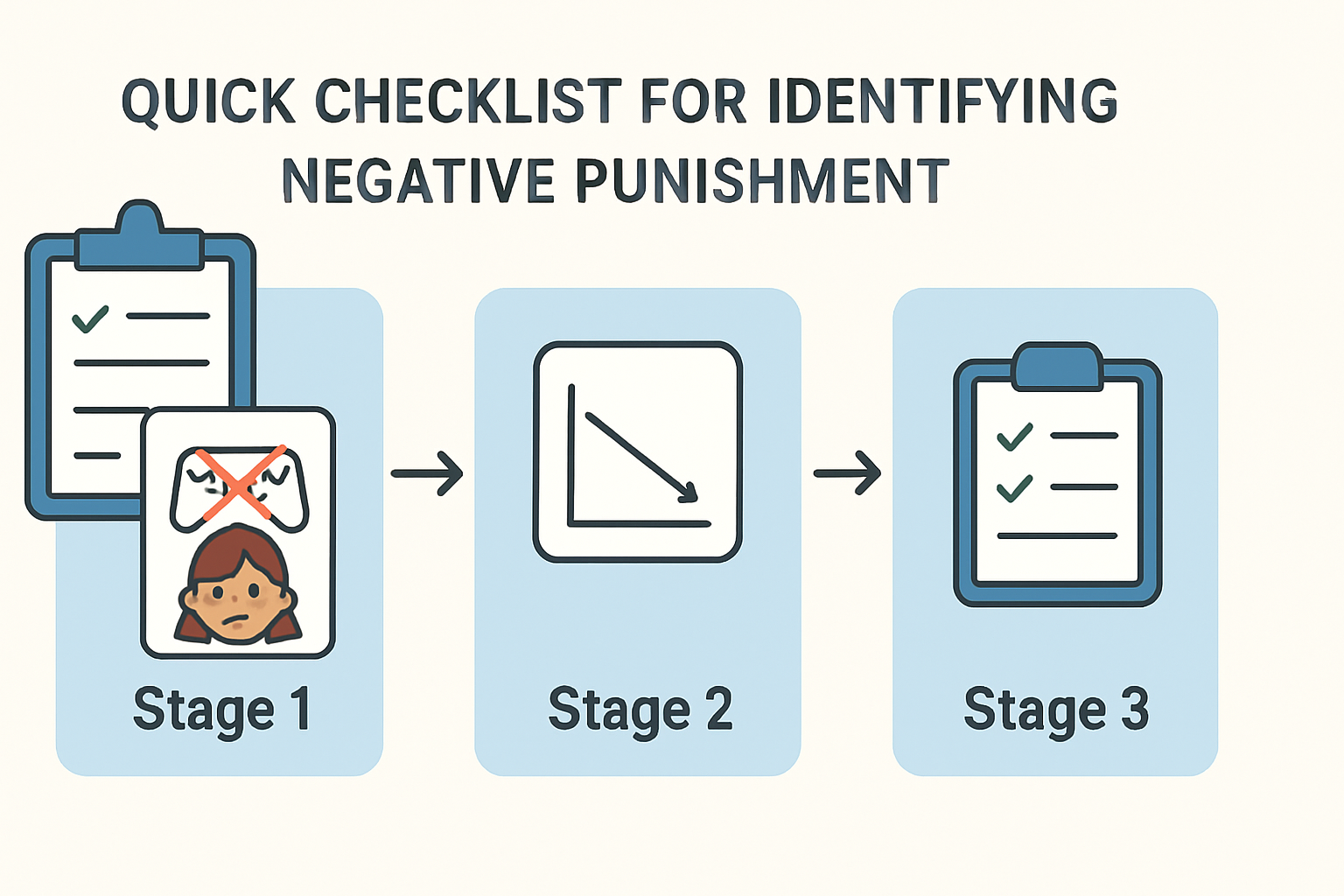
Quick Checklist for Identifying Negative Punishment
Use this practical guide when analyzing exam questions or clinical scenarios.
- Check for removal: Did a stimulus get taken away following the behavior?
- Verify reinforcement value: Was the removed item or privilege something the individual finds reinforcing?
- Assess behavioral effect: Did the behavior decrease in future occurrences?
- Distinguish from extinction: Is this removal of an ongoing stimulus rather than withholding reinforcement?
- Consider ethical guidelines: Does the procedure align with ethical standards and include reinforcement of alternative behaviors?
Summary and Key Takeaways
Negative punishment represents a behavior reduction procedure involving removal of reinforcing stimuli. Mastery requires understanding several core principles.
- Negative punishment is defined by stimulus removal leading to decreased behavior
- Effective implementation requires functional assessment to identify maintaining variables
- Response cost is a subset involving quantifiable reinforcers
- Ethical application includes reinforcement of alternative behaviors and consideration of side effects
- Exam success depends on distinguishing negative punishment from positive punishment and extinction
For comprehensive preparation, explore related concepts like positive versus negative punishment and behavioral functions. Always consult the BACB Ethics Code and current literature when implementing punishment procedures in practice. Additional resources on ethical considerations in punishment can further inform clinical decision-making.


