
What is Negative Punishment? An ABA Definition
In applied behavior analysis, negative punishment refers to a specific behavioral procedure where a stimulus is removed immediately following a behavior, resulting in a decreased future frequency of that behavior. The term ‘negative’ indicates removal, while ‘punishment’ specifically denotes the effect of decreasing behavior. This definition is crucial for BCBA exam success, as precise terminology separates effective practitioners from those who misunderstand fundamental principles.
The Operant Contingency: Removal to Decrease
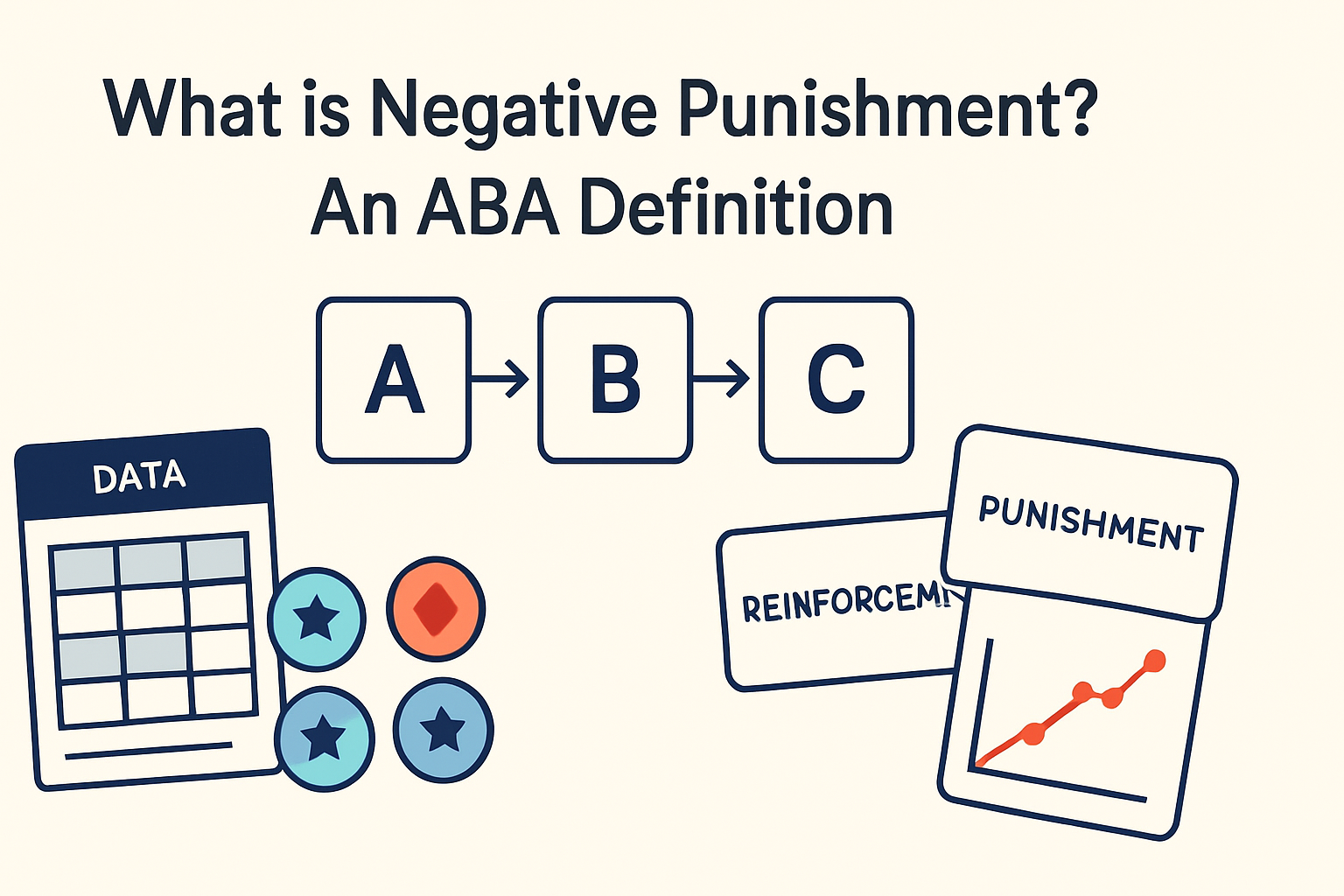
Negative punishment operates through a clear three-term contingency: antecedent, behavior, and consequence. The consequence involves removing a preferred stimulus contingent upon the target behavior. For punishment to be effective, this removal must occur immediately after the behavior and consistently across occurrences. The defining feature is the behavioral effect—if the behavior doesn’t decrease in future occurrences, the procedure isn’t technically punishment, regardless of what was removed.
Negative Punishment vs. Other Procedures
Understanding distinctions between procedures is essential for both clinical practice and exam success. Negative punishment differs from positive punishment, which involves adding an aversive stimulus rather than removing a preferred one. It also differs from extinction, where reinforcement is withheld rather than a stimulus being removed. For example, ignoring attention-seeking behavior is extinction (withholding attention reinforcement), while removing a preferred toy is negative punishment (removing access to the toy).
Key differences include: negative punishment removes something desirable, positive punishment adds something undesirable, and extinction withholds reinforcement that was previously maintaining the behavior. These distinctions become critical when analyzing behavioral interventions and selecting appropriate procedures based on functional assessment data.
Negative Punishment in Practice: ABA Examples and Analysis
Moving from theory to application requires examining realistic scenarios that behavior analysts encounter. Each example demonstrates how negative punishment procedures are implemented with consideration of function, ethics, and practical constraints. These scenarios mirror the types of case studies you’ll encounter on the BCBA exam and in clinical practice.
Example 1: Response Cost for Disruption
Consider a classroom scenario where a student frequently calls out during instruction. The teacher implements a response cost procedure: for each instance of calling out, the student loses five minutes of preferred computer time. The ABC data would show: Antecedent – teacher giving instruction, Behavior – student calls out, Consequence – removal of five minutes computer time.
The hypothesized function is likely access to attention, though a functional assessment should confirm this. The removed stimulus (computer time) must be sufficiently preferred to function as an effective punisher. This example demonstrates how response cost, a common form of negative punishment, can be implemented in educational settings while maintaining ethical standards and considering individual preferences.
Example 2: Time-Out from Positive Reinforcement
In a home setting, a child engages in aggression when a sibling is playing with a preferred toy. The parent implements time-out from positive reinforcement: contingent on aggression, the child must sit in a designated chair away from the play area for three minutes. This procedure removes access to the reinforcing environment (play with sibling and toys).
Critical implementation details include: ensuring the time-out area is safe and non-reinforcing, using brief durations, and immediately returning to the environment when time-out ends. This differs from seclusion or isolation, which are not recommended practices. The effectiveness depends on the play environment being sufficiently reinforcing that its removal decreases future aggression.
Ethical Implementation and Considerations
Implementing negative punishment requires careful ethical consideration aligned with the BACB Ethics Code. Key factors include conducting a functional behavior assessment before intervention, ensuring client safety, providing alternative reinforcement for appropriate behaviors, and maintaining consistency. Practitioners must also consider potential side effects like emotional responding or avoidance behaviors.
Ethical guidelines emphasize using the least restrictive alternative, monitoring effectiveness through data collection, and ensuring procedures are part of a comprehensive behavior support plan. These considerations are not just clinical best practices—they’re essential knowledge for the BCBA exam and real-world application.
Negative Punishment on the BCBA® Exam: What to Know
The BCBA exam tests both conceptual understanding and practical application of behavioral principles. Negative punishment appears in multiple content areas, particularly those addressing behavior change procedures and ethical implementation. Understanding common exam traps and key terminology will significantly improve your performance on test day.
Common Exam Traps and Misconceptions
Several recurring mistakes trip up exam candidates. First, confusing negative punishment with extinction—remember that extinction withholds reinforcement, while negative punishment removes a stimulus. Second, misidentifying the removed stimulus in scenario questions. Third, forgetting that punishment is defined by its behavioral effect (decreased future frequency), not just the procedure implemented.
Other common errors include: assuming all stimulus removal constitutes negative punishment (it must decrease behavior), overlooking the importance of immediacy and consistency, and failing to consider function before selecting interventions. Exam questions often present scenarios where multiple procedures could be described, requiring precise discrimination based on the consequences described.
Key Terminology and Task List Alignment
Several related terms frequently appear alongside negative punishment questions. Conditioned motivating operations (CMOs) can affect the value of removed stimuli. Abolishing operations (AOs) temporarily decrease the effectiveness of reinforcement, which interacts with punishment procedures. Discriminative stimuli (Sd) signal when punishment contingencies are in effect.
These concepts align with Task List sections B-6 (measurement) and B-7 (behavior change procedures). Understanding how negative punishment fits within broader behavioral frameworks, including operant conditioning principles and ethical implementation guidelines, is essential for comprehensive exam preparation.
Study Checklist and Summary
This final section provides actionable tools for consolidating your understanding and preparing effectively for exam questions on negative punishment. Use this checklist to self-assess your readiness and identify areas needing further review.
Quick-Reference Checklist
- Can you define negative punishment using the three-term contingency?
- Can you identify the removed stimulus in any given scenario?
- Can you distinguish negative punishment from positive punishment and extinction?
- Can you predict at least two potential side effects of punishment procedures?
- Can you name and describe two common types: response cost and time-out from positive reinforcement?
- Do you understand the ethical considerations and when to conduct a functional assessment first?
Core Takeaways for Your Exam
First, remember that negative punishment always involves removing a stimulus to decrease behavior—if behavior doesn’t decrease, it’s not punishment. Second, the removed stimulus must be preferred or reinforcing to the individual for the procedure to be effective. Third, always consider function and ethics before implementation, as emphasized in the BACB Ethics Code.
For comprehensive preparation, integrate your understanding of negative punishment with other behavioral principles through practice questions and mock exams. This interconnected knowledge will serve you well both on the BCBA exam and in your future practice as a behavior analyst.


