
What is Natural Environment Training (NET)? Core Principles for the Exam
Natural Environment Training is a learner-centered approach that embeds teaching opportunities within everyday activities and natural contexts. This method aligns with Section G-9 of the BACB Task List, which addresses the use of naturalistic teaching procedures. The core philosophy emphasizes using natural reinforcers that are directly related to the target behavior and context.
NET operates on several fundamental principles that distinguish it from more structured teaching methods. First, instruction is motivation-based, meaning teaching occurs when the learner shows interest in an item or activity. Second, skills are taught in natural settings where they would typically be used, promoting immediate generalization. Third, consequences are functionally related to the behavior, creating meaningful learning experiences.
Unlike traditional approaches, NET doesn’t rely on artificial reinforcers or contrived settings. Instead, it capitalizes on existing motivation and environmental cues to teach functional skills. This approach is particularly effective for teaching communication, social skills, and daily living activities that need to transfer across multiple environments.
NET vs. DTT: Knowing the Difference on Test Day
Understanding the distinction between Natural Environment Training and Discrete Trial Training is crucial for BCBA exam success. While both are evidence-based interventions, they differ significantly in structure, implementation, and purpose. DTT uses highly structured teaching trials with clear beginnings and endings, typically conducted in controlled settings.
NET, in contrast, employs loose structure that follows the learner’s interests and natural routines. The location for NET is typically everyday environments like homes, playgrounds, or community settings, while DTT often occurs in clinical settings with minimal distractions. Reinforcement in NET comes from natural consequences related to the activity, whereas DTT may use arbitrary reinforcers like tokens or edibles.
The target skills also differ significantly. NET focuses on functional skills that have immediate utility in natural contexts, while DTT often targets discrete skills that build toward more complex behaviors. Both approaches have their place in comprehensive ABA programming, and many effective interventions combine elements of both methodologies.
NET in Practice: Worked Examples with ABC Contingencies
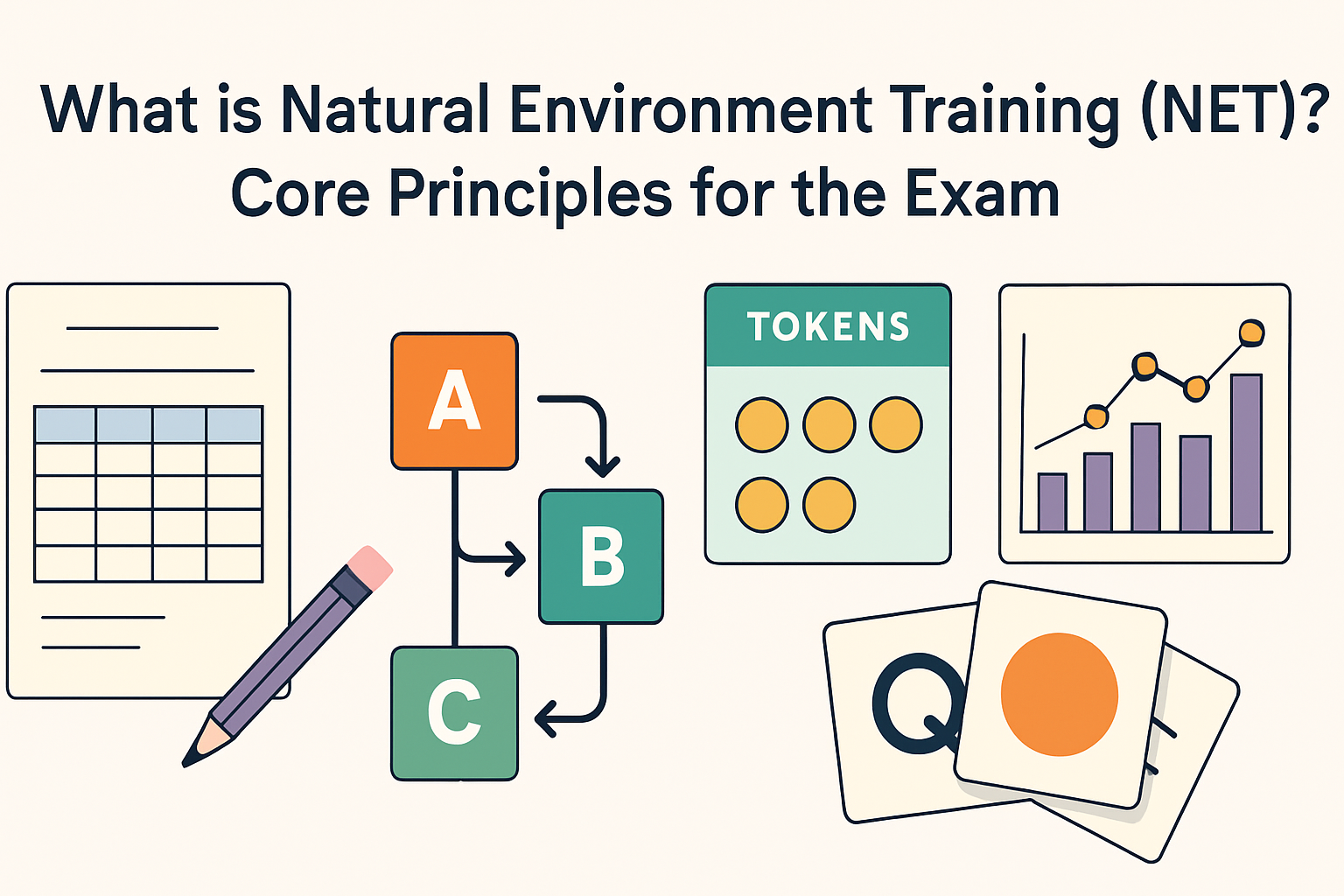
Effective implementation of Natural Environment Training requires careful analysis of environmental contingencies. BCBA candidates must be able to identify teaching opportunities and analyze them using ABC frameworks. This section provides detailed examples that model the analytical thinking required for exam vignettes and clinical practice.
Each example demonstrates how to contrive opportunities for learning while maintaining the natural flow of activities. The key is to identify motivating operations and arrange the environment to create teaching moments. Successful NET implementation requires careful observation of the learner’s interests and subtle manipulation of the environment to prompt target behaviors.
Example 1: Teaching Manding During Snack Time
Consider a scenario where a child wants crackers from a closed jar during snack time. The therapist observes the child’s reaching behavior toward the jar and recognizes this as a teaching opportunity. The antecedent is the closed container with desired items inside, creating an establishing operation for manding.
The target behavior is a verbal mand for “open” or “crackers.” The therapist might use a time-delay prompt, waiting briefly to see if the child initiates communication spontaneously. If needed, the therapist provides a partial verbal prompt (“Say ‘open'”) or models the target response.
The consequence is the natural reinforcer of opening the jar and providing access to crackers. This maintains the functional relationship between the mand and the desired outcome. The hypothesized function is access to tangibles, and the ABC data would show: Antecedent (closed jar with crackers), Behavior (verbal mand “open”), Consequence (jar opened, access to crackers).
Example 2: Promoting Social Interaction on the Playground
During playground time, a child enjoys swinging but needs assistance to maintain momentum. The therapist notices a peer nearby and creates an opportunity for social interaction. The antecedent arrangement includes positioning the peer within proximity and making a commentary statement (“The swing is slowing down”).
The target behavior is a social initiation such as “Can you push me?” or tapping the peer’s shoulder while making eye contact. The therapist might use a gestural prompt toward the peer or a verbal cue (“Ask your friend for help”) to facilitate the interaction.
The consequence is the peer’s response of pushing the swing, followed by continued swinging and social engagement. This creates a naturally reinforcing chain where the social initiation leads directly to the desired outcome. The function is access to attention and continued activity, with ABC data showing: Antecedent (slowing swing, peer nearby), Behavior (social initiation), Consequence (peer pushes, continued swinging).

NET on the BCBA® Exam: Key Terms and Common Traps
BCBA exam questions about Natural Environment Training often test your understanding of related concepts and common implementation errors. You’ll need to recognize terms like incidental teaching, which is a specific NET strategy that capitalizes on naturally occurring teaching opportunities. Another important concept is activity-based intervention, which embeds learning objectives within meaningful activities.
Generalization is a critical outcome of effective NET implementation, and exam questions may ask about strategies to promote skill transfer across settings and people. Be prepared to identify mand training opportunities and understand how NET supports the development of functional communication skills. The concept of motivating operations is central to NET, as teaching occurs when these operations are in effect.
A common exam trap involves confusing NET with non-contingent reinforcement or other antecedent interventions. Remember that NET always includes contingent teaching of specific skills. Another frequent mistake is overlooking the requirement for natural reinforcers that are functionally related to the behavior. Exam questions may present scenarios that seem like NET but use arbitrary reinforcers instead.
Be cautious of questions that describe highly structured teaching in natural settings – this isn’t true NET. The BCBA exam may also test your ability to distinguish NET from pivotal response training and other naturalistic approaches. Understanding these subtle differences is essential for selecting the correct answer on exam day.
Quick Checklist: Is NET the Right Answer?
Use this heuristic when analyzing exam questions about teaching procedures:
- Is instruction based on current motivation and learner interests?
- Are skills taught in everyday settings where they would naturally occur?
- Is the reinforcer directly related to the behavior and context?
- Does the teaching follow a loose structure rather than rigid trials?
- Are prompts naturalistic and faded as quickly as possible?
- Does the scenario emphasize functional skills with immediate utility?
- Is there evidence of generalization planning or outcomes?
If most answers are yes, NET is likely the correct choice. For more on distinguishing teaching procedures, see our guide on comparing ABA teaching methods.
Summary and Next Steps for Your Study
Natural Environment Training represents a powerful approach for teaching functional skills in meaningful contexts. Its emphasis on natural reinforcers and learner motivation makes it particularly effective for promoting generalization and maintenance of skills. For BCBA exam preparation, focus on understanding the core principles and being able to identify appropriate applications.
To strengthen your NET knowledge, practice analyzing scenarios using ABC contingencies and identifying potential teaching opportunities. Review the differences between NET and other naturalistic approaches like incidental teaching and pivotal response training. Remember that effective NET implementation requires careful observation of the learner’s interests and subtle environmental arrangements.
For further study, explore the BACB resources on naturalistic teaching procedures and review research on generalization strategies. Consider how NET integrates with other components of comprehensive ABA programming, including verbal behavior training and social skills development. The key to exam success is understanding both the theoretical foundations and practical applications of this important teaching approach.
As you continue your BCBA exam preparation, remember that NET questions often test your ability to apply principles in realistic scenarios. Practice identifying motivating operations, analyzing environmental arrangements, and selecting appropriate teaching strategies based on contextual factors. With thorough understanding and practical application, you’ll be well-prepared for NET-related questions on the BCBA exam.


